Index Entries
The Climate Web's more than 4,000 Index Entries, all linked together into their own “knowledge web,” serve as “front doors” to climate-related topics and sub-topics. Many individual Index Entries are subsidiary to “Deep Dive” Index Entries (as shown below). You can identify Index Entries by their color, the fact that they are preceded by an “I -”, and contain no spaces (this makes them a lot easier to search for).
Index Basics
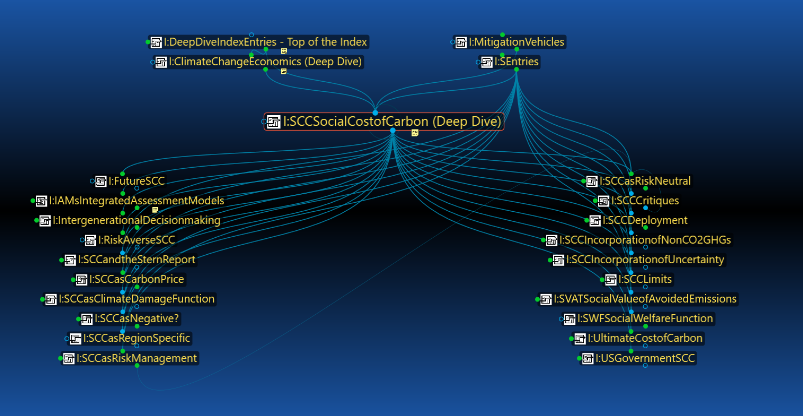
Index Entries are organized vertically, and almost any Parent or Child thought to an Index Entry will be an Index Entry in its own right. This means that you can click your way through the Index, and through the entire topic of climate change, accessing higher-level topics as Parent thoughts and more granular sub-topics as Child thoughts. You can get the idea via the screenshot below.
Index Entries link you to associated topical materials through Jump thoughts to the left of an Index Entry. These might be topical headings for broader topical Index Entries, or they might be individual sources and other materials for much more granular Index Entries. You can see a variety of materials and topical headings to the left of the central Index Entry thought in the screenshot below.
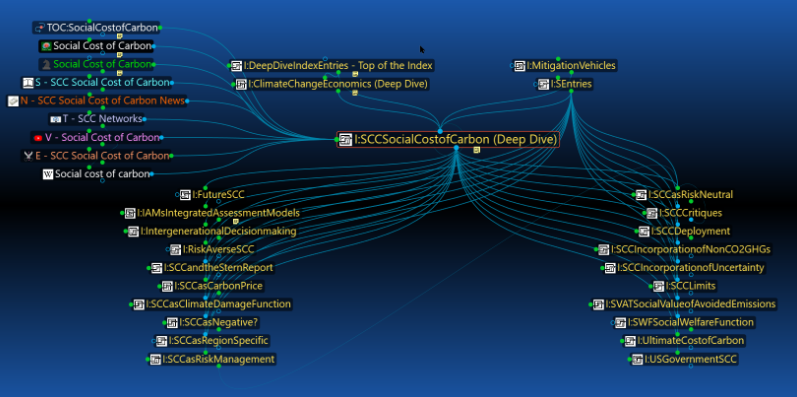
Index Entries serve as topical front doors to topic, allowing you to dig into the topic in multiple ways. The first is through other Index Entries (Parents and Children) that may help you zero in on what you’re looking for. The second is through the Jump thoughts to the left of an Index Entry, which organize all kinds of topical content.
A Great Way to Navigate the Climate Web
All Index Entries are preceded by an "I -" and lack spaces in the body of the Index Entry (Note that we had to change to “I -” from the “I:” shown in the screenshots for technical reasons). This doesn’t impede your ability to understand its meaning, but makes it a lot easier to Search specifically for Index Entries which are the easiest way to rapidly navigate. The topic of carbon pricing, for example, has an Index Entry I - CarbonPricing. Searching for that will get you to the Carbon Pricing Deep Dive Index Entry pretty easily, whereas searching for "carbon pricing” generates thousands of results to sort through.
Two important naming conventions for Index Entries, supporting our goal of making Index Entries as easy to find as possible.
- Instead of having a ton of Index Entries that start with l - Climate, we’ve flipped the term. Instead of I - ClimateScience it’s “I - ScienceofClimateChange. Instead of I - ClimateEconomics, it’s I - Economics of Climate Change.
- Because we know it can be a big confusing, we’ve created extra Index Entries to help you find the right Index Entry, even if you’ve tried a different search term. So if you search for I - ClimateEconomics you’ll find I - Climate Economics - Synonym. No content is linked to that “synonymous” Index Entry, but you will see I - EconomicsofClimateChange as its Parent thought.
Note that if we tried to link every Index Entry to every other potentially relevant Index Entry, most would have dozens of Parent and Child thoughts, making the Index confusing to navigate. Instead, try clicking on Parent or Child Index Entries that seem relevant, and see what else shows up. In many cases you'll find specifically what you are looking for within a click or two of where you started.