A Quick Introduction
This page provides you with a quick understanding of how the Climatographers have built the Climate Web. Through the Child Thought you can see in the Plex at left, you can also access a slide-deck based introduction to the Climate Web, and an introduction to TheBrain software we’ve used to build the Climate Web.
Here’s the process we’ve gone through in building the Climate Web.
Step 1: Finding the Information
We’re always asked how we find the information organized in the Climate Web, and whether we use bots or spiders to scour the internet for materials to add to the Climate Web. The answer is no; that would simply replicate the chaotic information deluge you get searching for a climate topic on Google.
In fact, everything in the Climate Web, including 25,000+ books, reports and published papers, 35,000+ news and opinion pieces, 5,000+ websites, 4,000+ videos and podcasts, and much more, has been individually selected and added to the Climate Web by the Climatographers.
So how do we source those materials? Often through our social media feeds. We also do a lot of internet digging into specific topics, going much deeper than the first page of search results.
Step 2: Getting It Ready
Before materials are integrated into the Climate Web, we use naming and color conventions to make it easy to know what you’re looking at, and to make it easy to Search for specific things in the Climate Web.
- For books, reports, PPTs, and articles, the naming convention is: Year Author_Title
- For News and Opinion, the convention is: Year/Month Title
- For Videos, the convention is: Year Title
Step 3: Integrating It Into the Climate Web
First, all new additions to the Climate Web are “typed” by kind of content, e.g. sources, news, videos, websites, etc.. Each type has its own identifiable thought icon and font color for easy recognition. Learn more about the key Types here:
- Sources
- News and Opinion
- Networking
- Multimedia
- Extracted Materials
All new additions are then allocated to Topical Headings specific to their content type. In all, more than 5,000 Topical Headings, color coded for easy recognition, organize materials topically in the Climate Web.
Topical Headings are then linked to Index Entries that form the backbone of the Climate Web, and which are the easiest way to navigate the entire Climate Web. There are more than 3,500 Index Entries in the Climate Web.
Step 4: Advanced Knowledge Curation
In addition to organizing climate materials as described in Steps 1-3, generating what is in effect a massive climate change knowledge filing cabinet, the Climatographers take several more steps to curate information in ways intended to help generate Actionable Knowledge.
- We go through many books, reports, papers, and news stories to extract key graphics and ideas - more than 20,000 and counting. These Extracted Materials are then organized under Topical Headings of their own, allowing you to scan topical materials from MANY different sources in one place.
- We pull together content from all over the Climate Web to populate 500+ Topical Dashboards that help you quickly come up to speed on specific topics and questions.
- We author Insights Pages to distill topical information, helping you rapidly come up to speed on more than 500 topics.
- We use Index Entries to provide “topical roadmaps” to topics in the Climate Web.
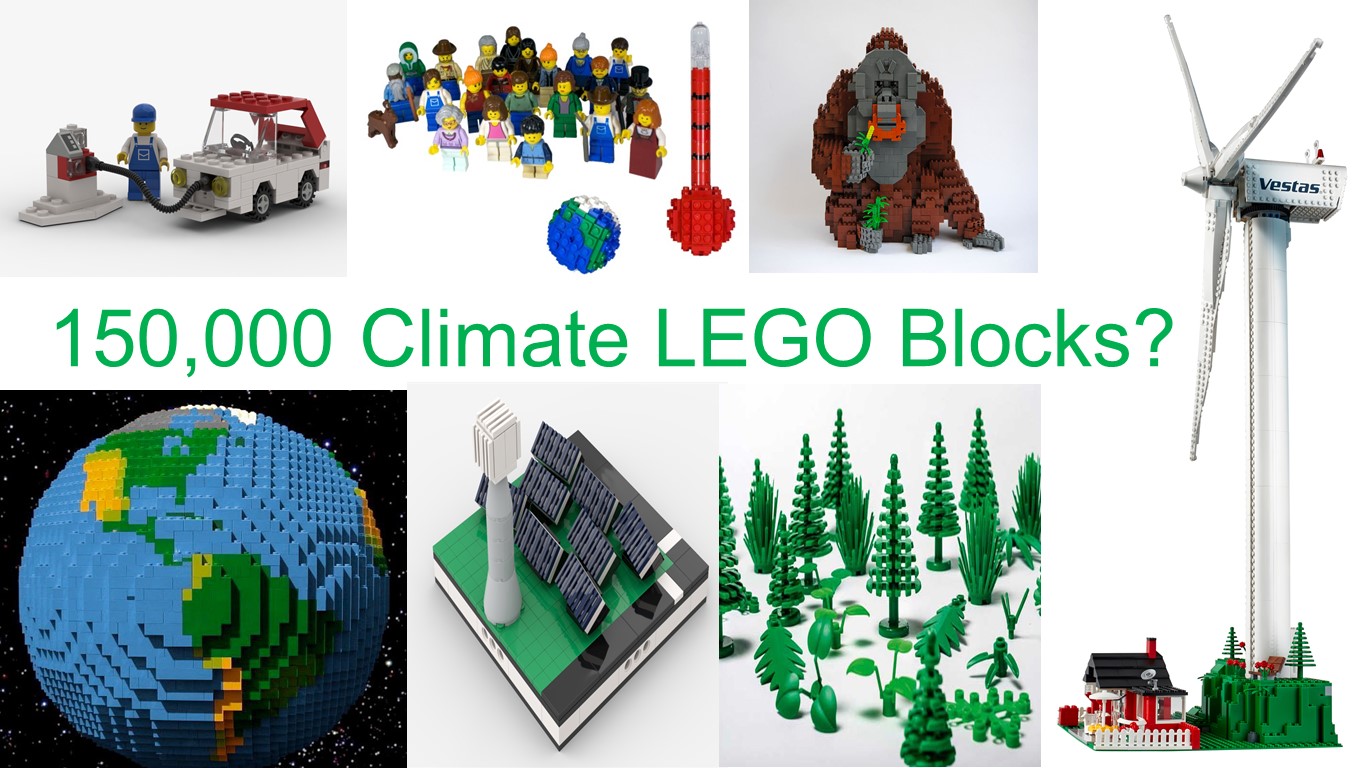
200,000 Climate LEGOs!
LEGO® is a trademark of the LEGO Group of companies which does not sponsor, authorize, or endorse the Climate Web. We use the word LEGO to help visualize information building blocks fitting together to deliver actionable climate knowledge.
One way to think about the Climate Web is as a collection of 200,000 LEGO bricks (or thoughts), each representing a piece of climate knowledge. It might be a report, or a news story, or a specific graphic or idea, or a website, or a video, or an Insight page. The Climate Web represents hundreds of thousands of such climate LEGO bricks. We’ve organized these LEGO bricks into hundreds of Topical Dashboards to help you come rapidly up to speed on all kinds of climate topics, but we’ve only scratched the surface of what’s possible with the Climate Web.
What kinds of new “actionable climate knowledge kits” would you like to see us build with the 200,000 climate LEGOs in the Climate Web today, and the thousands being added every month?
Facilitating Your Knowledge Journey
One way to think about leveraging the Climate Web is as the means to exploit thousands of climate knowledge “shortcuts” as described by mathematician Marcus du Sautory just below. Not with the goal of facilitating a journey “into the darkness,” but “towards actionable climate knowledge.”