Aceh War
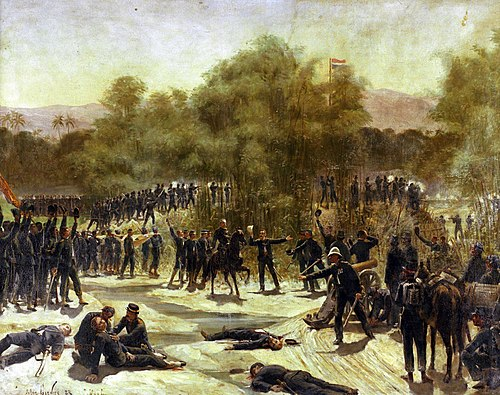
The Aceh War (Indonesian: Perang Aceh; Acehnese: Prang Acèh; 1873–1904), was an armed military conflict between the Sultanate of Aceh and the Kingdom of the Netherlands which was triggered by discussions between representatives of Aceh and the United States in Singapore during early 1873.[8] The war was part of a series of conflicts in the late 19th century that consolidated Dutch rule over modern-day Indonesia.
The campaign drew controversy in the Netherlands and Aceh as photographs and accounts of the death toll were reported. After early 20th century (1904), Aceh surrendered.
Quotes from article:
- By this stage, the Aceh War was being used as a symbol of Muslim resistance to Western imperialism.[2]
- One intellectual Sayyid Ahmad Khan advocated discontinuing the "jihad" against the Dutch.[1]
- Perang sabil was the Malay equivalent to other terms like Jihad, Ghazawat for "Holy war".[39]
- Throughout the early 20th century, Dutch citizens and personnel were targeted by sporadic suicide attacks by the Acehnese who were influenced by the Hikayat Perang Sabil and other proscribed texts.[61]
- During the early 20th century, Standard Oil and Royal Dutch Shell developed oil refineries to profit from the province's substantial oil reserves.[62]
- In 1953, Sukarno stated that he opposed Aceh's plan to enact sharia law, stating that "Indonesia is a nation state with the ideology of Pancasila, not a theocratic country with a certain religious orientation."
See PDF for complete article.
Tuesday, February 17, 2026 07:28PM