Indonesia
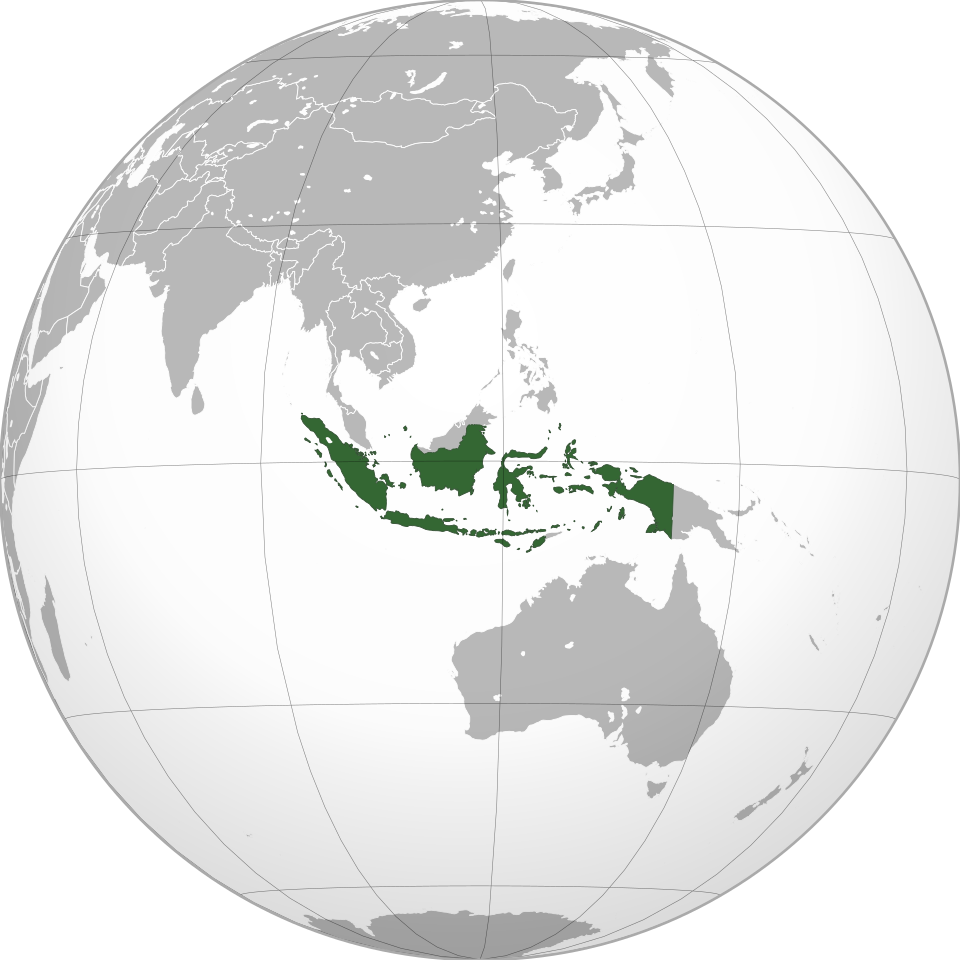
Indonesia,[b] officially the Republic of Indonesia,[c] is a country in Southeast Asia and Oceania, between the Indian and Pacific oceans. Comprising over 17,000 islands, including Sumatra, Java, Sulawesi, and parts of Borneo and New Guinea, Indonesia is the world's largest archipelagic state and the 14th-largest country by area, at 1,904,569 square kilometres (735,358 square miles). Indonesia has significant areas of wilderness that support one of the world's highest levels of biodiversity. It shares land borders with Papua New Guinea, Timor-Leste, and Malaysia, as well as maritime borders with seven other countries, including Australia, Singapore, and the Philippines.
The Indonesian archipelago has been inhabited since prehistoric times, with early human presence evidenced by fossils of Homo erectus and Homo sapiens, and megalithic sites. By the early second millennium, it had become a crossroads for international trade linking East and South Asia. Over the centuries, external influences—including Hinduism, Buddhism and later Islam—were absorbed into local societies, which introduced lasting cultural and religious influences. European powers later competed to monopolise trade in the Spice Islands of Maluku during the Age of Discovery, followed by three and a half centuries of Dutch colonial rule, before Indonesia proclaimed its independence after World War II.
Since independence, Indonesia has grappled with numerous challenges including separatism, corruption, political upheaval and natural disasters, alongside democratisation and rapid economic growth. The country today is a presidential republic with an elected legislature and consists of 38 provinces, some of which enjoy greater autonomy than others. Home to over 280 million people, Indonesia ranks fourth in the world by population and has the largest Muslim population of any country. More than half of Indonesians live on Java, the most heavily populated island in the world, while the capital Jakarta is the world's largest urban agglomeration.
Indonesian society comprises hundreds of ethnic and linguistic groups, with Javanese forming the largest. National identity is unified under the motto Bhinneka Tunggal Ika, reflected by a national language alongside cultural and religious pluralism. A newly industrialised country, Indonesia has the largest national economy in Southeast Asia by GDP. The country plays an active role in regional and global affairs as a middle power and is a member of major multilateral organisations, including the United Nations, G20, the Non-Aligned Movement, ASEAN, and the Organisation of Islamic Cooperation.
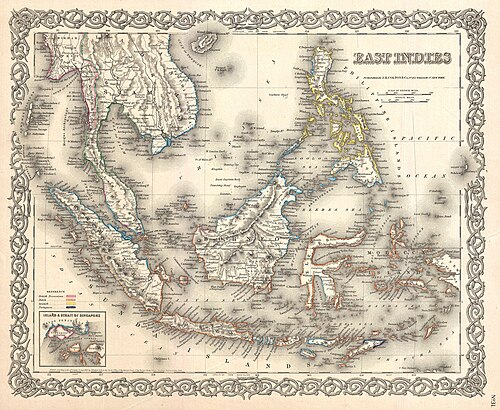
The Indonesian archipelago has carried different names in the past, such as "East Indies" in this 1855 map.
The name Indonesia derives from the Greek words Indos (Ἰνδός) and nesos (νῆσος), meaning 'Indian islands'.[12] The name dates back to the 19th century, far predating the formation of independent Indonesia. In 1850, George Windsor Earl, an English ethnologist, proposed the terms Indunesians—and, his preference, Malayunesians—for the inhabitants of the "Indian Archipelago or Malay Archipelago".[13][14] In the same publication, one of his students, James Richardson Logan, used Indonesia as a synonym for Indian Archipelago.[15][16] Dutch academics writing in East Indies publications were reluctant to use Indonesia. They preferred Malay Archipelago (Dutch: Maleische Archipel); the Netherlands East Indies (Nederlandsch Oost Indië), popularly Indië; the East (de Oost); and Insulinde.[17]
After 1900, Indonesia became more common in academic circles outside the Netherlands, and native nationalist groups adopted it for political expression.[17] Adolf Bastian of the University of Berlin popularised the name through his book Indonesien oder die Inseln des Malayischen Archipels, 1884–1894. The first native scholar to use the name was Ki Hajar Dewantara, who established a press bureau in the Netherlands, Indonesisch Pers-bureau, in 1918.[14]
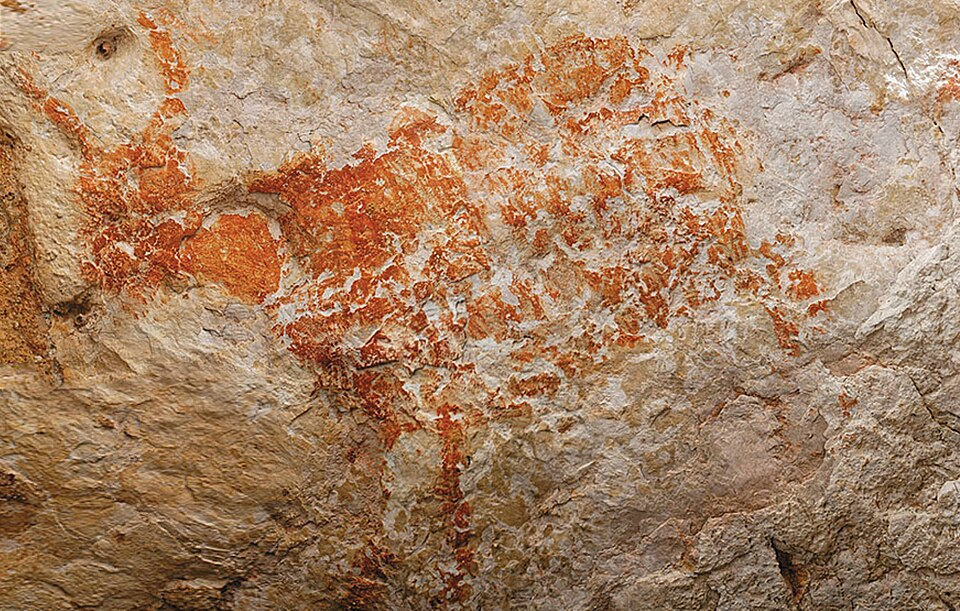
One of the oldest known figurative paintings, a depiction of a bull, was discovered in the Lubang Jeriji Saléh cave dated as 40,000 to 44,000 years old.
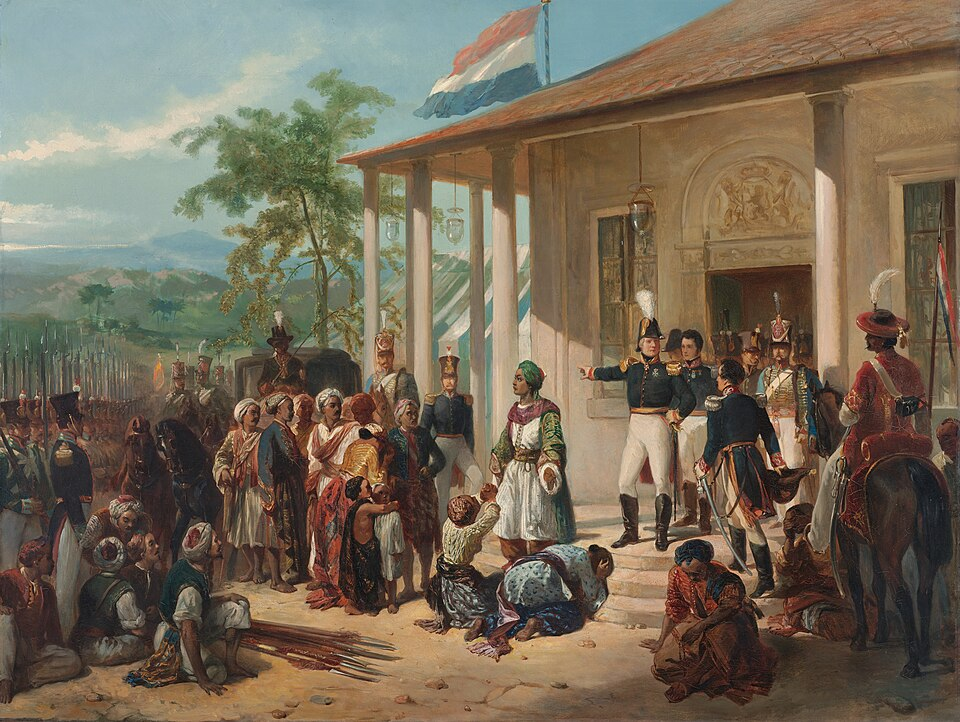
An 1835 painting illustrating the submission of Prince Diponegoro to General De Kock at the end of the Java War in 1830
Quotes from article:
- Indonesia has significant areas of wilderness that support one of the world's highest levels of biodiversity.
- Indonesia proclaimed its independence after World War II.
- Home to over 280 million people, Indonesia ranks fourth in the world by population and has the largest Muslim population of any country.
- A newly industrialised country, Indonesia has the largest national economy in Southeast Asia by GDP. The country plays an active role in regional and global affairs as a middle power and is a member of major multilateral organisations, including the United Nations, G20, the Non-Aligned Movement, ASEAN, and the Organisation of Islamic Cooperation.
- In 1850, George Windsor Earl, an English ethnologist, proposed the terms Indunesians—and, his preference, Malayunesians—for the inhabitants of the "Indian Archipelago or Malay Archipelago".
- The Indonesian archipelago has been inhabited since prehistoric times. Fossils of Homo erectus ("Java Man") date back between 2 million and 500,000 BCE,
- The archipelago's strategic location facilitated sustained contact with civilisations from the Indian subcontinent and mainland China, profoundly influencing Indonesian history and culture through trade.
- Islam began to take root around the same time in northern Sumatra,[38] and gradually became the dominant religion in Java and Sumatra by the 16th century. It blended with existing local traditions, producing a distinct Islamic culture, particularly in Java.[39]
- Instability and terrorism were persistent in the 2000s[80][81] but the economy has performed strongly since 2004 despite pervasive corruption.
- Its conservation framework includes 54 national parks, several of which are recognised as World Heritage Sites, World Network of Biosphere Reserves, and wetlands of international importance under the 1971 Ramsar Convention.[
- Since the start of the 21st century, Indonesia has developed close relations with China, primarily relating to trade and investments in infrastructure,[173] while at the same time maintaining a strategic partnership with the United States, focusing on economic cooperation, security, and counterterrorism efforts.[174]
- Indonesia has been a member of the United Nations since 1950, with a brief interruption in 1965,[h] and is a founding member of the Non-Aligned Movement (NAM), the Organisation of Islamic Cooperation (OIC) and the East Asia Summit.[176] Indonesia also participates in multilateral economic institutions, including APEC and the World Trade Organization (WTO). Indonesia has been a humanitarian and development aid recipient since the late 1960s,
- During the New Order, the military exercised a direct political role under a doctrine known as "dual function" (dwifungsi).
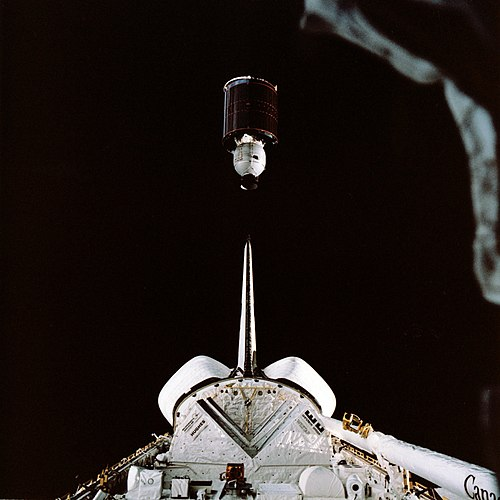
- Palapa satellite launch in 1984
It would be best to read the PDF to get proper context.
Tuesday, February 17, 2026 07:08PM