Greco-Roman Stoicism, Transcript
Introduction to Stoicism

(00:04) Counterpart Dr. McCoy, who's this passionate guy who's always really emotional about everything that happens. Mr. Spock is always very reserved, and he's always logical, and he tries not to let his emotions govern him, right?
 And so, he has them, but he, as opposed to Dr. McCoy, always says to McCoy, "Don't let your emotions govern your passions; they'll be your undoing," this kind of thing. And we also know from just watching him, he, for example, pursues mental clarity by using the discipline of meditation.
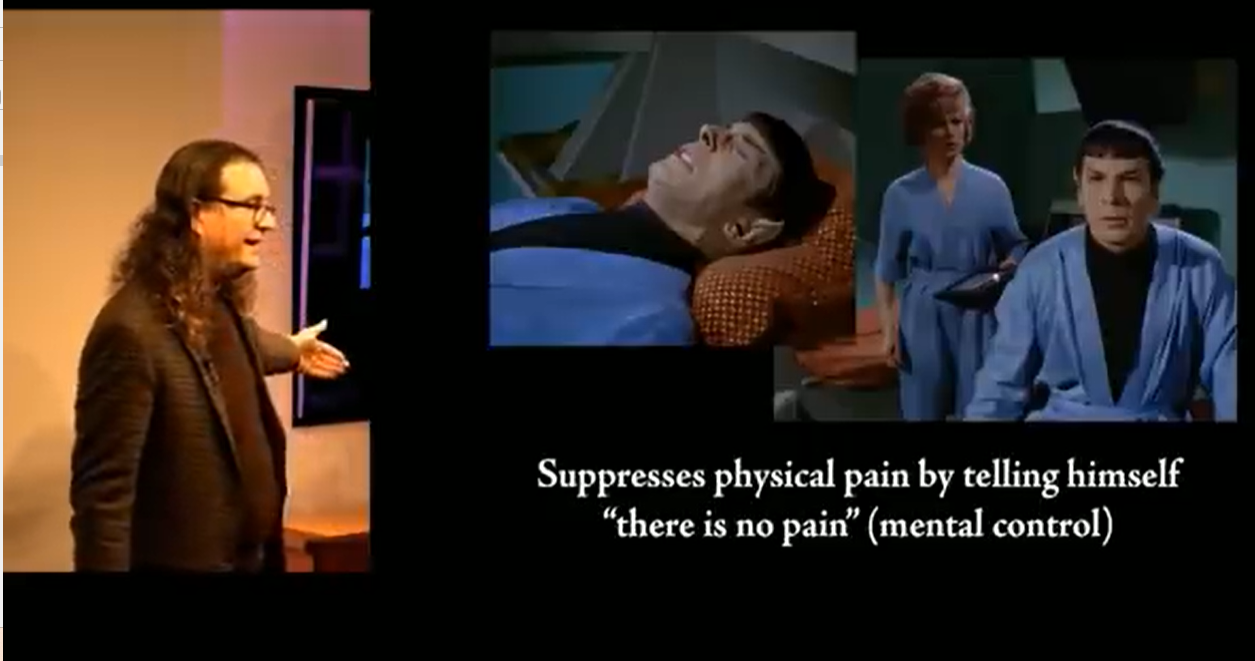 (00:42) And he specifically is able to suppress physical pain by telling himself things like, "There is no pain," right? So he exercises mental control over his mind-over-matter kind of thing over his physical body. So all of those things in the thumbnail and a pop thumbnail, you know, are best to his counterpart Dr. McCoy, who's this passionate guy who's always really emotional about everything that happens. Mr. Spock is always very reserved, and he's always logical, and he tries not to let his emotions govern him, right?
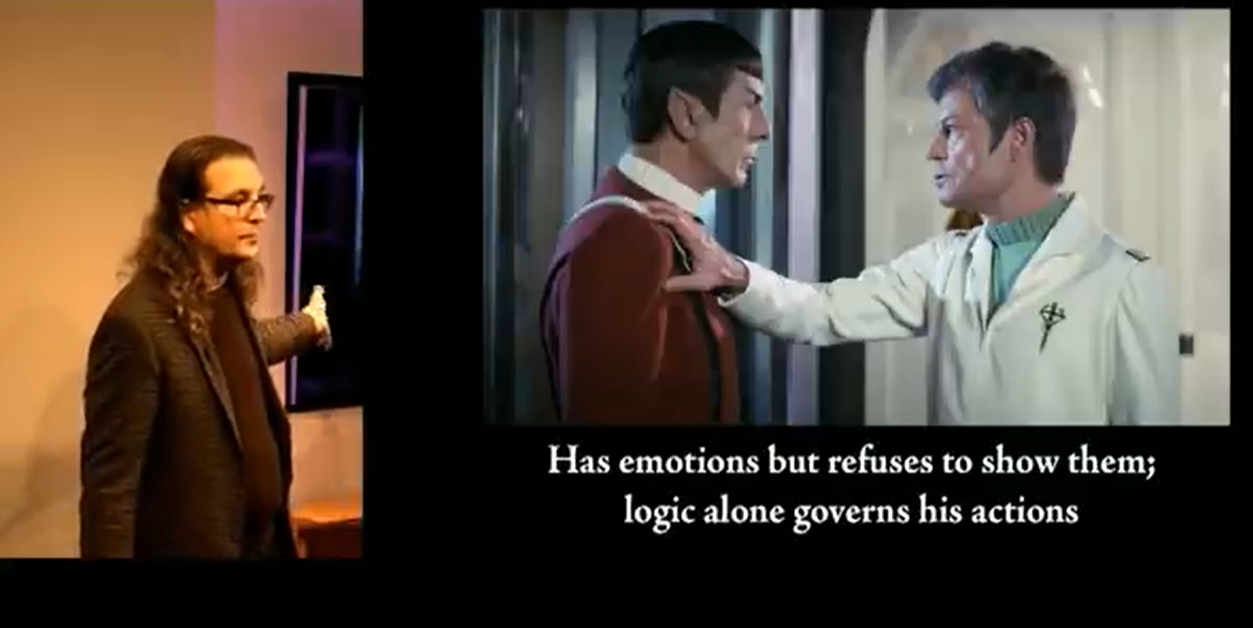 (01:16) And so, he has them, but he, as opposed to Dr. McCoy, always says to McCoy, "Don't let your emotions govern your passions; they'll be your undoing," this kind of thing. And we also know from just watching him, he, for example, pursues mental clarity by using the discipline of meditation, and he specifically is able to suppress physical pain by telling himself things like, "There is no pain," right? So he exercises mental control over his mind-over-matter kind of thing over his physical body. So all of those things in the thumbnail, a pop thumbnail.
(01:52) You know, are the writers of Star Trek drawing from stoicism? So say it's a pop version of ancient stoicism, right? And I did not have to photoshop that; that's an actual episode.
Stoicism and Ancient Philosophy
So anyway, okay, so we go back here to Socrates, where it all tends to start when we're talking about ancient philosophy. So Socrates, as we mentioned, has this method of asking questions, and the core of his question is, "How are you living a virtuous life, or how are you living the good life, the meaningful life? What is that? What
 (02:27) constitutes doing that?" And as he did that, Socrates didn't believe in writing, so he thought that if you, once you're writing the thing down, it's no longer going to be alive, and all of his disciples didn't believe that. And so fortunately, they all wrote things down; otherwise, we wouldn't necessarily have it. But as a result of that, all the different people that he had conversations with came away with different understandings, right? And so we have different disciples with different answers.
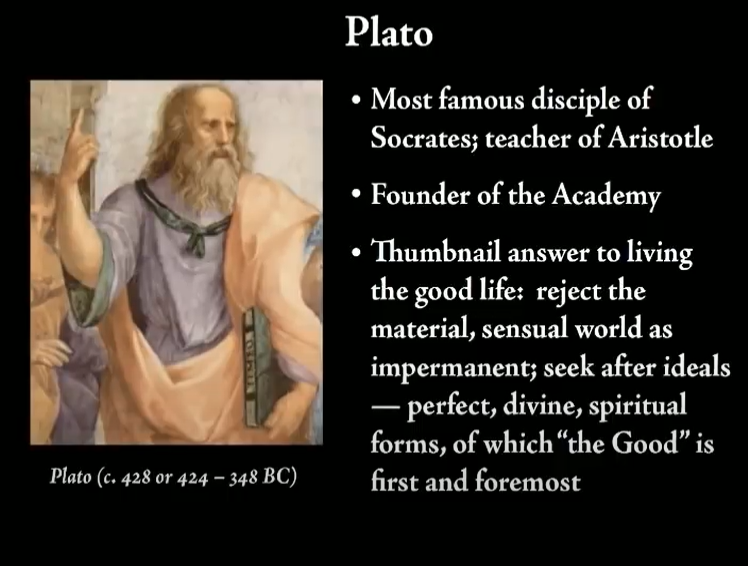 (02:59) The most famous is Plato, and we've talked about him before. So he's a disciple of Socrates, also the teacher of Aristotle. He's the founder of his school, which he's called the Academy, and that also yields one of these words that have come down to us. So we still use "academy" for a school, but we also have the word "academic" for just learning in general. But I think it also is appropriate to a discussion of philosophy because sometimes I think we think of all of these philosophical questions as just being academic, right? So in other words,
(03:33) which we used to mean they're too obscure for our practical daily life. It's all academic. So if we're going to take Plato's thumbnail answer, obviously we have whole lectures on Plato and actually just little components of Plato. His basic answer to living the good life is rejecting this material sensual world as being less important, and instead, because it's impermanent, it doesn't last, and instead, he's seeking after an ideal, ideals. So for example, the perfect divine spiritual forms of which the good is
(04:08) first and foremost. So essentially, you're living the good life by participating in the universal eternal good that is unchanging spiritual good.
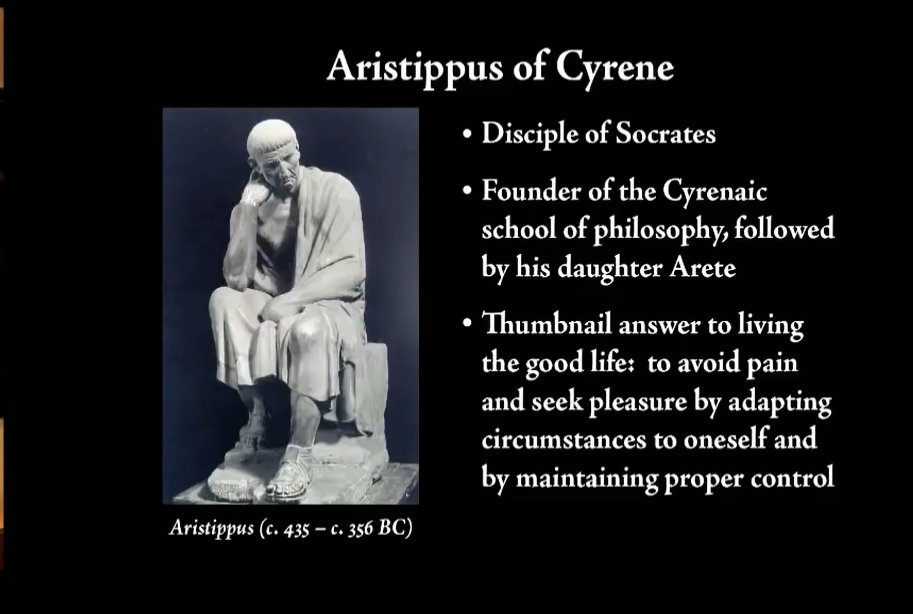 But a very different answer comes from Aristippus of Cyrene. So this is another one of Socrates' disciples. He's the founder of the Cyrenaic school, and his pupil includes his daughter, Arete. And I just mentioned in part because sometimes when we, for example, when we have that picture at the beginning where we have the wonderful picture from Raphael of the School of Athens that we
(04:44) start our lectures with, there's not a lot of times in antiquity do we have women philosophers, and this is an example of a school that has women philosophers and also important transmission through women philosophers. So his thumbnail answer, though, is avoiding pain and seeking pleasure. So this is the sensual pleasure as opposed to the spiritual pleasure that Plato was talking about. And so the idea is to adapt circumstances to yourself and maintain proper control. So this is essentially a line of hedonism that is also related
(05:25) then to ultimately, you know, becomes, we've mentioned Epicureanism, which is not directly in the same line, you know, in other words, if that goes from Socrates to Epicurus, but it's part of the ideas that are around for answering this question.
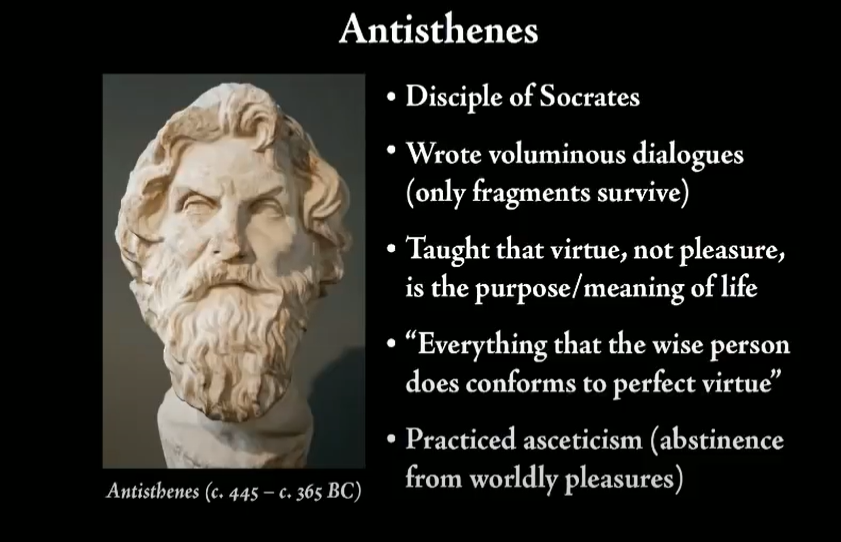 Then we also have Antisthenes, and we talked about him when we had our lecture on the Cynics. So he's a guy who wrote lots of dialogues of which only fragments survive when he teaches that virtue, not pleasure, is the purpose and meaning of life. One of his maxims that has come to us is that everything the wise person does
(06:00) conforms to perfect virtue. He practiced asceticism, which is to say abstinence from worldly pleasure in order to have virtue. So this is the idea that if it feels good, it's probably wrong kind of thing. And so this aesthetic way that we talked about, and so this is the whether or not he is himself a cynic may not be, but he is the person between Socrates and kind of the founders of the Cynics.
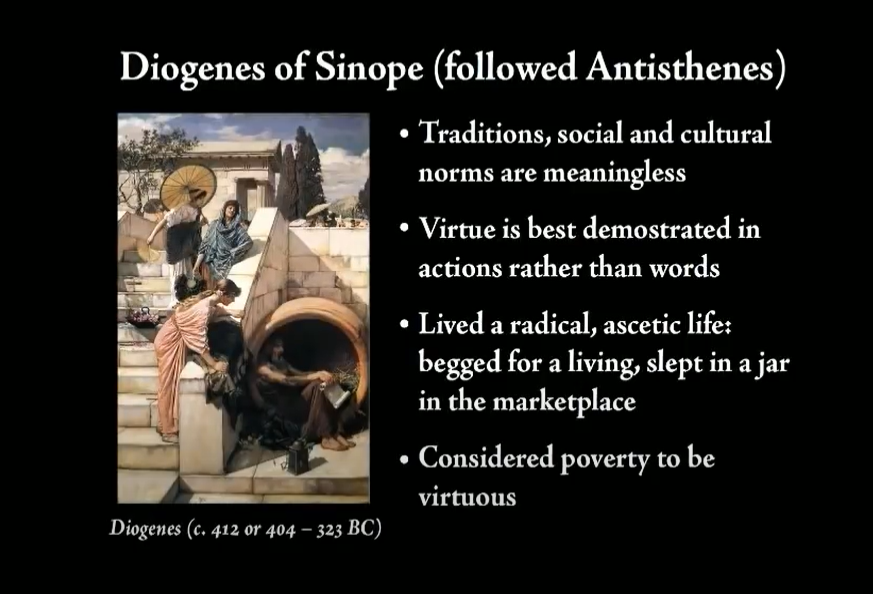 So for example, Diogenes, who we mentioned, Diogenes of Sinope, who followed (06:36) Antisthenes, is one of the Cynics here who, in any way, like we mentioned, traditions, social and cultural norms are meaningless. Virtue is best demonstrated in actions rather than words. And so then he lived a radical aesthetic life. He begged for a living, he slept in a jar in a marketplace, and he considered poverty being virtuous. And so he also wanted to have a very simple life. And so the idea of it was, you know, there's the story that he doesn't have any of these possessions. You're a slave to all these possessions if you have to worry about having all these possessions. He has
(07:13) very few things. He's got his purse, he's got his one cloak, he has his staff, and he has a cup, and, you know, they drink water. And then he sees a kid who gets water out of his hands, and he says, "Man, I'm a fool." He throws his cup away, you know, "I've been living with way too much stuff. I gotta downsize," you know, in terms of and minimize my life. And so he was able to, you know, eliminate cup having after that insight. So to just kind of have that, yes, it's also the guy with the light. So he also does stunts, right? And so
(07:51) part of the idea of it is that he's yelling at people, calling them out as they're all trying to go and do about daily business and things like that. And so one of the stunts that he has is he takes his lights like this, he goes into the middle of the room here, like, you know, and says, and it's, well, actually, it would be outside, and it would be when we were outside, and when it's sunny. And so it would be to light a lamp seems absurd because you're wasting the oil and everything like that. But he has a lit lamp, and they're asked, "What are you doing, Diogenes?" He says he's trying to find a wise man, right?
(08:22) And so, and he's not able to find one. So these kind of things, so he's trying to shame people into doing what Socrates was doing, which is consider what you're doing in life and how are you living a meaningful life. But he's actually, you know, using harsher tactics in order to actually, Socrates is also often a jerk to people, you know, according to the way we get from Plato. But anyway, so that's how Diogenes has followed in that path.
 And so just to have this kind of a chart, this is just our thumbnail chart of Socrates, then
(08:56) these three disciples that we mentioned, there's more, and those schools. So we mentioned the Cyrenaic school, which is all kind of over here in this column of, let's say, light hedonism. But over here, it's the stronger stuff. So Democritus, who is fairly famous for the atomic theory, right? So instead of having the elements as the ancient Greeks understood them, instead, there's the idea, which we've since decided is way more accurate, that all of matter is actually made out of all kinds of little particles that are moving around randomly. And then that influences that Epicurus,
(09:33) who is the center of this school that is pretty much the outlier school in antiquity, and that the other schools sort of get along. They all carp at each other, but they all hate the Epicureans. And so that's the one thing they all agree on, if they hate Epicureans. Plato, his descendants, the Platonists, Neoplatonists, and Aristotle, his descendants, Peripatetics, Aristotelians, Pythagoras, so this kind of mathematical mysticism had a major influence on Plato. But then also, there's still Neo-Pythagoreans too that are not Platonic, but there's usually synthesis.
###
(10:10) And then over here, the Cynics that we mentioned. So we mentioned their Antisthenes and Diogenes, and then Diogenes' student Crates, and then Crates' student Zeno starts something new, and that's what we're talking about today.
Stoicism and Ancient Philosophy
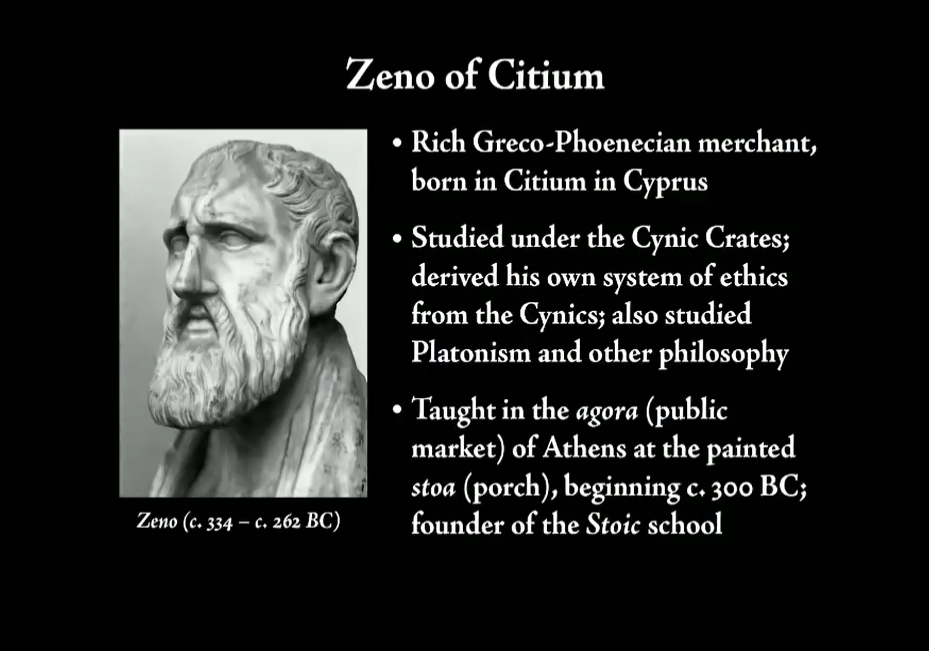
So Stoicism. Okay, so who's Zeno? So Zeno is a rich Greco-Phoenician merchant who's born in Cyprus. He studied then under Crates, he's a Cynic, and he derived his own system of ethics from the Cynics. But he also went around and studied widely, so he studied under the Platonists in the Academy and also other philosophical schools.
(10:54) He, instead of doing like Plato did and setting up shop in a specific academy or Aristotle in the Lyceum or anybody else in all of the other different traditions, he instead, I guess like the Cynics and the Diogenes, is also out in the, in just kind of randomly, doesn't have a specific place. He is in the marketplace, so in the Agora, and he's at a, you know, like a portico, you know, so there's like, as we think of like a cloister or essentially exterior antiquity. It's warmer there than here, and so they don't, all the public
(11:30) buildings are in the antiquity, as opposed to the way we do it now, where there's walls and you go inside and we climate control them. Instead, more or less, everything's open air, and so a marketplace is a big open-air space that has porches so that you could go under the shade. And so this is where he is, and so he's at a place called the Stoa, which is to say the porch, the painted Stoa, and so that's why we get the name Stoic, right? So he's, but it's important that he's out in public and talking and just teaching
(12:01) in front of everybody. So he wrote, for example, a treatise, he wrote a bunch of treatises, but one of them is called The Republic, which is opposing, deliberately writing against, you know, Plato's masterwork. And so all the things that Plato has decided, he's decided, no, no, no, and so he has his own counterwork. Rather than a state ruled by philosopher kings, we don't have Zeno's Republic, but we have some summaries and quotes from it. And so Zeno apparently envisioned an egalitarian society cutting across social stratification. Then
(12:40) Stoicism ultimately becomes a very popular philosophy in the last, the next six centuries, both in the Hellenistic world and later when the whole thing becomes the Roman Empire. And it becomes probably the most popular philosophy of later antiquity in the Roman Empire.

So we're not going to go through everybody, but just to kind of show then all the way back from Zeno, who's back in the class, the early classical antiquity, all the way then through, you know, the year zero, it doesn't exist, but anyway, 1 BC to 1 AD, and then to the later, in the
(13:18) Roman period, including Latin philosophers, Latin-speaking philosophers. And so we'll talk a little bit about, well, Zeno, of course, and Seneca, and Epictetus, and Marcus Aurelius, among others. So in that grouping, Epictetus, these later ones, Epictetus and Marcus Aurelius, this is covering the whole gamut of the social classes, or how it's not really class, but anyway, social status in antiquity. So Epictetus is a slave who is later a freedman, and Marcus Aurelius is the emperor himself in the Roman Empire. And so both of them consider
(13:58) themselves important philosophers in the Stoic tradition because Stoicism is specifically reminding everybody that they're all from the same, they all have one thing in common. When you're a person, you're not, it's not all about this hierarchy that's so important to Platonism and Aristotelianism. Instead, the Stoics often remind everybody, you're all gonna die, you know, so you have that in common with your slaves. Men and women have that in common. So Seneca wrote, "Remember that he whom
(14:36) you call your slaves sprang from the same stock, human race, as you, and they're smiled upon by the same skies, and on equal terms with yourself, breathes, lives, and dies," right?
The Development of Stoicism
So, okay, so let's look a little bit at Stoicism. So Stoicism is, in some ways, a total and complete interlocking system, and so therefore it's hard to decide which part to start with because every piece is kind of dependent on all the other pieces. And so anyways, there's a bunch of pieces, and we're going to examine a bunch of different pieces here.
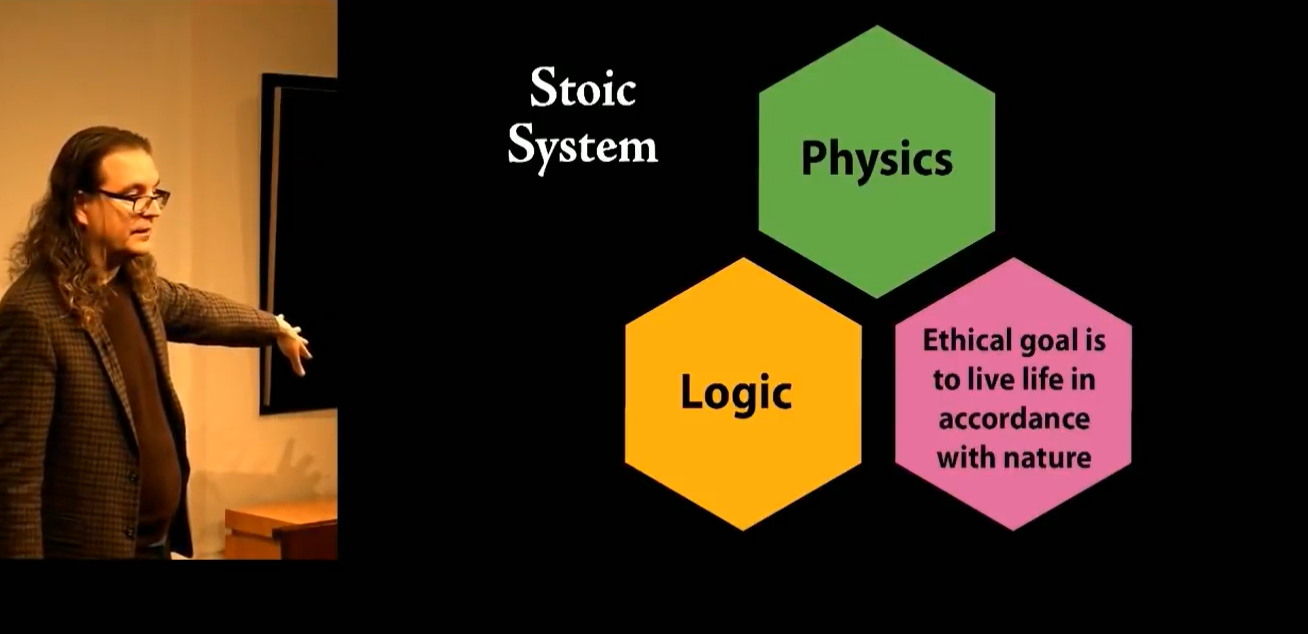 (15:13) So for exposition's sake, the Stoics often, as they're doing the teaching, they divide their system into three parts, just to say physics, logic, and ethics. We'll look at each of these. So for them, the ethics, their ethical goal is to live life in accord with nature. So they want to be living harmoniously with nature. So that goal, they achieved that goal, that was ethics. So again, using logic, so it's conceived through consistent logical action on your part, and, you know, it's done logically. You're acting according to nature, and that nature itself
(16:00) is a logical being. And so that's why these all then attach together, because by living in accord with nature, living logically according to nature, since nature is itself logic, that's gonna work out. And so for that, and so this is in part the idea then that the whole cosmos is infused as with living, you know, a living nature, a living rational, logical purpose. No, not for the Stoic. So the Stoics have the sense that all nature is connected to each other. So it's all material. Every single thing is all connected, and every single thing is connected by cause
(16:49) and effect back to a prime cause, which is the first cause and motion of everything, similar to what Aristotle's motion works, but in this case with the idea that then the whole of it is infused with essentially the world's soul, and then that world soul then is God, our nature, or, and therefore we sometimes call this pantheism, right? So the universe itself is God. So as you kind of see, then the system is going to be totally, they're all dependent on each other and all interlock with each other, and so it's going to create an organic unity, and in some ways it becomes an all
(17:33) or nothing system. So just to talk about, we'll start with the physics part, because this is the part that's most alien to us, and anyway, we may not, you know, it may be the harder part to swallow for all of us. But anyway, so if we go back to Zeno, this founder, he has a bunch of sayings talking about kind of physics or the natural world, and so he says the end, or let's say the purpose, may be defined, the reason for things may be defined as life in accordance with nature, or in other words, in accordance
(18:09) with our own human nature as well as that of the universe. So the universe's nature, the purpose of life is living life, human life, our nature in accordance with universal nature. So there's all those equal signs there. He says a bad feeling that we have, bad passion, is a commotion of the mind repugnant to reason and therefore against nature. And so nature is operating according to reason and logic, so those are also going to be equal signs as far as Zeno and the Stoics are concerned. And so when we are feeling
(18:48) negative passions like envy or something like that, that means that we're not being logical or rational, and so we are doing something that is essentially a commotion of the mind, and it's repugnant to nature because it's irrational. And he also says here, that which exercises reason is more excellent than that which does not exercise reason. So the exercise of reason is the excellent thing, and not is that non-excellent thing. There is nothing more excellent than the universe. And so his syllogism then brings us back
(19:24) to, therefore, the universe exercises reason. So given that, if we assume that the universe is excellent and that reason is excellent, then the universe exercises reason is, anyway, his syllogism there. Okay, so this kind of, this physics, what is this about then? So as opposed to what we had with Plato, where Plato is talking about idealism, which is to say ideas, where you're focused on ideas as being what's important. So the form of good or the cosmic form of good, as opposed to worrying about the stuff we're feeling and sensing, it's
(20:05) things that we can understand in our minds as opposed to the things that we touch and sense that are the most important. So idealism as opposed to materialism. Stoicism here is materialist because they're not, they don't see Platonic ideals as anything. So instead, everything we can see is all part of a cosmic material nature, and they're actually, the way you learn about it is through empiricism. So you, you know, you see what happens, and you're able to draw conclusions from it, and that's actually what's causing all this kind of stuff.
(20:40) But it is opposed to, we talked about Epicureanism, so that's also materialist, but Epicurean materialism, this idea of, instead of having all motion all coming back together to one prime mover or prime cause, the Epicureans are saying, no, instead, everything is made up of all these little atoms. There's all this little void between all of the atoms, and the atoms are all moving around totally at random, and so that everything is pretty well happening according to chance, and so there is, so there, you can't find
(21:11) purpose anywhere, and so that things are purposeless as a result, and so that's kind of Epicurean atomism materialism. And so this is the opposite of that in terms of, even though it's still concerned with the material world, the Stoics are saying that they think that everything is occurring, is happening for a reason or a purpose, and then in fact, that reason we can posit and we can find out by looking at how all the universe, they think that they, you can say, well, it's also happening for a logical purpose,
(21:43) a rational purpose. So therefore, everything is interconnected and moves by cause and effect, and if we trace that, everything happened because that's what happened, and that happened because of that, and that happened because of that. If you trace all of those cause and effects all the way back on every little line, they'll eventually get back to that prime cause, which is God or nature or the universe itself, the world, the world soul. Nature then is a rational world soul, which is imminent in everything, which means it's everywhere, and it infuses the cosmos then with
(22:17) purpose. Stoic physics, so nature is also reason, this incredible Greek word, logos, that gets used by everybody in every philosophical system down to, you know, New Testament Christians for whom Christ is logos, right? So the divine nature is in everything, animate and inanimate, but humans have a special divine quality of rationality. So in other words, humans have logos too, and humans then achieve happiness when they use rationality, when they use logos to study and understand nature and to live in accordance with nature's cosmic
(23:00) logos. So there's the big logos that's all happening in the universe, which is to say the divine one, and then there's a divine spark inside of everybody in that they also are partners with the gods, the god and then the lesser gods, who are all, you know, able to reason and have logos themselves. Okay, so we know that as people, as mortals, we can't control the snow and the cold. So as far as the Stoics are concerned, providence is another one of these equal signs for God and nature, and the world soul is
(23:40) also providence, which is to say that which is controlling destiny and everything that happens. Nature has given us cold weather by fate and destiny, so we were fated to have all of this wonderful weather that we've been having the last few months or so. So we can't control it ourselves. We can hate the cold and complain about the weather all we want, and we can be miserable. That's certainly one response, and many people maybe have been having that response for the last couple of months here. But we can also, according to the Stoics,
(24:15) we can try to emulate a Stoic sage and instead be unaffected by what is outside of our control, since we can't control that, and instead we adapt ourselves in accord with nature and be happy, right? And so, in other words, there's no reason for us to be unhappy by all of this because it was something that we couldn't do anything about anyway. And if we just understood ourselves to be, that this is, you know, our nature to be happy and to understand it and put up with it with all the cold, and in fact, now we are
(24:50) we are more endurant people because we have done this. There's so many more things that we're prepared for. We have learned all kinds of wisdom, maybe, because we have been exposed to something that we didn't like, as opposed to if we never had had that. So that's a response, right, to this kind of physics. Okay, next component. So that was nature, physics. Next part, logic. So pain and misfortune, like pleasure, aren't entirely in our control, and therefore, for the Stoics, they fall into a category of indifference, right? So we can't control
(25:30) whether we're going to be in pain or whether we have pleasure, whether we're going to have adulation or whether we're going to be mocked and taunted by all, you know, by other people. And so all of those things, both natural and the response of other people, all fall into this category of indifference. And the sage has, is the true sage here, which is to say a person who is following the Stoic system perfectly, is unaffected by all these indifference. So all of these faded external circumstances over which you have no control. Instead, the sage has the power to determine his
(26:07) or her own attitude to those outside events, right? So that this is clear, maybe. So let's just, here's Epictetus teaching on this topic. So some things are in our control and others are not. Things in our control are opinion, let's say our own opinion, pursuit, desire, aversion, and in a word, whatever are our own actions. So we can control all of those things inside of us, according to the Stoics. Things that are out, not in our control, are body, property, reputation, command, and in one word, whatever are not
(26:50) our own actions. So can't control all the things that are the responses to all the things that I do, right, outside of that, are outside of me. Is that all clear? Okay, so this logic then, so from all of this, as follows, or it's at least part of the whole interlocking system, that the only good, as opposed to, let's say, what we had with the Epicureans, what we've had with the hedonists, which is the good is pleasure, and to avoid pain, pain is what's bad, physical, sensual pain, or sensual pleasure is what's good. No, no, no, no, according to the Stoics, instead, what's good is virtue,
(27:32) and that is something that is informed by our own rational disposition, and the only evil is vice, which is going to be irrational action. So in other words, I know that overindulging, you know, like, you know, breaking my diet and just eating, you know, on Christmas time, all of these cakes all the time, you may think it tastes so good, you know, but in fact, it's really bad for me in every different way, and so therefore, it's a vice, right? So the line here from Happy Days, feels so right, it can't be wrong, you know, that's the song. Anyway, that is
(28:11) absolutely the opposite of what the Stoics conclude. In fact, if it feels right, you know, it probably is wrong, maybe, right? So what are you going to say? I'm not sure if my question is interrupting your thought here, but basically, did they think, though, that everything has to be in balance? So it's great to have a virtuous life, but then you need to balance that out with something else that is, you know, the good and the bad. Yes, yes. So yeah, absolutely. So yeah, it's not so, as opposed to, let's say, the Cynics that are really
(28:46) practicing extreme asceticism, let's say, you know, where they are doing ascetic practices, which is to say they're mortifying the body, they're doing things that are showing that the body and matter don't matter. The Stoics are, one of their cardinal virtues is going to be moderation. And so, and so that definitely, so definitely, it's not that you shouldn't eat sweets at all, but rather, like you say, I was just, my example then of eating all that cake was not that I shouldn't have cake at all,
(29:21) but rather that I shouldn't eat the whole cake, right? And so, and so this is the, again, there's a rational disposition that is going, one of those virtues, those rational dispositions is towards moderation and that idea of balance. So yes, so true happiness then, out of these kind of, so virtues, these are what good is. So true happiness is identical then to goodness. So these are interchangeable terms, being happy or the good life or the meaningful life. And that is an internal disposition then of logos, logic,
(29:51) reason, how we thinking, which is achieved then by actions that are consistently determined by reasoning that accords with the divine logos, which is to say all of those different ways that we can be doing something that is a rational or a logical virtue. And so that it's achieving kind of this logical state of perfect goodness. So there's a lot of different places where this is a, you know, this is a harsh or hard doctrine. So for example, what if you get sick? So we've been diving here, the only good here is virtue, right? Which is to say a rational
(30:28) act or a rational process. So isn't being healthy good and isn't sickness bad, right? That's the way we normally use the words. No, no, for the Stoics, no, that's not what the, that's not what the body is. You don't have control over body. You can affect your body, but you don't have control over whether you're going to be able to, say, get sick. So health is simply a natural advantage. It's not to say that's a good or a good end. It's not something that you have control over. So it, again, is not something when you have all of your aches and everything like that sitting around and complaining about it or
(31:06) whatever is also, again, not the Stoic way, right? So this is where we get this idea that Stoics, in the face of pain or in the face of ill health or any number of adversities, they're also supposed to see that as a way, the ill health, you know, that they have had is a way that is, you know, testing their fortitude or showing that they have fortitude or there's all kinds of wonderful virtues that can be illustrated by this. And so instead, you have a natural, a bunch of different natural advantages that may be, you know, health is one, maybe speaking
(31:43) talent or anything like that, but you are not really supposed to, you could prefer having a natural advantage to not having the advantage, but again, it's not that that preference needs to be pretty dispassionate and you're not really supposed to be focused on that as if that was like a good or the end. It's not. So then this is where we get to this kind of maxim or, you know, paradox or final state with the sage. The sage is happy even on the rack. So because even, so even under those circumstances, because the sage is sufficient unto
(32:21) himself or herself, right? And so torture is falling within these kind of categories about which the sage is indifferent, and therefore it's really not something to complain about. And then the flip side of this, when you're, for the Stoic absolutes here, is the fool is always miserable regardless of their circumstances. So they may be seeming like they're really rich and they can be lazy and they can yell at people with impunity and they can be bigoted and all the other kinds of things that seems like they're happy.
(32:51) They could tweet all day long, but in fact, they can't be happy because the only way to be happy is to be virtuous, right? Because virtue is what's happy. So all of these things that they have that are seeming happiness are in fact not real happiness because they're still just a fool and they can never enjoy true happiness, right? So that's the story. So we'll just look at some of these in the actual words of some of the philosophers here. So we have Seneca the Younger, who was a Roman senator, very rich man, who's a philosopher. He writes,
(33:29) "Apply reason to difficulties. Harsh circumstances can be softened, narrow limits can be widened, and burdensome things can be made to press less severely on those who bear them cleverly," right? So if you are, you know, if you have these circumstances, all these burdens and things like that, the sense of the harshness of what your lot is can be softened. Again, it all can be less severe if you are wise or reasonable or rational on how you're perceiving the expectations of all of these things. He also points out here, "Men don't care how nobly they live,
(34:10) but only how long, although it is within the reach of every man to live nobly, but within no man's power to live long." In other words, you can't even know you may, you can extend life through all kinds of different positive practices, or you can actually extend the potential to live long, but at any given moment, any one of us could die right now. And, you know, any kind of accident can befall us or any other number of things. Death is outside of our control. Meanwhile, though, and so
(34:44) then even so, and yet he points out all the way back in his time period, people are still continuously obsessing about it, or there's all sorts of people that are fear death, that are very worried about death and tried in our society today. Often we try not to even think about death. We put it out of our thoughts and our conversations. There's hardly any place we can talk about death. It seems like, or maybe even less equipped to deal with it because it's more hidden for us. But more, but he's saying here that even though that's where we're at and we're really kind of maybe have been obsessed
(35:20) with it, all of these other things, these Stoic virtues, as far as he's concerned, which account for living nobly, you know, just as I say, the good life, the virtuous life, nobody cares about doing that at all, even though they could learn how to do that. So let's give Valerie. That reminds me of the saying, and probably people here have heard about it, a long life may not be good enough, but a good life is long enough. Oh, there you go. Yeah, that could be, if it's not a Stoic saying, it could be maybe this. So they have lots of these wonderful epigrams. I only picked a few just to
(35:55) give a sample for everybody. So, and then he also says here, it's not a man, it's not the man who has too little, but the man who craves more that is poor, right? And so if you, as is often the case, you may well know all sorts of, say, even very, very rich people who maybe made their money from nothing. And at a certain point, they just are continuously, that's all they know. And so even though they have plenty of money and they probably don't need to be worried about it anymore, they are still continuously worried about, you know, gaining more money. And so then they are at, are
(36:35) functionally, as far as Seneca is concerned, they still don't, they still aren't content with anything. And so they are constantly trying to gain something that they don't have, where it may be possible that somebody who is living, you know, very comfortably on not too much salary or something like that, but isn't as worried about the necessity, they have some kind of job security that is rare in this century, but, or some other way that they're living that way. And they, even though they are living
(37:04) very simply, are wealthy as far as Seneca is concerned, because they're not constantly craving more, right? And so that's not only true with money, but it could be with any virtue. So we talked about then these cardinal virtues. So what just practically, what are some of the virtues that Stoics see as consistent with nature and as being rational? And so we mentioned one of them here. So I call this one self-control, but it's also providence. And so that, I'm not providence, temperance. And so that's also balance, right? So that's the goal of trying to
(37:42) keep everything balanced. So you're exercising self-control. So it's not that you don't eat the cake, but you don't eat all the cakes, right? You're eating the right amount of cake. And so that's self-control. It's connected then with the various, we've just already seen like some of the practical wisdom that they're talking about, a sense of justice and a sense of courage in the face of all of these adversity and loss. And so all of these together are the four cardinal virtues of Stoicism, and they are all part then of one rational disposition. You can't, for example, have courage
(38:24) without having all the other ones together. So in order to understand and be courageous, you have to have the practical wisdom. You have to have the self-control to exercise that. You have to be looking out for justice and wanting to use your courage to promote justice. And so therefore, they're all, again, like I say, with like that puzzle that I had at the beginning, as with everything with Stoicism, it's sort of all or nothing altogether connected. So for the ethics then, ancient Stoicism in practice, Stoics don't claim to have achieved that perfect condition of the sage
(39:00) because in some ways you can't possibly, even if it's in this kind of all or nothing circumstance, they themselves realize you can't have done it all. And so all the Stoic writers that we talk about don't claim to be sages. They instead are holding out the ideal of the sage as something that they are all continuously aspiring to achieve, but in some ways obviously can't be ever be perfectly achieved, purging all of the passions and that kind of thing. So they're working towards that, and they use spiritual practices like meditation in order to
(39:34) get closer and closer to that ideal. Another way that they do it is by engaging in, let's say, a Socratic discourse or in discussions about these things, exploring what you would do on certain circumstances, reminding yourself of Stoic maxims. So you're just constantly reminding yourself you have no control over what other people are doing. You only can control your own attitude. You're reminding yourself that kind of thing. So both Epictetus and Marcus Aurelius, who we mentioned before, they're constantly urging themselves to maintain that indifference to circumstance and to
(40:09) only value moral choice. So all circumstances, they'll have all these sayings that they have to themselves or the meditations that Marcus Aurelius meditates on every day where he reminds himself those two things, the things that are happening all around him he has no control over. He can only value and be control over all the things that he has power over inside himself. So here's a couple examples of these meditations. I feel like that as I was going through the Stoics, they're made for Facebook memes. So a lot of these ideas are actually could still be
(40:43) pretty, you know, anyway, popular and things like that. So you have power over your mind, not outside events. Realize this and you'll find strength. So that's kind of that central Stoic maxim. Here's a rule to remember in the future when anything tempts you to feel bitter, not say, "Not this is misfortune," but "To bear this worthily is good fortune." And so that's kind of what I was trying to say with the snow, right? So the snow isn't misfortune, but to be able to worthily bear the fact that we have all this snow, it was good
(41:23) fortune that we got the snow because we were able to then worthily bear that, right? Begin each day by telling yourself, "Today I shall be meeting with interference, ingratitude, insolence, disloyalty, ill-will, selfishness." So you just experience that constantly as you're walking around. All of them due to the offender's ignorance of what is good or evil. You know, so in other words, you're having that, and actually there should be, there's probably a second part of this statement, but in other words, that's not your, what you can control. You do have
(41:55) that all the time. And so his answer to these kind of things is you have, if you allow this kind of negative things to happen, you know, negative behaviors in others, you don't react with anger or with passion. You have to react dispassionately, right? React rationally, react with reason, with the logos, not with passion. So for all of this then, if you, you know, it's like a big, like I say, a big puzzle and it's interlocking piece. How do you do it? You know, if you, you can't start from nowhere, the Stoics, and so there is this general
(42:36) ancient Greek philosophical sense of doing stuff that we kind of have lost. And so what does Epictetus advise us here? He says, "Whatever you make habitual," I'm sorry, "Whatever you would make habitual," so things that you want to be your habits, this is how you want to behave, you want to be virtuous. So if you want that to be something that you just do habitually, then practice it, do it. So do that thing. If you want to go to the gym, then go to the gym every day, you know, practice doing that, right? And if you would not make the thing habitual, don't practice it. So if you
(43:13) don't want to, you know, drink every single day, don't do it, but accustom yourself to something else. So replace, it's hard to replace something with nothing, but do something else as a new ritual. As if you were, let's say, I've been a smoker, you may well have certain moments where you even find your hands, you fidget with your hands and things like that. Get a little fidget twirler, get something to put in your mouth, like mints or something like that instead, you know, anything, those things. So you can't, instead of replacing something with nothing, so essentially you start practicing it
(43:47) in order to do it, just put one foot in front of the other and then you'll soon be walking. So first say to yourself what would be, then do what you have to do. So in other words, say and decide what you want to do, then do it. And so this is this idea of ahead of an antiquity. So we know what, so what you just do, let's say naturally, what has come about naturally because you've learned bad habits maybe, and the Stoics consider like almost all like teaching that kids have when they're growing up and things like that essentially is training you to do bad.
(44:25) So essentially in the same way that my parents in retirement got a little lap dog that runs around and they have trained it to be a horrible dog, you know, it's not the dog's nature to have been like that, but it feeds, it loves to jump up at you, it likes to yip, it likes to beg for food because it knows if it begs for food, it will get food. So in other words, it's been trained to do that. So in the same exact way, by doing these things, if you train yourself enough, if you do a thing enough, it'll become habitual and then it
(44:57) becomes what they call the second nature. And we still use that phrase, right? So it's our second, becomes second nature. So you're going to say, you know, there's maybe somebody else can quote this more accurately. It comes from native tradition somewhere. Grandfather is talking to his grandson and he says, "There are two wolves inside me. There's the wolf that's the good wolf that wants to do well and there's the bad wolf that wants to do evil and wants to bite everybody." And grandson says, "Which wolf wins?"
(45:39) "The one that you feed." [Laughter] Very good. So having gotten that system then and having had that system achieved kind of a, let's say, a broader popularity, late antiquity was perhaps the time period when philosophy is more popular and more widely practiced than any other time in all of Western history. So when Plato and Socrates were running around in real life, the number of people that were philosophers, you know, was a couple dozen people maybe that are hanging around them in Athens.
(46:27) By the time you get to the end here with Marcus Aurelius, when the emperor and all the other people in the empire maybe are thinking themselves as being a philosopher of some kind or following some kind of a philosophical school, maybe it's five to twenty percent, somewhere in that range. Anyway, way more than probably are thinking about what kind of philosophy you are right now. If in the 21st century, people probably aren't often thinking, "Well, I'm a structuralist," or "I'm a, you know, relativist," or
(47:00) whatever, a nihilist, or whatever people are saying. It's not as common, I think, in terms of, anyway, maybe it is, but it was very common, especially in late antiquity. And so the question, though, is, so what are some of the potential failings of this system? One we could just start with is we maybe aren't convinced by the Stoics' particular claims about nature and maybe the pantheism part of it. That part is harder for us because of modern physics to immediately reconcile. But another possibility, too, is if you were always,
(47:44) let's say, reconciled to all of the events that are going on outside of you and not constantly feeling that you have to struggle against them, you know, is it possible then, as, let's say, the emperor himself or one of the slaves in the empire, too, those are both Stoic philosophers, is it possible that they are not challenging the system as a result of that? Because they're part of then this kind of brutal, oppressive system that includes slavery and all the other kinds of things that the Roman Empire involved. And
(48:17) are they perhaps not doing their utmost to reform it because the system does or doesn't cause them to, right, or doesn't emphasize that? So fatalism, maybe. Oops, going back. So for us, too, maybe they're too optimistic about this idea that they do have complete control over their own mind. So they may be too fatalistic about not being able to affect everything around them, but maybe they also, this idea that you really can't do anything with your own mind and train yourself to be good and virtuous and all those kind of things, we now have a different
(48:54) model and understanding of the mind where we have a sense of that there is a big chunk, biggest chunk, the biggest chunk of the mind is happening in our subconscious. And so maybe we don't have the kind of control over that that the Stoics kind of optimistically believed. So, yep. Yeah, it's curious, though, that presently the most popular form of psychotherapy in the United States, this is determined by pragmatics, you know, what is the most cost-effective solution to any medical problem. And the most, the one found through experimentation to be most effective
(49:38) is one called cognitive therapy, which is very, very close to the Stoic position on how one should deal with one's psychic ails, you know, that one can, through rational, through reasoning, you know, come to terms with, you know, emotional difficulties or, you know, life difficulties. And so what the insurance companies apparently are funding, are willing to fund, is a relatively short period of cognitive therapy, maybe six months, sometimes in combination with drugs if needed. And they're not willing to fund, you know, what would be probably, you know, on average, let's say about a five-year
(50:16) psychodynamic therapy like Freudian or Jungian, which deals with the unconscious, right? And it's not that they are just being cheap, but rather it's been found that the proper term isn't recidivism, that's from criminology, but let's say repeat visits are lessened, you know, with that particular approach compared to pretty well, and there's dozens of therapies, but that's the one apparently has been settled on is the most effective. So that's kind of curious. Yeah, yeah, no, and so in that way, by asking these questions, I'm not saying that this is a problem necessarily with Stoicism, but just asking the question of it. So, yeah, so this is the opposite question then for us in modernity, too, though, is how, you know, so how fatalistic maybe have we come to be? Because we, if you also, let's say, are considering that everything, you are also a result, ourselves are a result of both our genes and then also all the different things that have happened to us in our lives, and that so much of our everything that we're doing isn't something that we control because there's all of this unconsciousness, you know, and to the point where then we don't have any of those kind of controls. So how much is maybe, do we have this fatalistic problem that maybe looking at Stoicism and some of these techniques for building good habits or habits that we're trying to achieve, maybe those actually do have some results in kind of a therapy. Yeah, I'm just going to say that, in fact, the whole concept of mind and control of mind is thousands of years old in Buddhism, which essentially talks to mind only. In other words, everything really is a product of the mind and how you interact with your external environment as well as your internal environment. And that would include the unconscious because largely what's in your unconscious is stuff that you're not conscious about. And a whole realm of meditation, you know, including the Zen, which is what they call it, what's the modern mindfulness, mindfulness is, you know, a very specific meditative technique within the whole realm of meditation. But that too is very current and it does tie into what Valerie was talking about in terms of the cognitive because really up until I would say maybe the last 15 years, the prevailing, you know, philosophy within psychology was that the mind was fixed and, you know, you couldn't change it. And whereas, you know, something like Buddhism or some of the other Eastern religions have always worked on the premise that there's plasticity in the mind and that would be the unconscious, you know, working towards making the unconscious conscious because the unconscious is largely as a result of conditioning, regardless of which culture you're in, it's your mind and your unconscious is conditioned. So to bring that to the surface. Yeah. So that and a lot of what the Stoics are actually saying, you know, the dispassionate is again, very, you know, good and bad or the same different sides of the same coin. And if you're constantly, you know, worried about good and bad, then you're kind of a lost, kind of lost, right? You know, whereas to be dispassionate or neutral or wherever is actually, you know, someone like Krishnamurti, for example, he would say that, you know, much of how we operate is just transactional. We do something in order to get. So whereas if you're, you know, to get good or to get bad, whereas if you're neutral, then you're dispassionate in the way the Stoics are expressing it. So the bigger picture. Oh, wait, let's and we'll come back. But the application of this in today's time in terms of these Stoics said to be rational and when you're in situations where someone's wronged you and you're rational and you don't, you're not reactive, how do you make it passive but apply, right? Do you walk away and ignore them and therefore you're Stoic or where did they mention how you apply it? Right. So, yeah, how does some of this application go to work, you know, like a daily life kind of circumstance? And so I guess there's a couple different scenarios here. So if you, let's say, are experiencing, let's say, a workplace situation where somebody is aggressively, let's say, trying to diminish your status or take credit for something that you're doing. So there's a couple different scenarios. So one of the things that they might be doing is they might be malicious, like they're really trying to bring you down, you know, or they might just be completely inconsiderate. And so they aren't really thinking of you at all. And they might just be doing, this is just their modus operandi and you were just doing this in the way of them and they were just that kind of a person. And so one of the things that I think is a Stoic response to that is that you, instead of immediately allowing, let's say they told you about, they've said something, they've done something at that moment, you know, kind of a work-life environment, you instead of immediately reacting and so you're aggressive, you're like, you feel slighted. And so then you in turn, tit for tat, you say something bad about them or you say, but you will never do this or that kind of thing. If you instead step back and look and try to analyze their motivation, see why they did it, you would be, you'd be able then to dispassionately and rationally or logically address the situation. So you either, if they're just like that and you can't fix them, you step out of their way and you just are not, you just avoid them. If it's something that where they're actually aggressively going after you, then you would have to see them as the threat that they actually are, you know, and then you'll have to take, you know, take steps to how, how can you live your life in such a way that you are not, you know, in their path, their path of action. So it's, it'd be different, I think, than when you're talking about if you were being assaulted by somebody at a time. So you're not supposed to just necessarily lie down and take it necessary. You can, but it doesn't, so I don't think it means that there can, there can be no fighting at all. But the point of it is, is that what's the rational response to that in order to get the desired aim of them not to be able to be aggressive in that way. So you have a better answer for it here. Wait, you have to get the microphone. Sorry. From my perspective, just to add on to that is basically you're in this world, but not of the world. So you recognize the situation and you respond in a rational way, but you don't respond in the same energy tone. The reverb isn't the same as what's coming towards you. Yeah. And so in that way, I think that both Martin Luther King Jr., who's today, they've just been celebrating in the States and also Gandhi, I think are also informed or they've studied to some extent ideas from some of the Stoics too. And so it's not that, so with the nonviolent response to it is not to just roll, it's not the idea of rolling over and accepting the injustice, but rather by having this response to it, like you're saying, isn't taking that same negative energy that's causing this feedback loop, but instead is stopping, you know, it's, it actually, in these cases, shamed the power structure and ended up having a positive result. Right. Who, who, somebody else back here had a, yes, you were next. I'm sorry. Well, I tend to perceive Stoics a little bit pessimistic and in this, apart from Marcus Aurelius, who is outwardly optimistic about anything that can come onto him, but this is a little bit of philosophical question, but is there this, maybe can we do this distinction between up to Marcus Aurelius, when you, when you show us this whole 600 year lifespan, the span of, of this whole spec, whole idea, because they had, they're aware that they can never be fully virtuous. Yes. And this is something a little bit against the nature, maybe if they are, they are not fully integrated to this logos, right? This is this question, the philosophical question, but to me, for instance, Seneca never, okay, I'm pursuing to be Stoic, but I know that I can never be this. So probably maybe they're not that optimistic that, or some of them are not that optimistic that they can achieve this mind control to a full extent. Right. Is part of the philosophy, because this whole philosophy is based on the fact that, that how to live this life and up to this difficulty, right? They, they, they acknowledge the difficulty that they cannot do it. So they try to, there's another maxim that I think it was anyway, one of them has Seneca maybe who is, he's like, you can't have, you can't have hope without despair or, you know, you, and you also shouldn't despair, despair without hope or something like that. But like you're saying, so there, there isn't a, there's a sense here that they can't actually ever achieve this. And so there is a pessimism. And the one thing that I, I also then was kind of struck by, so you're talking about like after Marcus Aurelius. So the next century, couple centuries that what ends up happening is that the Roman Empire and philosophy gets totally swallowed up by Christianity and Christianity swallows philosophy and it largely fall swallows Neoplatonic philosophy. And, and one of the things that's interesting about that is even though Christianity in some ways is optimistic in some ways, but in some ways it's also very pessimistic in this kind of a sense too, because the idea is that if let's say everybody is in a condition of sin, right? And you can't ever, there's nothing you can ever do about that other than you just have God giving the gift of grace. So maybe it's that, that is, that make it more optimistic. I don't know, because I guess I feel like that's the same kind of limitation that, you know, Christian Neoplatonists are having, which is you'll never can achieve, let's say being a good person, a truly good person, truly righteous person, because it's all, it's impossible. You're always going to be in a condition of sin. And so maybe it's this, that last mechanism when they decide, well, God has also given you grace and so on, that makes you, makes it more optimistic than what the Stoics had. And so maybe that's why Christianity won and the Stoicism didn't. So Bogdan was next and Elizabeth. I think this acceptance of circumstance and not challenging things and coming, maybe it's coming too readily to an acceptance of a reality and the Stoicism has been accused of being a slave philosophy, which is good for slaves because they are slaves and they can't change their reality. So they accept things. Yeah. But I think that Nietzsche was the first one to challenge that saying that we need to promote heroism and passion and the use of the subconscious and to strive towards greater things while Stoicism says, accept your limitations. But some people might want to reconstruct things that might be seen in a limited way and challenge that for themselves and for others and challenge the system. Yeah. As opposed to accept it. So challenging the system, challenging oneself are greater philosophies than acceptance of things because sometimes you don't have to accept things. The Stoicism promotes this acceptance because it is a kind of a servile philosophy to accept your fate. So this is a common critique of Stoicism. And I read a bunch of different Stoics who were, let's say, modern Stoics, modern Stoics. So it's like, I guess it's neo-neo-Stoics who argue, no, no, no, we are not supposed to accept the system. You are accepting the external realities of it, but you can still be, you're still supposed to be courageous and challenge the system. In other words, you're supposed to promote change so the system becomes more and more in accord with nature and reason and logic. So we want to be improving. But like you say, maybe functionally for the common Stoic on the street or the slave Stoic, maybe they, that maybe that maybe they could, we're open to that criticism that you're making. But anyway, so Stoics don't necessarily agree with that. There's been a bunch of hands. So I think Elizabeth was first and then, yeah. A couple of things come to mind. One is that the basic outlook of Stoicism seems to be that the world makes sense. We may not understand it, but it does. And this, I can see how this is very attractive to anybody and how Christianity glommed onto it. It's a sort of the powers that be are ordained of God. The powers that be are likely to be very happy with people who believe that they are ordained with, with, of God. The other thing that strikes me is that the Stoics, at least the ones you've been quoting, seem to be assuming that people are autonomous and that they can be and that they should be, that this is good and this is indeed possible. There seems to be very little said about the influence on other people of the way we live our lives. Yeah. Because this is, we now know that it's tremendous, that if you cut somebody off in traffic, they're going to go and do it to somebody else. And conversely, if you let somebody in, then they're likely to be nice to somebody further on. These things have cascading consequences. Right. And we can't do very much perhaps, but you never know. You never know. And I was just talking to, so I said my husband, Mike, beforehand about, you know, like Stoicism and the Stoic value of simply under these circumstances when somebody cuts you off or something like that, that your response really is modeling good behavior. But there's a lot of people who don't watch model good, model behavior, right? They're not, they're not paying attention to when you're modeling good behavior. And so therefore the big good behavior doesn't get passed on. But one of the critics, so I was like, they say reading a whole list from contemporary Stoics about criticisms of Stoicism and they have answers for things like fatalism and this kind of a thing. But one of them did admit, but it is a really lonely, it is a really lonely discipline. So in other words, as opposed to Christianity or something like that, which is about congregational life and doing stuff together and being part of a community, in this case, it's like you say, very focused on the individual and your own personal attitudes and individualism maybe. And so therefore a little more lonely. So I think you need to talk first. Go ahead. Urgent's got the microphone. The slave Stoics and who has no control over their own life. Yeah. And like Marcus, he was, there's lots of control over everything. Yes. And are there any differences in their Stoic ideas? Because one is totally fatalistic. Yes. However, everything could change everything. Yes. Yeah. So it is remarkable that this thing can cut across bounds that strongly. And so on the one hand, so we were mentioning about how Seneca, for example, who is one of the richest men in the empire, whose farms that he, you know, around the empire that he doesn't know where all the property is. He has so many slaves. He has no idea what all their names are. And so you're going to probably reproach me that this is not moderate, you know, and so, and it's, this is not, I'm not been able to achieve any of the kind of Stoic values here because I, you know, I'm just so super rich, you know, which is not one of the ideals of what the philosopher is. And so he's more or less says, well, I'm working on it or whatever, you know what I mean? Don't, don't just because, just because I don't, don't do what I do in that case, do what I say. Right. So don't, so there's the, the ideals here don't condemn the ideals just because I'm not living up to them. The ideal here is still moderation and that kind of a thing. And so in some ways you would think therefore you would be able to exercise a lot more power and control by that circumstance. But in some ways the teaching is the same, I think. So you haven't gotten to talk yet. So why don't we give it to you and then just going back slightly to the point where you talk about Stoicism being lonely. Yes. What if anything does the Stoic philosophy have to say on human relationships, love, family, people should be striving for, or should you be indifferent to? So let's see how it works. For Stoics, there's a whole thing on, on friendship and why friendship is like this ultimate good. And so you are, so why does a philosopher, so a philosopher is sufficient unto himself or herself, right? So you don't actually need friends, but, but nevertheless, friends are, having friends is virtuous because it allows you to exercise all sorts of virtues that you have by having friends, right? So you're able to exercise generosity, you're able to teach. Of course, the only way that friendship works is, is the only people who can be really be friends are in fact philosophers. So as far as the, in the same way that all of these equal signs and the whole puzzle all works together, none of us who, let's say if you're a fool and you're just constantly selfish and have envy and all these kind of things, you don't actually have friends. You just think you have friends or you call them friends or something like that. But what you have is a, yeah, you have exactly a very impure version of it. Whereas for the philosopher, for the sage, the friend is essentially the other self. So there's this, this ideal where you'll just do everything for that person. And so essentially the value of it is that you are exercising all of these virtues that you otherwise wouldn't have the capacity to do, but it's not essential because you're sufficient under yourself. So in that way, lonely, but you can, you know, with benefits. And I'll let you and then Valerie. My question was similar to that. Okay. Self-sufficiency and just trying to understand the Stoic concept. I think it's called autarky. Is that okay? Yes. Yeah. Right. Basically my lame understanding, it's that principle of self-sufficiency that yes, the sage doesn't require, is sufficient in itself. And to have a requirement for say friendship is a indication that you're not sufficient. So, right. Right. So your motivation, like you say, for family, for example, you may well, unlike the cynics who are, are telling you custom is bad and, and all these familial obligations are enslaving you and this kind of thing, the Stoics may well, let's say, go and take care of their elderly parents in old age, but they are doing it out of a completely different motivation than a person who is doing it because they have obligation or society is telling them to, or peer pressure or anything like that. They are doing it because they are themselves, like you say, morally autonomous and they are doing that to exercise virtue rationally. So then they're demonstrating. Was it connected to something similar along the lines of the self is an absolute and to have desires, requirements to go outside of the self is an indication of, of not being virtuous in the sense that everything is sort of like, everything is resolved or resolves down into the self and it can be reconciled and that leads to virtue and happiness because you don't have a desire requirements for things that are outside the self. And the only thing that we do have control is the self, right? It's because you have no control over it, right? So you can't control what all these people do. You can't control if your family is just total horrible to you and all those kind of ways or disown you or anything like that. You can't even help it if, you know, your friends betray you and this kind of thing. And that's why, therefore, those are all of those things that are outside of control and therefore outside of what, what truly matters. Let me get Valerie's turn if we can get the, yeah, just to get back to the Stoic idea of controlling one's passions, being able to rationally respond, rationally respond to, you know, adverse circumstances, annoying people with whatever it was, you know, a very dispassionate, calm and rational internal attitude. Yeah. In modern psychology and in modern neuroscience and neurology, it's now known that we have different pathways in the brain, different structures in the brain that serve some, you know, some of those very, you know, functions that the Stoics are talking about. The passions are, you know, to be found in structures within the so-called limbic system. In older terminology, that would be like the reptilian brain. And then the neocortex is the, is where, you know, our reasoning is found. And, and so as we mature, we gain greater control over, over the limbic system. And, and it is possible to do an override just actually physiologically where the pathways can go rather than leaping to a limbic reaction, which is like a emotional hyper reaction. Yeah. That the pathway can go to the neocortex and then back again to, you know, to the, to, to the action centers. So, so, you know, think before you leap sort of a thing. But there is a problem, I think, with the Stoic view that, and I do believe that you're either all good or all bad. You're either 100% virtuous or you're not at all. Right. And in modern psychiatry, it's known that there are many people who, for a variety of reasons, but some of them are, you know, some of them are genetics, some other, you know, just conditions like personality disorders where people really cannot control that even with, you know, certainly with the psychotic conditions like schizophrenia, bipolar, whatever. And these are typically very emotionally hyper reactive conditions. But these people really cannot help themselves. And so I think Stoicism doesn't have very much room for what the modern notion of mental illness. Right. You know, but for them, these people would not be virtuous. They'd be the opposite. Right. And so that's put it under the rubric. Is there, are they too optimistic about the total control we have over our, you know, and all, and all circumstances over our own self? And at some point, do you not have control of those things? So maybe some of them, you know, and some people less so than other people due to no fault of their own. Right. Yeah. So they're not evil people in the modern sense. You know, we now know they're not evil, that they are sick. But I wonder if Stoicism could make that distinction. And then also I'm thinking about, you know, what was just being discussed a little, a little earlier too about, you know, whether this is a possibly can be seen as a slave philosophy. And certainly Christianity, including by figures like Nietzsche, has been called a slave, a slave religion. And I'm thinking that, that Marxist communism in some ways came to, was the answer to that, that under some circumstances, it's okay to become enraged. It's okay to become violent. It's okay to have a violent revolutionary, even murderous reaction to slave conditions. Yeah. And that is moral. That's a moral response to intolerable, you know, oppression. Right. So I, I've some, I've come to think of communism, Marxist communism is, I think of it as a Christian heresy. And I think of it as Christianity become weaponized. Okay. You know, and so maybe this is the maturing in some ways of Christianity, but, or maybe this is, you know, have a Christianity having a internal flaw in terms of being too ready to submit to social injustice and then overreaction to the other side. But, but, but right. One of the, one of the ways that it works is let's say, so in the, for example, in North America, the antebellum South in the United States, the slaves and them and the owners are, are Christian. But the way it works is that you may be, if you're, you're able to have the religion as part of you, if you, even though you're in perpetual bondage with no hope, right, that the system was hopeless for generations and generations, was that in Christianity, then you then are envisioning this apocalypse, right? So you're envisioning the end of the world when God is going to intervene and the first will be last and the last will be first. So this is why the song is, you know, when the saints go marching in, they want to be in that number. This is, that's the into Zion and the end times when they want to be in the 144,000, the elect when, when the whole world is destroyed. But in the meantime, by waiting for that time period, in other words, that's delayed, then you endure what you have right now. Likewise, probably in that same context, you know, Stoicism is a similar idea that is answering these same kind of questions, but then also not causing a systematic change. It's not saying we need to have a bloody revolution now, rather you endure this condition that you find yourself in because there's nothing you can do about it. Right. So, all right. So we also, we're going to have to take, we'll take two more and then, then we'll close formal discussion. All right, go ahead. I just thought the premise, this isn't like they sort of, you know, like, I don't know much about philosophy, but it seems to me to say that nature is not chaotic and to say that nature was perfect. To me, that, that one statement didn't make much sense to me. Yeah. So at different times, people have envisioned nature as being, like you say, chaos. And so especially you have some questions from the audience online. So, all right. So anyway, so in, in paganism, in ancient paganism, nature is, tends to be viewed as monsters, right? And so it tends to be viewed as, you know, that Fenrir, the wolf or the Tiamat, the dragon or the, the, the world dragon or all the different monsters that have to get slain by the kind of Olympian gods who are trying to hold back chaotic forces, even though they themselves are, are kind of chaotic. And it's only now in this time period of, of the philosophers that people have started to, and also let's say in Buddhism. So this axial age where there's this era of religious reform around the planet where people have noticed, for example, well, everything is sort of chaotic in terms of, we don't know when the lightning is going to strike our town and we don't know when the snowstorm is going to happen and all those kind of things. All those, we don't know when an earthquake is going to topple our city down. But what we do notice is that the sun comes up every single day, that all the stars move back to their same position after every year, that the planets can be predicted where they're all going to go. So there is this kind of underlying order that is maybe affecting the cosmos. And so that has started to have people speculate that maybe there is an orderly system and that we just simply don't understand all of these localized chaotic forces and that the more we kind of learn from them, the more we're going to understand that the universe is an orderly system. That's at least the proposition here. But you don't have to believe that the universe is orderly or rational. You can believe it's a monster, you know, that would be possible. Yeah. So that's not, well, they probably don't. So yes, we're going to have, that's him. And then you stated that towards the end of the empire, Stoicism was one of the leading or if not the leading philosophy of the day. Yes. And we're, we see in modern America still the rise of Stoicism. Is there parallels in terms of a declining empire and the popularity of this philosophy or this philosophical view among the populace? Is it, does it tap into something? Does it connect with this sort of like existential predicament that the powers of the day feel a declining world and that this somehow addresses or this somehow connects with them? Actually, I have a related question. Okay. We'll get one from the internet. That's some related. Now I lost it. Tim Burt is asking, how did Christianity respond to this philosophy if it did? Okay. Well, so let's talk about the situation now. Well, there's, there's much more Stoics than there have been, but there wasn't anywhere near as much as there were in the empire. I do think that we are at a place right now in the postmodern world. So as after modernism has kind of run its course and we no longer see the future as being always, you know, optimistic in getting to this, like my, when I was a little kid, the Federation that is going to be where everybody values diversity and we're not going to have poverty anymore because the computers will just give us replicated food out of the, you know, out of energy. There is where, and everybody will have unitards, you know, because there won't be discrimination. So in other words, we're not getting in that, in that direction because now the future may well be Blade Runner, you know, where everything is, is chaos and cities are horrible and everything is oppression and you're in this kind of post-apocalyptic world. So we, we lost that