Who Wrote the Gospels? By CentrePlace
Summary
The four canonical gospels are attributed to Mark, Matthew, Luke and John. Matthew and John are among the Twelve Apostles. Mark was a companion of Peter and Luke a companion of Paul. Nevertheless, none of the texts gives any indication that these characters are their actual authors. In fact, the texts originally circulated anonymously and were only assigned their present names by later copyists. John Hamer of Toronto Centre Place will look at the origins of the traditional designations, why none is likely to be an accurate identification, and what we can know from the texts themselves about the anonymous evangelists.
Introduction
(00:02) This evening, our discussion centers on the authorship of the Gospels. A previous version of this lecture was delivered, but upon reviewing it in preparation for this session, I realized it dates back to the spring of 2016, marking it as one of the inaugural lectures at the Center Place. The methodology employed at that time was notably different. This current lecture is significantly updated and entirely new. It is a topic that has been frequently requested. We have extensively discussed various characters and figures in the New Testament, as well as apocryphal texts such as The Shepherd of Hermas.
(00:37) Generally, whenever we address these topics and I mention, for instance, that the four canonical Gospels—those attributed to Mark, Matthew, Luke, and John—are anonymous and not eyewitness accounts, it often surprises people. Many of you who have been with us are familiar with this information, as we have covered it extensively. However, there have been numerous and repeated requests to revisit this subject. Therefore, we shall examine it in great detail, with the hope that you will find the discussion both enlightening and beneficial.
Presentation Slides
1. The Four canonical Gospels 1:15hms
During the first, second, and third centuries, numerous Gospels were in circulation. However, when the Christian Church received official endorsement from the Roman Empire in the 4th century, a decision was made to include only four of these Gospels in the Canon that would form the New Testament of the Bible. These Gospels are known as Mark, John, Luke, and Matthew. A pertinent question arises: how can we distinguish between them when observing depictions of the four evangelists, such as in this relief sculpture or in a stained glass window?
2. Four Traditional Symbols for the Evangelists 2:00hms
One notable aspect is that these figures are consistently linked with their symbolic totems or logos. Mark is represented by a winged lion, John by an eagle, Luke by a winged ox, and Matthew by a winged man. These symbols are typically present in iconography. For instance, in the Book of Kells from the British Isles in the 9th century, you can observe the winged man, winged lion, winged ox, and eagle. Similarly, an ivory plaque features a cross accompanied by the four totemic evangelist icons.
3. Winged Lion Symbol (St Mark) of Venice 2:46hms
One of the most renowned symbols is the winged lion, emblematic of the Republic of Venice. This symbol is prominently featured on the flag of Venice, the Phoenician Republic, and atop a column in Saint Mark's Square. The square is named Saint Mark's Square, and the basilica is called the Basilica of Saint Mark because Saint Mark is the patron saint of Venice. During the Middle Ages, the Venetians claimed to have taken the remains of Saint Mark the Evangelist from Alexandria. However, it is important to note that Mark is considered a legendary figure, and while they may have acquired someone's remains, the people of Alexandria dispute the claim that the Venetians took the actual remains. Such disputes are common with Apostolic or near-Apostolic relics.
4. Four Living Creatures from Revelation 3:36hms
The origin of these four living creatures is found in a vision described in the Book of Revelation. Revelation offers a significant amount of iconography and symbolism within Christianity, which is otherwise somewhat lacking in captivating pictorial elements. However, Revelation is replete with such imagery. In Chapter 4, we encounter a vision of the throne of God.
These four symbols or logos are drawn from a vision of God's throne in the Book of Revelation 4:6b-8: Around the throne, and on each side of the throne, are four living creatures, full of eyes in front and back: the first living creature like a lion, the second living creature like an ox, the third living creature with a face like a human, and the fourth living creature like a flying eagle. And the four living creatures, each of them with six wings, are full of eyes all around and inside. Day and night without ceasing they sing, "Holy, holy, holy, the Lord God the Almighty, who was and is and is to come." |
5. Vision in Revelation c.90 Predates the Canon 4:53hms
The vision described in the Book of Revelation actually precedes the establishment of the New Testament Canon. Revelation was composed at the very end of the first century, making it roughly contemporaneous with the authors of the Gospels of Matthew, Luke, and John. However, it was written centuries before the New Testament Canon was formally established. Consequently, the vision of the four living creatures predates the church's later decision to canonize four gospels. The association of these creatures with the vision is a much later tradition. It is important to note that this is a historical development; the vision itself predates the existence of the four gospels. The decision regarding which creature corresponds to which gospel is not found in the text itself but rather emerges from Christian tradition.
6 Author Names are Also Just Tradition 5:48hms
It has been revealed that the names associated with the Gospels are rooted in tradition. Initially, the texts of the first, second, third, and fourth Gospels circulated without attribution. There is no indication within the texts themselves regarding the identity of the authors. For instance, the author does not declare, "I, Luke," or, hypothetically, "I, Matthew the Apostle, when I was a tax collector, encountered Jesus, who invited me to follow Him, and I accepted." Such first-person narratives are absent from these gospel texts. The titles, such as "Gospel according to Matthew" or "according to Mark," were appended in the second century. It is believed that later Christians, in their efforts to ascertain the origins of these texts, assigned these names based on tradition rather than the original authorship.
Furthermore, it is important to note that the names were derived from characters in the Gospels, the Book of Acts, and the writings of Paul. However, these attributions were incorrect, as none of the texts were authored by the individuals to whom they are traditionally credited.
7. Proto-Christianities in the First Century 7:14hms
In this presentation, I have prepared a contextual slide that outlines a timeline of the first century. This timeline illustrates several key events and figures. Initially, it highlights the ministry of John the Baptist, which concludes with his execution by Herod Antipas. Subsequently, it depicts the brief ministry of Jesus, spanning from His baptism by John to His crucifixion under Pontius Pilate. Following this, the timeline extends to the leadership of Jesus' brother, James, who is associated with the movement sometimes referred to as the "Poor of Jerusalem," the "Jerusalem Church," or the "Jewish Christian Movement." James's leadership continues until approximately the year 62, when he is martyred by Jewish leaders.
Simultaneously, the timeline acknowledges the career of Paul, who significantly alters the course of Christian history by converting non-Jewish individuals and informing them that adherence to Jewish law, such as circumcision and dietary restrictions, is not requisite for Christians. At a certain juncture, Paul even advises against such practices. This creates a rivalry between Paul's followers and James's Church, with James, known as "James the Just," advocating for strict adherence to the law.
The timeline further delineates the emergence of early Christian writings, beginning with Paul's epistles. By the 50s and 60s, there is mention of a lost gospel, referred to as "Q," which is a collection of Jesus' sayings. Additionally, there may have been another sayings gospel that served as a source for what later became the Gospel of Thomas. The original source for Thomas is lost, as only a later version exists. There is also speculation about an early "signs gospel" that documented seven miracles demonstrating Jesus as the Messiah.
The first surviving gospel, the Gospel of Mark, is dated around the year 70. This is followed by the Gospels of Matthew and Luke in the 80s or 90s, and eventually, versions of John, which may be expansions of the sayings gospel, culminating in the final version in the 90s or early 100s. These later gospels are set against the backdrop of the Roman-Jewish War or its aftermath.
It is important to note that although John, Jesus, and James would have spoken Aramaic, the colloquial language of the time related to Hebrew, all early Christian texts were eventually written in Greek. Consequently, there are no Aramaic or Hebrew manuscripts of these early teachings and writings.
8. Historical John the Baptist 11:39hms
I wish to discuss the development of early Christianities to provide context for the emergence of the Gospels. Often, I approach this by initially presenting the Gospels, explaining our understanding or misinterpretation of them. Frequently, they are misread as historical accounts. However, as we have observed, they developed later within the broader narrative. Thus, the Gospels did not exist during the time of the historical figures. Therefore, I intend to proceed chronologically to eventually address the other Gospels in this presentation.
We shall commence with John the Baptist, a historical figure. We have previously dedicated an entire lecture to The Historical John the Baptist, examining his portrayal in the Gospels and his enduring legacy. Historically, John the Baptist was an ascetic, renouncing certain bodily indulgences and eschewing much of contemporary society. He retreated to the wilderness, abstaining from specific foods and the trappings of civilization. He lived as a desert ascetic, fasting and leading a spiritual life focused on mortifying the flesh.
John the Baptist professed detachment from the physical world, concentrating instead on the spiritual realm. He was also an apocalyptic prophet, believing in the imminent end of the world. He was among those proclaiming that the end was near, gathering disciples who were drawn to his preaching and spirituality. Individuals who felt estranged from God or burdened by sin sought his guidance, and he offered them a means of release. Residing near the Jordan River, he adapted the Jewish ritual of mikvah bathing, traditionally reserved for priests seeking ritual purity after becoming ritually impure, such as through contact with a dead body. This practice had expanded over time.
In the wilderness near the Dead Sea, there existed a sect known as the Qumran sect, or the Essenes, associated with the Dead Sea Scrolls, who also engaged in mikvah bathing. However, John the Baptist is credited with repurposing this Jewish ritual. While still Jewish, he reinterpreted it as a one-time spiritual renewal, symbolizing the washing away of sins. This act represented cosmic forgiveness and the commencement of a new spiritual life, preparing for the coming of God, the destruction of the sinful world, and the establishment of God's reign. Thus, he was an apocalyptic prophet.
9. John and the Historical Jesus 15:22hms
| John and the Historical Jesus 15:22hms |
|---|
|
John the Baptist is believed to have preached in Aramaic, yet he did not leave behind any written works. There is no evidence to suggest that he authored any texts. One significant act attributed to him is the baptism of the historical Jesus of Nazareth.
As discussed in our lectures on the historical Jesus, this narrative later posed a challenge for Christians. The dilemma arises from the fact that John baptized individuals to cleanse them of their sins. Consequently, when he baptized Jesus, it implied that Jesus had sins, which conflicted with the Christian belief that Jesus led a sinless life and thus would not require baptism. Furthermore, the act of baptizing typically suggests that the baptizer holds a position of authority, which added to the discomfort for early Christians.
This aspect of the story is one reason why there is a consensus that it is a genuine historical event. Despite this, the author of the Gospel of Luke later fabricated a narrative in which Jesus and John are portrayed as cousins, a claim lacking historical foundation. This invention, along with subsequent Christian apologetics, sought to address the implications of the baptism. These apologetics include dialogues attributed to John, such as expressing unworthiness to baptize Jesus and suggesting that Jesus should baptize him instead. Such statements are considered later additions, reflecting early Christian efforts to reconcile the event with their theological beliefs.
10. Jesus Departs from John’s Movement 17:12hms
| 10 Jesus Departs from John’s Movement 17:12hms |
|---|
|
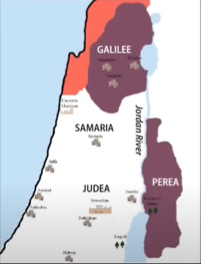
Map: Areas ruled by Herod Antipas the Tetrach 4 bee through 39 ce
In further developments, it is noted that John was executed by Herod Antipas, a successor of Herod the Great. Herod Antipas is referred to as the tetrarch because he governs only the regions of Galilee and Perea. These areas include the location where Jesus resides and the Wilderness of the Jordan, where John is situated. It is a plausible hypothesis, though not definitively confirmed, that Jesus was baptized by John. There is a strong possibility that Jesus initially began his ministry as a disciple of John. Following John's execution, Jesus embarked on his own path, gathering followers and establishing his teachings.
Notably, Jesus diverged from many of John the Baptist's teachings. For instance, Jesus did not adhere to John's ascetic lifestyle, which involved residing in the wilderness, abstaining from certain foods, and practicing fasting. Evidence of this divergence is found in the criticisms directed at Jesus, as recorded in the Gospels. Early Christians often found themselves in the position of having to defend or explain these criticisms.
11. Jesus Rejects John’s Extreme Asceticism 18:33 hms
| 11 Jesus Rejects John’s Extreme Asceticism 18:33 hms |
|---|
| Luke 7:33-35 (from Q): "For John the Baptist has come eating no bread and drinking no wine, and you say, ‘He has a demon’; the Son of Man has come eating and drinking, and you say,‘Look, a glutton and a drunkard, a friend of tax collectors and sinners!'Nevertheless, Wisdom is vindicated by all her children.” |
|
In the Gospel of Luke, Chapter 7, verses 18:40, there is a notable reference to the lost sayings gospel, often referred to as "Q." In this passage, John the Baptist is described as having abstained from bread and wine, leading some to claim he was possessed by a demon. Conversely, the Son of Man, who partakes in eating and drinking, is labeled a glutton and a drunkard, and is criticized for associating with tax collectors and sinners. However, the passage concludes with the assertion that wisdom is ultimately justified by all her children.
This passage presents a critique directed either at Jesus himself or his followers. It suggests that while John the Baptist was admired for his ascetic lifestyle, Jesus faced criticism for his more social approach, which included dining with those considered sinners. The response to this critique implies that regardless of the actions taken, there will always be grounds for complaint.
Furthermore, the text highlights the concept of wisdom as an aspect of the divine, suggesting that both John and Jesus are embodiments of this divine wisdom.
12. Jesus Criticized for lack of Asceticism 20:14hms
| 12 Jesus Criticized for lack of Asceticism 20:14hms |
|---|
| Mark 2:18-20: Now John’s disciples and the Pharisees were fasting, and people came and said to him, "Why do John’s disciples and the disciples of the Pharisees fast, but your disciples do not fast?" Jesus said to them, “The wedding attendants cannot fast while the bridegroom is with them, can they? As long as they have the bridegroom with them, they cannot fast. The days will come when the bridegroom is taken away from them, and then they will fast on that day.” |
In the Gospel of Mark, we encounter another instance of criticism regarding Jesus's perceived lack of asceticism. This account, distinct from previous sources, involves the disciples of John and the Pharisees who were engaged in fasting. Observers approached Jesus with an inquiry: "Why do John's disciples and the disciples of the Pharisees fast, but your disciples do not fast?" This question highlights the societal expectation of ascetic practices, such as fasting, which were seen as a means of self-denial and spiritual discipline.
The narrative suggests that Jesus' ministry did not prioritize extreme asceticism. In response to the inquiry, the apologetic explanation provided is that "the wedding guests cannot fast while the bridegroom is with them, can they? As long as they have the bridegroom with them, they cannot fast. The days will come when the bridegroom is taken away from them, and then they will fast on that day." This response may not have been a direct statement from Jesus but rather a later Christian apologetic addressing the question of why Jesus did not fast, while contemporary Christians might incorporate fasting into their spiritual practices. This explanation is articulated in the Gospel of Mark.
13. Rejecting John's Apocalyptic Literalism? 21:33hms
| 13 Rejecting John's Apocalyptic Literalism? 21:33hms |
|---|
|
In discussing apocalyptic literalism, it is posited that John the Baptist was likely an apocalyptic prophet who preached the imminent literal end of the world. However, this anticipated end did not materialize. If such an event were to occur during John the Baptist's lifetime, it is evident that it did not, as both he and all his contemporaries have since passed away. This outcome represents a prophetic failure. Indeed, all individuals who have predicted the end of the world have invariably been incorrect, reflecting a fundamental misunderstanding of prophecy and cosmic time.
Some historians, such as Bart Ehrman, perceive Jesus as following in the footsteps of John the Baptist as a failed apocalyptic prophet. This perspective is academically defensible and is perhaps the most prevalent interpretation. Nevertheless, there are scholars like John Dominic Crossan who propose that when a prophecy fails, as in the case of John the Baptist's unfulfilled apocalypse, the teachings may persist but undergo a transformation. Instead of a literal interpretation, these teachings may be spiritualized. It is conceivable that Jesus adopted this approach, shifting the focus from a literal apocalyptic prophecy to a more spiritual understanding of the kingdom of God in this life. Certain sayings attributed to Jesus appear to support this interpretation.
14. Teaching Against Apocalyptic Literalism 23:18hms
| 14 Teaching Against Apocalyptic Literalism 23:18hms |
|---|
| Luke 17:20-21 (from Q): Once Jesus was asked by the Pharisees when the kingdom of God was coming, and he answered, “The kingdom of God is not coming with things that can be observed, nor will they say,‘Look, here it is!‘or‘There it is!’ For, in fact, the kingdom of God is among you.” |
|
For instance, drawing from the Sayings Gospel Q, in Luke chapter 17, it is noted that when Jesus was inquired by the Pharisees regarding the arrival of the Kingdom of God, he responded by stating that the Kingdom of God does not arrive with observable phenomena. Furthermore, people will not proclaim, "Look, here it is," or "There it is," for indeed, the Kingdom of God is among you. This statement can be understood as a refutation of a literal interpretation of the Apocalypse. Rather than anticipating the end of the world in a visible manner at a specific point in history, followed by the establishment of a new Kingdom physically present among us, it is instead interpreted that the Kingdom is already spiritually present among us.
15. Spiritualizing Kingdom in Thomas and John 24;12hms
| 15 Spiritualizing Kingdom in Thomas and John 24:12hms |
|---|
|
| Thomas 3:1-3: Jesus said, "If your leaders say to you, ‘Look, the Kingdom of God is in the sky, then the birds of the sky will precede you. If they say to you, ‘It is in the sea,’then the fist will precede you. Rather the Kingdom of God is within you and it is outside you. |
|
In the Gospel of Thomas, a profound sentiment is conveyed in saying three, where Jesus imparts wisdom regarding the nature of the Kingdom of God. He states that if leaders claim the Kingdom is in the sky, then the birds will reach it before humans. Similarly, if it is said to be in the sea, the fish will precede humans. Instead, Jesus emphasizes that the Kingdom of God resides both within and outside of individuals, suggesting a spiritual rather than a literal interpretation.
Furthermore, the primary author of the Gospel of John, as we shall explore through various authors, similarly advocates against a literal understanding of the Resurrection. In the narrative of Lazarus, although Lazarus is physically resurrected, Jesus conveys to Lazarus's sister, Martha, that anyone united with Christ, spiritually integrated into the body of Christ, shall never truly die. This underscores the notion that the spiritual Kingdom and the essence of resurrection are already present among us in a profound, non-literal manner.
16. Spiritual Community of “the Poor” 25:38hms
| 16 Spiritual Community of “the Poor” 25:38hms |
|---|
|
The precise stance of the historical Jesus on the literal end of the world remains a subject of scholarly debate. Multiple academically defensible interpretations exist due to the diverse traditions and perspectives through which we must examine the historical Jesus. However, it is evident that Jesus' primary focus was on establishing a community of spiritual disciples, both female and male, who renounced worldly entanglements such as property and familial obligations. These individuals appeared to lead spiritual lives akin to mendicants or begging monks, reminiscent of those who have divested themselves of all possessions and donated the proceeds to the impoverished.
This lifestyle is comparable to that of Buddhist monks or Franciscan friars today. Jesus' teachings often emphasized the importance of aiding the poor, as illustrated by the narrative of the rich young man whom Jesus advised to sell all his possessions and give to the poor to achieve perfection. The New Testament contains numerous references to the poor, with Jesus and other New Testament writers, such as Paul, frequently addressing this theme. Paul, throughout much of his ministry, collected donations for the impoverished in Jerusalem.
The community that Jesus founded and led, which was later overseen by his brother James in Jerusalem, may have been referred to as "the poor." It is noteworthy that this community was not initially identified as the Christian church. The term "Christian" did not come into use until several decades after Jesus' death, as explained in the New Testament.
17. Jesus Instructs Mendicant Disciples 27:38hms
| 17 Jesus Instructs Mendicant Disciples 27:38 |
|---|
| Luke 9:1-6: Then Jesus called the twelve together and gave them power and authority over all demons and to cure diseases, and he sent them out to proclaim the kingdom of God and to heal the sick. He said to them, "Take nothing for your journey: no staff, nor bag, nor bread, nor money — not even an extra tunic. Whatever house you enter, stay there, and leave from there. Wherever they do not welcome you, as you are leaving that town shake the dust off your feet as a testimony against them.” |
18 Connecting the Kingdom and “the Poor” 30:31hms
| 18 Connecting the Kingdom and “the Poor” 30:31hms |
|---|
| • A few examples of this focus of Jesus’ teachings |
| Luke 6:20 (from Q): "Blessed are you who are poor, for yours is the kingdom of God.” |
| Matthew 6:9-11 (from Q): "Pray, then, in this way: Our Father in heaven, may your name be revered as holy. May your kingdom come. May your will be done on earth as it is in heaven. Give us today our daily bread. And forgive us our debts, as we also have forgiven our debtors... |
19. Roman Execution of the Historical Jesus 31:22hms
| 19 Roman Execution of the Historical Jesus 31:22hms |
|---|
|
It is noted that the historical figure of Jesus concentrated the majority of his activities within his native region of Galilee. However, towards the conclusion of his life, while participating in the Passover Festival in Jerusalem, he became involved in an incident perceived by the Roman authorities as an insurrection. The Gospels provide varying accounts of this event. One account describes a triumphal entry, wherein Jesus is depicted riding a donkey and being hailed as a king, which could be interpreted as a claim to kingship over the Jews, thus posing a potential threat of rebellion.
It is further elaborated that the Romans might have perceived this as a threat, or alternatively, or perhaps concurrently, there was a disturbance in the temple marketplace. In this scenario, Jesus is described as overturning the tables of the money changers, as detailed in the Gospel narratives. Regardless of the specific incident, these actions were sufficient for the Roman authorities to decide upon his arrest. It appears that one of his own followers betrayed him, leading to his arrest and subsequent execution by the Romans. The remaining disciples fled the scene.
Crucifixion, although now closely associated with Jesus, was, in fact, the standard Roman method for dealing with individuals involved in insurrection, runaway slaves, and similar offenses.
20. Continuation of Jesus’ Movement 32:49hms
| 20 Continuation of Jesus’ Movement 32:49hms |
|---|
|
As previously mentioned, the movement persisted in Jerusalem and subsequently came under the leadership of Jesus' brother, James. Similar to John the Baptist, Jesus imparted his teachings to his followers in Aramaic and did not author any texts. Likewise, the group that had been disciples of Jesus continued to adhere to his teachings following his execution. As stated, Jesus' brother led this group, known as the "poor of Jerusalem," for many decades after Jesus' crucifixion.
21. Visions of the Risen Jesus 33:26hms
Slide 21
| 21 Visions of the Risen Jesus 33:26hms |
|---|
|
22. Converting Non-Jews (“Gentiles”) 34:34
Slide 22
| 22 Converting Non-Jews (“Gentiles”) 34:34 |
|---|
|
Paul held the conviction that Jesus' resurrection signified His role as the Messiah, synonymous with the Christ, the Anointed One, and the Savior of the world. Paul was convinced of the occurrence of the resurrection and regarded his spiritual experience as sufficient evidence of this truth. He interpreted this event as a sign that an apocalypse was imminent, a belief he held quite literally. Like John the Baptist, Paul was a literal apocalypticist, anticipating the end of the world within his own lifetime.
In contrast to Jesus' original followers, who were predominantly from the Galilean peasant class—comprising fishermen, farmers, and small craftsmen—Paul was well-versed in Greek rhetoric. This distinction made him the first Christian writer whose works have survived. He took the initiative to convert Greek-speaking individuals who were not Jewish. These individuals, residing in the diaspora, frequented synagogues throughout the Greek-speaking cities of the Eastern Roman Empire. Jewish synagogues, where scriptures were read in Greek, attracted a group known as the God-fearing people. These individuals were interested in Judaism but could not fully participate due to their non-adherence to Jewish law.
Paul proposed that adherence to Jewish law was unnecessary for becoming a Christian, thus introducing a form of Christianity that did not require compliance with Jewish law. This stance led to conflicts with James, Jesus' brother, who was the leader of the Christian movement in Jerusalem. This movement, known as the "poor of Jerusalem," maintained that adherence to the law was essential. Peter and John were also part of James's group, and Paul documented his disagreements with them in his letters.
23. Proto-Christianities in the First Century 37:10hms
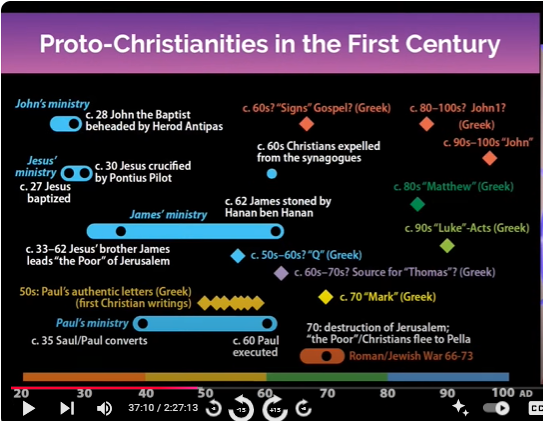
To establish a foundational understanding, we must examine the current state of the movement. Notably, John the Baptist and Jesus are no longer present, leading to the emergence of new leadership. James assumes a pivotal role in guiding the Jewish Christians, while Paul leads the Greek-speaking Gentile Christians, who do not adhere to Jewish law. This divergence has resulted in conflicts between the two groups. This context sets the stage as we approach the period during which the gospels will begin to be composed.
24. Early Triumph of Pauline Christianity 37:53hms
| 24 Early Triumph of Pauline Christianity 37:53hms |
|---|
|
|
To establish a foundational understanding, we must examine the current state of the movement, particularly in relation to its development. With the departure of John the Baptist and Jesus, leadership has transitioned to James, who provides guidance to the Jewish Christians. Concurrently, Paul leads the Greek-speaking Gentile Christians, who do not adhere to Jewish law, resulting in conflicts between these groups. This context sets the stage as we approach the period during which the gospels will begin to be composed.
25. Writings as of the late 60’s 40:02hms
Slide 25

| 25 Writings as of the late 60’s 40:02hms |
|---|
|
As the early Christian generation gradually passed away, the community found itself with limited access to written materials, most of which were in Greek. Within Paul's communities, some individuals preserved his letters, which began to circulate widely. These letters were eventually compiled into collections corresponding to the various locations to which Paul had written, and they started to gain authoritative status.
Simultaneously, in Galilee, there was an effort to gather the sayings of Jesus. This endeavor possibly led to early versions of the Q document, which may have served as a precursor to what later became the Gospel of Thomas. These sayings were also initially recorded in Greek.
Additionally, there is speculation that a small community might have possessed a brief gospel, not widely disseminated, which depicted seven miracles interpreted as signs of Jesus being the Messiah. This so-called "signs gospel" has since been lost. These other texts remain hypothetical and have either been lost or absorbed into other works, with the exception of Paul's letters, which have survived.
26. First Surviving Narrative Gospel 41:21hms
Slide 26
| 26 First Surviving Narrative Gospel 41:21hms |
|---|
|
The initial Christian theologian who undertook the task of composing a relatively extensive theological text concerning the ministry of Jesus may have been familiar with the writings of Paul. It is plausible that this individual had access to some of Paul's letters. However, they did not have access to the Sayings Gospel Q, the Gospel of Thomas, or the Signs Gospel source for John. This theologian was likely part of a community that had preserved certain writings and certainly retained some recollections of Jesus' sayings. These recollections were notably less elaborate than those documented in the Q sayings collection, yet they remained consistent with that tradition.
27. Connection Between Mathew and Mark 42:07hms
| 27 Connection Between Mathew and Mark 42:07hms |
|---|
|
28. The Testimony of Papias of Hierapolis 43:33hms
| 28 The Testamony of Papias of Hierapolis 43:33hms |
|---|
“Matthew put the logia in an ordered arrangement in the Hebrew language, but each person interpreted them as best he could"
|
The hypothesis that the Gospel of Matthew was the earliest text is primarily based on a statement by a second-century bishop named Papias of Hierapolis, a city in Anatolia. Although we do not possess Papias' original writings, his work is quoted by Irenaeus and Eusebius, providing us with a few excerpts. Papias asserts that Matthew compiled the logia—which could refer to teachings or sayings—of Jesus in an ordered arrangement in the Hebrew language, which might also imply the Aramaic language. Each individual, according to Papias, interpreted these as best they could.
Despite Papias' assertion at the beginning of the second century, contemporary literary criticism has definitively established that the text of Matthew was originally composed in Greek, not Aramaic or Hebrew. When a text is written in one language and subsequently translated into another, traces of the original language typically remain evident in the translation. These traces, such as Hebraisms or Semiticisms, are notably absent in Matthew's text, which is composed solely in Greek. Thus, Papias' claim is incorrect.
29. The Testimony of Papias of Hierapolis 45:11hms
| 29 The Testimony of Papias of Hierapolis 45:11hms |
|---|
The Elder used to say: Mark, in his capacity as Peter’s interpreter, wrote down accurately as many things as he recalled from memory — though not in an ordered form — of the things either said or done by the Lord. For he neither heard the Lord nor accompanied him, but later, as I said, Peter, who used to give his teachings in the form of chreiai, but had no intention of providing an ordered arrangement of the logia of the Lord. |
Papias also preserved a second quotation that pertains to Mark and Matthew. In this instance, he cites an informant named John the Elder. It is important to note that many Christians have traditionally misunderstood this reference to mean John the Apostle. However, Papias clearly distinguishes John the Elder as a separate individual from John the Apostle.
John the Elder stated that Mark, in his role as Peter's interpreter, accurately recorded as many events as he could recall from memory, albeit not in a sequential order. These events pertained to the actions and sayings of the Lord. It is crucial to understand that Mark neither heard the Lord directly nor accompanied Him. Instead, as previously mentioned, he was associated with Peter, who conveyed his teachings through brief anecdotes. Peter did not intend to provide a structured arrangement of the logia, or sayings of the Lord.
This account suggests that John the Elder's understanding of the text of Mark, which we now recognize as the Gospel of Mark, is not an eyewitness account. Rather, it implies that Mark served as an interpreter for Peter, a Galilean fisherman who likely spoke Aramaic. Mark, therefore, translated Peter's words into Greek. As Peter spoke, Mark documented these anecdotes without organizing them, which ultimately formed the Gospel of Mark, according to John the Elder's account.
30. The Testimony of Papias of Hierapolis 47:19hms
| 30 The Testimony of Papias of Hierapolis 47:19hms |
|---|
Consequently Mark did nothing wrong when he wrote down some individual items just as he related them from memory. For he made it his one concern not to omit anything he had heard or to falsify anything.
|
I apologize for the continuation of the quote. Consequently, Mark did nothing wrong when he documented certain individual items from memory. His primary concern was to neither omit anything he heard nor falsify any information. He is elucidating why he does not perceive this text to be particularly orderly or chronological. If Papias is indeed referring to the texts we now identify as Matthew and Mark, which is likely, although these texts were originally anonymous and could have been associated with different names, there is a possibility that he was referring to other texts.
Some scholars have posited that when Papias or John the Elder mentions the logia or sayings, he might be referring to the hypothetical Q source, as he may have had access to the sayings gospel. However, if he is indeed referring to what we now call Matthew and Mark, this interpretation is incorrect. If Matthew was the original gospel, then the author of Mark was not an independent companion of Peter, documenting what he heard from Peter. Instead, he would be an editor creating a condensed version of Matthew's gospel. This is because Matthew and Mark are now understood to be interrelated texts, and it is not feasible for Matthew to have had priority in this context.
31. Deleting Parts of Matthew? (But Why?) 48:48hms
| 31 Deleting Parts of Matthew? (But Why?) 48:48hms |
|---|
| If Matthew is the original text, the author of Mark was making the choice to delete huge chunks of that gospel — including sections like the Sermon on the Mount! |
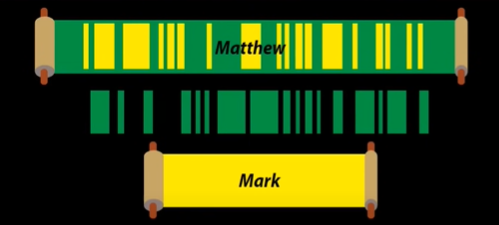
The situation presents a complex issue: if Matthew's text is considered the original, and Mark selectively includes only the portions he favored, such as the highlighted sections, then Mark is intentionally omitting significant content, such as the green sections. This includes narratives like the Christmas story, the birth story, and the resurrection story. Furthermore, Mark excludes pivotal teachings, such as The Sermon on the Mount. This raises questions about the rationale behind Mark's selective transcription of Matthew's work.
Additionally, Mark's approach introduces further complications. He appears to degrade the grammatical quality of the text and inaccurately quotes passages that Matthew had correctly cited from the Septuagint. This inconsistency raises questions about the omission of key elements, such as The Sermon on the Mount, and the motivations behind Mark's editorial choices.
32. Expanding and Correcting Mark 50:04hms
| 32 Expanding and Correcting Mark 50:04hms |
|---|
|

The Condensation Theory, as I have previously mentioned, lacks coherence and is not widely accepted. Consequently, the majority of scholars concur that the Gospel of Mark is indeed the original gospel. It is believed that the author of the Gospel of Matthew had access to Mark's gospel and utilized it as one of his primary sources when composing his own gospel.
33. Papias: Wrong Once Again 50:25hms
| 33 Papias: Wrong Once Again 50:25hms |
|---|
|
In examining the historical accounts, it appears that Papias is frequently regarded as unreliable in his assertions. Eusebius, a notable figure who references Papias, offers a critical perspective, suggesting that Papias was a man of limited intellect, as evidenced by his writings. This skepticism is shared by Eusebius, who, despite quoting Papias, holds a low opinion of his credibility. It is evident that Papias has made numerous errors in his accounts.
Furthermore, the texts in question are not translations from Hebrew or Aramaic. The text we now refer to as the Gospel of Mark is, in fact, anonymous; the author does not reveal his identity within the text, and the manuscripts were initially circulated without a title. It is Papias who attributes the authorship to Mark, proposing that he was a companion of Peter. However, scholars widely concur that this attribution is incorrect.
33. Historical and Biblical Marks 51:26hms
| 34 Historical and Biblical Marks 51:26hms |
|---|
|
There exists some ambiguity regarding the identity of Mark, as there are numerous individuals bearing this name, or perhaps it is a single individual to whom various attributes have been ascribed. In the first century, there was a Christian named Mark, known to us through the writings of Paul, a historical figure. Paul mentions Mark as one of his companions, alongside Barnabas, who is Mark's cousin. In this context, they are companions of Paul, not Peter, which could lead to confusion for Papias if he were to encounter this individual, or it might suggest an entirely different Mark.
In the Book of Acts, which constitutes the latter portion of the Book of Luke, there is mention of a character named John, whose surname is Mark, often referred to as John Mark. It is conceivable that this individual is the same as Barnabas' cousin. However, it is important to note that there is no substantial evidence, aside from conjecture from the second century, to support the claim that the Gospel was authored by a companion of Paul named Mark, a companion of Peter named Mark, or indeed any individual named Mark.
34. Characteristics of the Anonymous Author 52:57hms
|
|---|
|
Given that the traditional attributions are both late and inaccurate, the only reliable source for identifying the author of the Gospel of Mark is the text itself. What insights can we glean about the author from the text?
The author appears to be Greek and relatively less affluent compared to other New Testament writers. A notable characteristic of the author's writing style is the predominant use of the present tense. This suggests a possible lack of familiarity with the complexities of Latin and Greek conjugations and verb tenses, which can be intricate. It is plausible that the author is employing a simplified version of the language, indicative of it being a second language.
Furthermore, the author tends to avoid complex subordinate clauses, opting instead to connect phrases with simple conjunctions such as "and." This stylistic choice results in a narrative that progresses with straightforward, sequential statements.
Additionally, scholars have observed that the geographical references within the text are inaccurate. For instance, as Jesus and the disciples travel from one city to another, the sequence of locations does not align with the actual geography of Judea. This suggests that the author may not be familiar with the Galilee, Palestine, or Judea regions, indicating that he is likely not from there.
35. Characteristics of the Anonymous Author 54:18hms
|
|---|
|
The author of the Gospel of Mark appears to make numerous errors when describing Jewish customs and practices. This suggests that the intended audience was primarily Greek-speaking, largely Gentile Christians. In attempting to explain Jewish customs, the author occasionally misrepresents them, which scholars find improbable for someone who had grown up in Judea or Galilee, where such practices would be well-known.
Furthermore, while the author of Mark extensively utilizes the Greek translation of the Hebrew Bible, known as the Septuagint, as a major source for the text, there are frequent misquotations. This indicates a familiarity with the text, possibly suggesting that the author was a Hellenized Jewish Christian. Such an individual might have attended synagogue regularly and been exposed to these texts throughout their life. However, due to limited access to written texts in the ancient world, the author may have memorized portions incorrectly.
Despite this, the author often misquotes the Bible, implying limited access to the complete texts. It is possible that the author possessed some books of the Bible but not all. Consequently, the precise identity and origin of the author remain uncertain. Scholars generally propose that the author was likely a heavily Hellenized Jewish Christian from the diaspora, not from Galilee or Judea. The most common hypothesis is that the author may have been from Rome, potentially part of the large Roman Christian community. Alternatively, the author could have originated from Syria, a region where Aramaic and Greek were spoken, as evidenced by the author's imperfect Greek.
36. Drawing from Community Tradition 56:40hms
|
|---|
|
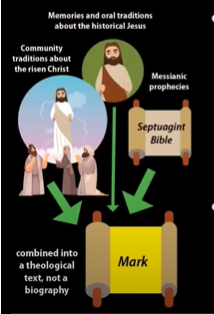
In considering the synthesis of these elements, it is important to note that the author of the Gospel of Mark existed in a period preceding the existence of any written Gospels. This author emerged from a community deeply influenced by the oral testimonies of Christian Apostles. Upon examining the narrative, it becomes evident that Jesus instructs the apostles to embark on their mission, guided by the spirit, without the encumbrance of material possessions. They are to rely on the hospitality of others for lodging and sustenance, subsequently moving on to continue their preaching. This method facilitated the initial dissemination of the movement.
The spread of the movement was largely attributed to mendicant prophet-apostles who, inspired by the spirit, engaged in preaching. A significant aspect of this spiritual preaching involved the apostles sharing visionary experiences they had personally encountered or had learned of from other apostles, particularly those involving the Risen Christ. Within the oral tradition of Mark's community, these spiritual experiences became intricately interwoven with recollections of the historical Jesus. This Jesus, who was active during his lifetime, teaching and engaging with people, became intertwined with the spiritual experiences of Christ in the period following the crucifixion.
37. Sources of the Events in the Gospels 58:10hms
|
|---|
|
The author of the Gospel of Mark, not being an eyewitness, relies on the collective memories of his community and any available writings, which likely included brief accounts of Jesus' life and teachings. These were intertwined with the traditions held by early Christians regarding the Risen Christ. Consequently, the text contains limited details about the historical activities of Jesus.
In instances where the author lacked supplementary material for his narrative, he freely incorporated elements from the Septuagint, the Greek version of the Hebrew Bible. This approach was influenced by Paul's testimony to Christians that Christ lived, died, and rose again in accordance with the scriptures. Thus, any scriptural references to the Messiah, or those perceived as prefigurations of the new Christian era, were considered applicable to Jesus.
The author of Mark felt justified in attributing to Jesus actions described in the Psalms and the prophecies of Isaiah, as these were viewed as Messianic prophecies. This method allowed for the inclusion of such details in the narrative, thereby crafting a theological text that conveys the good news: Christ is the Messiah and Lord. It is important to note that this work is not intended as a biography or a historical account.
38. An Apocalyptic Literalist 1:00:02hms
|
|---|
|
Mark 13:1-2: As Jesus came out of the temple, one of his disciples said to him, "Look, Teacher, what large stones and what large buildings!" Then Jesus asked him, “Do you see these great buildings? Not one stone will be left here upon another; all will be thrown down.” |
A notable characteristic of the author of the Gospel of Mark, which holds significant importance, is his alignment with figures such as John the Baptist and Paul as an apocalyptic literalist. The author of Mark held the belief that the world was destined to end imminently. Furthermore, he was convinced that the apocalypse had already commenced at the time of his writing. This perspective is particularly evident in Chapter 13 of the Gospel of Mark, which scholars refer to as the "Little Apocalypse."
In Mark Chapter 13, we read: As Jesus departed from the temple, one of his disciples remarked, "Look, Teacher, what large stones and what large buildings!" referring to the magnificent temple of Herod the Great. Jesus then responded, "Do you see these great buildings? Not one stone will be left here upon another; all will be thrown down." This passage serves as a prediction of the temple's destruction.
40. Destruction of the Temple a Sign 1:01:05 hms
|
|---|
|
Mark 13:3b-4: Peter, James, John, and Andrew asked him privately, "Tell us, when will this be, and what will be the sign that all these things are about to be accomplished?" Then Jesus began to say to them, "...When you hear of wars and rumors of wars, do not be alarmed; this must take place, but the end is still to come.” |
The Romans demolished the Jerusalem Temple in the year 70 ce, during the First Roman-Jewish War, which spanned from 66 to 73/74 CE/AD. In the Gospel of Mark, chapter 13, the destruction of the temple is portrayed as an indication that the end times have commenced. As the narrative progresses in the so-called "Little Apocalypse," Peter, James, John, and Andrew privately inquire of Jesus, "Tell us, when will this occur, and what will be the sign that all these things are about to be fulfilled?" For those who adhere to apocalyptic beliefs, it is essential to recognize all the signs of the end times to ascertain that they have indeed begun. Jesus then commenced to instruct them, stating, "When you hear of wars and rumors of wars, do not be alarmed; this must occur, but the end is not yet." Thus, when the Romans engaged in conflict with the Jews during the late 60s and early 70s, it was perceived as a necessary event preceding the imminent end.
41. Destruction of the Temple a Sign 1:02:06hms
|
|---|
Mark 13:14,24-26: "But when you see the desolating sacrilege set up where it ought not to be (let the reader understand), then those in Judea must flee to the mountains..." [After more signs relating to the war, he concludes]... “But in those days, after that suffering, the sun will be darkened,and the moon will not give its light, and the stars will be falling from heaven, and the powers in the heavens will be shaken. Then they will see the Son of Man coming in clouds with great power and glory..." |
In the Gospel of Mark, Jesus proclaims that in those days, following the period of suffering, the sun will be darkened, the moon will cease to emit light, and the stars will fall from the heavens, causing the celestial powers to be shaken. Subsequently, they will witness the Son of Man arriving in the clouds with immense power and glory. This event, though yet to transpire, is a prediction of the world's end and the glorious return of Christ, the Son of Man.
42. Reinterpreting the Apocalypse of Daniel 1:03:25hms
|
|---|
|
Daniel 7:13-14: I saw one like a son of man coming with the clouds of heaven... To him was given dominion and glory and kingship, that all peoples, nations, and languages should serve him. |
The apocalyptic vision of one resembling a "son of man" arriving with the clouds is derived from the Book of Daniel, Chapter 7. The author of this text was a prominent, albeit unsuccessful, apocalyptic prophet from the Second Temple period. He composed his work during a tumultuous era when the Seleucids were assaulting Jerusalem and threatening the Maccabean kingdom. He prophesied that the end of the world would occur shortly after his own time. The Book of Daniel was penned around 164 BC, following the desecration of the temple by the Seleucid King Antiochus IV Epiphanes.
In the Book of Daniel, the vision is described as follows: "I saw one like a son of man coming with the clouds of heaven. To him was given dominion, glory, and kingship, that all peoples, nations, and languages should serve him." This figure, referred to as the "son of man," is identified as the Savior or Messiah, whose arrival is imminent. The sign of this impending event is the desecration of the temple by Antiochus IV Epiphanes.
However, the prophecy did not come to fruition, marking it as a failed prediction. The text was not authored by Daniel himself but by an anonymous writer who assumed his identity. Although set centuries earlier, the prophecy was intended to predict the author's contemporary period. The prediction ultimately proved inaccurate as the world did not end. Despite this, the prophecy remains popular, with individuals attempting to reinterpret it for the 21st century or future dates based on new calculations.
The prophecy originally referred to the year 164 BC, and the author of the Gospel of Mark later reinterpreted it to refer to the year 70 AD. This reinterpretation is considered a misinterpretation or a new interpretation of the original prophecy. Ultimately, this reflects the folly of literal apocalypticism.
43. The End will Happen in the 1st Century 1:05:35hms
|
|---|
| The prediction by the author of Daniel having failed, the author of Mark has changed the calculus believing that the end is now actually going to happen in his own day; he therefore has Jesus promise the disciples: |
Mark 13:29-31: "So also, when you see these things taking place, you know that it is near, at the very gates. Truly I tell you, this generation will not pass away until all these things have taken place. Heaven and earth will pass away, but my words will not pass away.” |
The author of the Book of Daniel's predictions did not come to fruition, prompting the author of the Gospel of Mark to reassess the situation. The latter believed that the culmination of events would occur within his own era. He extends this belief further by having Jesus assure the disciples:
"So also, when you see these things taking place, you know that the time is near, at the very gates. Truly, I tell you, this generation will not pass away until all these things have taken place. Heaven and Earth will pass away, but my words will not pass away."
Thus, Jesus is depicted as promising that the end of the world would occur within the first generation of Christianity. However, this prophecy did not materialize, rendering it inaccurate.
44. The Author of Mark’s Unique Christology 1:06:18hms
| 44 The Author of Mark’s Unique Christology 1:06:18hms |
|---|
|
The author of the Gospel of Mark composed his work during the period of the First Roman-Jewish War. He held the belief that this era marked the commencement of the end times, anticipating the return of Jesus in the clouds. This perspective is notably distinct, as it revives the apocalyptic themes found in the Book of Daniel. Unlike Paul and other early Christians, whose faith was rooted in visions of the Risen Christ, the author of Mark did not subscribe to the belief that Christ had already returned. Consequently, he chose not to include narratives of the Risen Christ appearing after the crucifixion. For him, Christ's return would be a future event, characterized by His arrival in the clouds and glory as the Son of Man, as depicted in Daniel.
45. The Gospel of mark’s Unsatisfying Ending 1:07:07hms
| 45 The Gospel of mark’s Unsatisfying Ending 1:07:07hms |
|---|
|
It is noted that due to the author's distinctive belief that Jesus had not yet returned but was expected to do so imminently, the Gospel of Mark concludes without any visions of the Risen Christ. Instead, the narrative describes an encounter between Jesus' female disciples and a man in an empty tomb, which leaves them so frightened that they depart without speaking to anyone. This original, brief conclusion of the Gospel of Mark significantly diverged from the broader Christian understanding of the story.
The question arises: how did Christianity proliferate if the women did not communicate their experience? Other Christian communities retained memories of Christ appearing to various disciples at different times, which contrasted with Mark's account. Many Christians found Mark's version unsatisfactory, as evidenced by early manuscripts where additional endings were appended to alter the conclusion. These include both a longer and a shorter added ending. Typically, older Bibles present the extended ending as if it were the definitive conclusion of the Gospel of Mark.
Furthermore, at least two early Christians from the first century found Mark's account so objectionable that they composed their own texts in an attempt to supplant it.
46. Visions of the Risen Christ according to Paul 1:08:45hms
| 46 Visions of the Risen Christ according to Paul 1:08:45hms |
|---|
1 Cor. 15:3-8 3 For I handed on to you as of first importance what I in turn had received: that Christ died for our sins in accordance with the scriptures4 and that he was buried and that he was raised on the third day in accordance with the scriptures 5 and that he appeared to Cephas, then to the twelve. Then he appeared to more than five hundred brothers and sisters at one time, most of whom are still alive, though some have died. 7Then he appeared to James, then to all the apostles. 8 Last of all, as to one untimely born, he appeared also to me. |
I would like to reiterate a point made by Paul, our earliest Christian writer. His dissemination of the Christian message, often referred to as the "good news," is fundamentally rooted in the concept of Christ's appearance to the disciples. In his epistle to the Corinthians, Paul states,
"I handed on to you as of first importance what I in turn had received: that Christ died for our sins in accordance with the scriptures, that he was buried, and that he was raised on the third day in accordance with the scriptures, and that he appeared to Cephas, which is another name for Peter, and then to the Twelve. Subsequently, he appeared to more than 500 brothers and sisters at one time, most of whom were still alive at the time of Paul's writing, although some had passed away."
Furthermore, Paul acknowledges that Christ appeared to James, the brother of Jesus, and then to all the Apostles, indicating that the group of Apostles was more extensive than merely the Twelve. Lastly, Paul notes, "As to one untimely born, he also appeared to me," thereby providing his firsthand testimony of having experienced a vision of Christ.
47. Resurrection Makes Jesus the Son of God 1:09:59hms
| 47 Resurrection Makes Jesus the Son of God 1:09:59hms |
|---|
|
According to Paul's interpretation, Jesus was proclaimed to be the Son of God with power, in accordance with the spirit of holiness, by His resurrection from the dead. This same concept regarding the Risen Christ is also found in the Book of Acts , where it is stated that God raised Him from the dead. Furthermore, it is written in the Second Psalm, "You are my Son; today I have begotten you." This may represent the earliest Christian understanding that Jesus becomes the begotten Son of God upon His triumph over death, through His resurrection by God.
48. What to Do with Visions of the Risen Christ? 1:10:50hms
| 48 What to Do with Visions of the Risen Christ? 1:10:50hms |
|---|
|
What course of action was Mark intending to pursue? He was cognizant of the various visions circulating among the Christian community. He was aware that these topics were widely discussed among other Christians, and he had indeed encountered these traditions. However, as I have mentioned, they stand in opposition to his Christology. Mark's perspective was that Christ would return imminently, coinciding with the end of the world. Consequently, he might have been exposed to narratives concerning the Risen Christ appearing to disciples, perhaps as an apparition or in events such as walking on the Sea of Galilee. Additionally, there were accounts of the Risen Christ appearing to Peter, James, and John on a mountain, or being seen at the right hand of God. Furthermore, there were visions of Jesus with the Spirit descending upon him as a dove, accompanied by God's proclamation, "I have begotten you this day," which pertains to a resurrection or post-resurrection vision.
49. Mark’s Retrojection into the life of Jesus 1:11:53hms
| 49 Mark’s Retrojection into the life of Jesus 1:11:53hms |
|---|
|
Instead of disregarding these well-known reports, the author of the Gospel of Mark incorporates these visions of the Risen Christ into the narrative. This material concerning Jesus is valuable, yet the author chooses to integrate it into the life of Jesus prior to His crucifixion, as he wishes to avoid depicting any appearances of Jesus following His crucifixion. Consequently, in the revised narrative as presented by Mark, Jesus is depicted as walking on water before His crucifixion. The depiction of the Holy Spirit descending upon Christ as a dove is similarly retrojected into the baptism story of Jesus, among other instances. While this may not reflect the actual sequence of events, it provides an explanation for why language such as "I have begotten you this day" is associated not only with the resurrection appearances of Jesus, as seen in the Acts of the Apostles, but also with events during His lifetime.
50. Visionary Experiences Now in Jesus; Life 1:12:48hms
| 50 visionary experiences Now in Jesus; Life 1:12:48hms |
|---|
|
51. Retrojected Visions of Christ in Mark 1:13:00hms
| 51 Retrojected Visions of Christ in Mark 1:13:00hms |
|---|
|
All of the visions that occur in Mark's text prior to the crucifixion draw upon God's voice from a version of the second Psalm: "You are my son; today I have begotten you." As noted, Acts 13 references this in association with a vision of the Risen Christ. It is plausible, therefore, that Mark's distinctive opposition to the notion that Christ has already returned fundamentally alters the narrative of Jesus' ministry. This is particularly significant as Mark is the first individual to compose a narrative gospel.
52. An Unsatisfying (Rejected) Ending 1:13:34hms
| 52 An Unsatisfying (Rejected) Ending 1:13:34hms |
|---|
|
As previously mentioned, the conclusion of the Gospel of Mark was so unsatisfactory that at least two anonymous disciples composed epilogues . These new endings were subsequently appended to manuscripts of Mark. Furthermore, two additional Christian evangelists completely reworked the text of Mark, incorporating another source, the Lost Sayings Gospel, to create their own rendition of the narrative.
53. Timeline: Proto-Christianities in the First Century 1:14:02
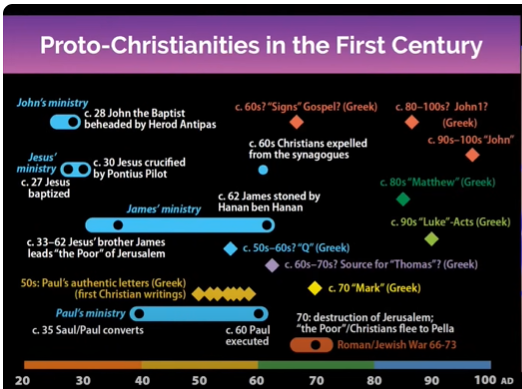
The timeline above indicates that around the 50s and 60s, the "lost gospel" known as Gospel Q existed. By the 70s, Mark's Gospel was present. Subsequently, the authors of Matthew and Luke began writing their texts.
54. Composition of Matthew and Luke 1:14:21hms
| 54 Composition of Matthew and Luke 1:14:21hms |
|---|
The two source hypothesis for solving the synoptic problem
|
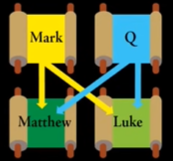
the next evangelist set out to write their gospels in the 80s or the 90s they had more sources available than Mark did again although they're later attributed to Matthew and Luke these are Anonymous they're not written by eyewitnesses both authors had access to mark and they had access to another similar source which we now which we don't have anymore but is now labeled Q by Scholars or at least this is the hypothesis that is most accepted it's hard to imagine how how the other
(1:14:56) hypotheses that have all been imagined are seem very much more unlikely
55. Matthew and Luke’s Use of Mark and Q 1:15:01hms
56. Who Was mark? 1:16:34hms
| 56 Who Was mark? 1:16:34hms |
|---|
|
In the context of early Christian tradition, the assignment of authorship to the anonymous gospels is a subject of considerable interest. Among these authors, Mark and Luke are notable for not being included among the twelve apostles. Consequently, even traditional accounts do not regard Mark as an eyewitness to the life of Jesus. As previously discussed, Mark was certainly not John. In contrast, John and Matthew are included in the traditional lists of apostles.
There is historical evidence of John's existence, supported by Paul's testimony, which confirms that Paul met John, who was a prominent leader in the church during Paul's time. However, regarding the Apostle Matthew, there is scant information available beyond legendary traditions, which are not well-documented or substantiated.
57. Matthew (Not a Publican or an Evangelist) 1:17:25hms
| 47 Matthew (Not a Publican or an Evangelist) 1:17:25hms |
|---|
|
In the earliest gospel, Mark, although Matthew is listed among the Apostles, there are no narratives specifically about him. Instead, Mark recounts a story involving an individual named Levi, who is identified as a publican and tax collector. Levi is described as the son of Alphaeus. Interestingly, in the Gospel of Matthew, Levi's name is altered to Matthew. Consequently, Matthew, listed among the Apostles, becomes conflated with Levi the Publican due to the editorial choices made by the author of the Gospel of Matthew.
This editorial decision does not provide any evidence that the gospel was authored by Matthew himself. Notably, when Jesus encounters this tax collector in the Gospel of Matthew, the narrative does not shift to the first person, nor is there any particular indication that the author is the same individual. The author has merely modified the name of a character from a story found in Mark's gospel, aligning it with the name of the Apostle.
58. Not an Eyewitness Text / Not Matthew 1:18:47hms
| 58 Not an Eyewitness Text / Not Matthew 1:18:47hms |
|---|
|
The author of the text attributed to Matthew appears to have relied heavily on the Gospel of Mark. This reliance suggests that the author was not an eyewitness, as an eyewitness would not need to depend on another's account, particularly when Mark himself was not an eyewitness and much of his account lacks historical accuracy. If the author had indeed been one of the apostles, the narrative would likely have been quite different, not merely an expansion of Mark's text.
Therefore, the Gospel attributed to Matthew is also an anonymous work, composed by an unknown Jewish Christian, likely in the 80s or 90s CE. The title "According to Matthew" was appended to the text in the second century. This attribution is supported by Papias, who has been previously mentioned. Papias' writings have led to the mistaken belief that the Gospel was originally composed in Hebrew or Aramaic and subsequently translated into Greek, and that it was the first Gospel written. However, this is not the case.
59. What the Gospel Tells Us About the Author 1:19:53hms
| 59 What the Gospel Tells Us About the Author 1:19:53hms |
|---|
Matthew’s editorial decisions give us insight into his community
|
Once again, our understanding of the author of Matthew must be derived from textual clues. It is evident that the Greek used in Matthew is of a higher quality than that found in Mark. Furthermore, Matthew corrects Mark's scriptural misquotations. For instance, Matthew enhances the text by adding verb tenses and subordinate clauses, resulting in more elaborate language. Whenever Mark misquotes scripture, Matthew discreetly amends it.
In Mark's text, Jesus lists the Commandments and, while enumerating several of the Ten Commandments, includes an additional commandment: "Thou shalt not defraud." Matthew quietly omits this, thereby rectifying the errors made by the author of Mark, who appears less familiar with the scriptures. The author of Matthew likely had access to the Septuagint, as he is able to quote it accurately and incorporates it extensively into his own material.
The primary editorial objective of the author of Matthew is to demonstrate that Jesus is the fulfillment of various Messianic prophecies as interpreted from the Hebrew Bible.
60. The Most Jewish Christian Gospel 1:21:24mhs
| 60 The Most Jewish Christian Gospel 1:21:42mhs |
|---|
Matthew’s community continues to observe Jewish Law
|
Matthew demonstrates a superior understanding of Jewish law and customs compared to the other evangelists. It has been noted that Mark, in his descriptions of Jewish customs, frequently errs. Similarly, Luke appears to be less informed about contemporary Jewish practices, despite being well-versed in the Septuagint. Furthermore, the Gospel of John presents additional challenges. It was composed at a time when Christians had sufficiently distanced themselves from Second Temple Judaism, to the extent that they no longer regarded themselves as a Jewish sect. Consequently, the Gospel of John portrays Jesus as speaking about the Jews as if they were a distinct group, which is an anachronism not present in the Gospel of Matthew.
The author of Matthew is likely a well-educated, Greek-speaking Christian of Jewish descent, residing within a Christian community that continues to adhere to Jewish law. In this context, Matthew's portrayal of Jesus emphasizes the continuity of Jewish law, as evidenced by the statement: "Do not think that I have come to abolish the law or the prophets." Thus, Christians within the Matthean community are expected to persist in observing Jewish law.
61. Who Was Luke 1:22:51hms
| 61 Who Was Luke 1:22:51hms |
|---|
|
Who was Luke? From our understanding, the same author is responsible for both the Book of Luke and the Book of Acts, making this individual one of the most prolific authors in the New Testament, alongside Paul. Historically, Luke is noted as a companion of Paul, who mentions him on several occasions. Paul refers to this individual, the historical Luke, as the "Beloved Physician." By the late second century, Christians attributed the third gospel to this historical figure, Luke.
62. Luke the Physician? 1:23:35hms
| 62 Luke the Physician? 1:23:35hms |
|---|
Some details unique to L seem to convey a medical perspective: Only in Luke is the story of Jesus healing a woman with what might be severe osteoperosis (Luke 13:10-13) Only in Luke do we have a description of fetal "quickening" during a pregnancy (Luke 1:41) |
# Analysis of Lucan Material
Numerous individuals have posited that the unique details found exclusively in the Lucan material appear to convey a medical perspective, which seems logical.
For instance, it is noted that the Gospel of Luke includes the narrative of Jesus healing a woman who may have been suffering from severe osteoporosis, as she is described as being bent over in Luke 13. Additionally, Luke provides a description of fetal quickening, which refers to the sensation of a baby kicking during pregnancy, as mentioned in Luke 1.
63. Luke Concerned with Woman 1:24:13hms
| 63 Luke Concerned with Woman 1:24:13hms |
|---|
|
Luke exhibits significant concern regarding various issues, particularly when examined from a perspective that does not solely focus on his role as a physician. Notably, Luke demonstrates a keen interest in matters pertaining to women and women's issues. These concerns encompass, but are not limited to, health-related topics such as osteoporosis and pregnancy. Furthermore, upon closer examination, it becomes evident that Luke frequently employs terms such as "womb" more often than the other evangelists.
64. Luke as Paul’s Companion 1:24:48hms
| 64 Luke as Paul’s Companion 1:24:48hms |
|---|
|
65. Consensus Against “Luke” as the Author 1:25:28hms
| 65 Consensus Against Luke as the Author 1:25:28hms |
|---|
|
In the book of Acts, the author consistently refrains from using the first-person pronouns "I" and "me," and does not provide an explanation for the use of "we" in the so-called "we passages." Furthermore, the name Luke is never mentioned by the author. Additionally, the author of Luke presents narratives that contradict Paul's own accounts of his activities. Consequently, the book of Acts does not align with the historical accounts of Paul. Notably, Acts also omits the title "Apostle" for Paul, a designation he emphatically claims in his own writings.
While it is evident that the author of Acts holds Paul in high regard, the portrayal likely reflects a figure who had already become legendary by the time of writing. The identity of the author remains uncertain, and scholarly consensus generally dismisses the notion of Luke as the author. Thus, we are left with an anonymous text, necessitating a close examination of the text itself to glean insights into the author's identity.
66. The Author’s Dedication 1:26:32hms
| 66 The Author’s Dedication 1:26:32hms |
|---|
The Author’s Dedication "The author to Theophilus: Many writers have undertaken to draw up an account of the events that have taken place among us, following the traditions handed down to us by the original eyewitnesses and servants of the Gospel. And so I in my turn, your Excellency, as one who has gone over the whole course of these events in detail, have decided to write a connected narrative for you, so as to give you authentic knowledge about the matters of which you have been informed." —Luke 1:1-4 |
The author is regarded as our most eloquent Greek writer, renowned for employing extensive Greek rhetoric, including an author's dedication. At the outset, the author addresses Theophilus, a name that could refer to an individual, a patron, or symbolically to those who love God, as "Theophilus" translates to "lover of God" in Greek. Numerous writers have endeavored to compile an account of the events that have transpired among us, adhering to the traditions passed down by the original eyewitnesses and servants of the gospel.
As such, I, in my capacity, Your Excellency, having meticulously reviewed the entire sequence of events, have resolved to compose a coherent narrative for you. This is intended to provide you with authentic knowledge concerning the matters of which you have been informed.
Here, Luke acknowledges that the author, referred to simply as "the author," does not claim to be an eyewitness. Instead, the author admits to relying on traditions handed down from those who were eyewitnesses. The author notes that while many writers have attempted to document these events, they intend to produce a superior, authentic version. This implies a certain dissatisfaction with the existing texts, particularly those attributed to Mark.
67. Implications of the Dedication 1:28:00hms
| 67 Implications of the Dedication 1:28:00hms |
|---|
The author didn’t like Mark
|
The author of Matthew has reviewed previous texts attributed to Mark and concluded that they do not provide a cohesive narrative. Furthermore, they fail to convey genuine knowledge. Consequently, the author expresses dissatisfaction with Mark and is endeavoring to amend and eliminate the influence of Mark.
68. Revising Mark’s “Inauthentic” Account 1:28:20hms
| 68 Revising Mark’s “Inauthentic” Account 1:28:20hms |
|---|
|
As previously mentioned, Mark's writing is characterized by its poor Greek and frequent misquotations of scripture. In contrast, Luke employs a more sophisticated Greek, enhancing Mark's grammatical structure. Similar to Matthew, Luke corrects all of Mark's quotations. However, unlike Matthew, who retains almost all of Mark's content, Luke omits approximately one-fifth of Mark's material.
69. Gaps in Luke’s Knowledge 1:28:39hms
| 69 Gaps in Luke’s Knowledge 1:28:39hms |
|---|
|
Luke demonstrates a profound knowledge of the Septuagint, the Greek translation of the Hebrew Bible. However, he appears to lack familiarity with the geography of Palestine. It seems that, unlike Mark, Luke is not a native. He does not fully grasp contemporary Jewish practices, often resorting to archaisms. This indicates that Luke's understanding of Judaism is primarily derived from the Old Testament, which predates the practices of the Second Temple period by several centuries.
It is plausible that Luke might be a Hellenized Jew, possessing limited knowledge of contemporary Jewish customs. Alternatively, he could be a member of a non-Jewish Christian community, possibly one of the Pauline communities, who relies on the Old Testament for insights into Jewish practices, as noted at the timestamp (1:29:24).
70. From Consensus to beyond consensus 1:29:34hms
| 70 From Consensus to beyond consensus 1:29:34hms |
|---|
General consensus, author of Luke:
But was the author a woman? |
There is a prevailing consensus among scholars that Luke is not the author of the Gospel of Luke. It is believed that Luke was neither the physician nor a companion of Paul, and certainly not an eyewitness. The author is thought to have been a native Greek speaker, well-versed in rhetoric, and not from Palestine. It is speculated that the author may have originated from the Aegean region, possibly Anatolia or Greece, in what is now Western Turkey. The author was likely a Christian from a non-Jewish background.
Furthermore, some scholars have proposed an intriguing hypothesis, though it remains unproven, regarding the author's gender. Given the author's evident interest in women's issues, it has been suggested that the author might have been a woman. Randall McGraw-Helms has written an excellent book on this subject, which I highly recommend. It is a concise and accessible read, and he presents a compelling argument. Personally, when considering the author of Luke, I am inclined to think of the author as female. While I typically refer to the author of Mark as "he," in the case of Luke, I prefer to use "they" or "she."
Helms' book, which I strongly recommend, is titled "Who Wrote the Gospel?"
71. Use of Key Terms by the Authors 1:30:51hms
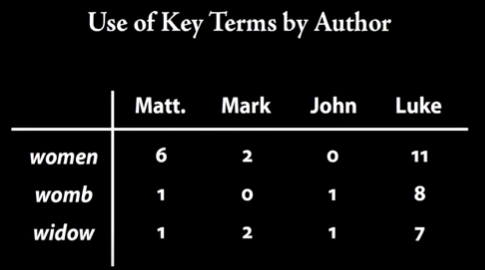
In Helms's study, it is noted that, for instance, the Gospel of Luke references women significantly more than the Gospel of John, where the term "woman" or "women" is not mentioned at all. Specifically, Luke mentions the word "women" 11 times, Matthew six times, and Mark twice. The term "womb" is cited by Luke eight times, while it is never mentioned by Mark and only once each by Matthew and John. Furthermore, the word "widow" appears seven times in Luke, once each in Matthew and John, and twice in Mark. This suggests, at least to me, that Matthew may have intentionally omitted a reference to "widow."
72. More Female characters 1:31:26hms
| 72 More Female characters 1:31:26hms |
|---|
More Female Characters Female characters in Luke/ Acts include: Elizabeth, Mary, Anna, the widow of Sarepta, the widow of Nain, Joanna, Susanna, Mary Magdalene, the sinner with the bottle of myrrh, Mary and Martha, the woman who lost a coin, the widow badgering the unjust judge, the Queen of Sheba, Mary the mother of James, John Mark’s mother, Sapphira, Rhoda, Lydia, Tabitha, Damaris, Priscilla, Philip’s four daughters, ‘Paul’s sister, Drusilla, Bernice |
There are significantly more female characters in the books of Luke and Acts. The characters marked with an asterisk are exclusive to the book of Luke. These include:
- Elizabeth
- Anna
- The Widow of Zarephath
- The Widow of Nain
- Joanna
- Susanna
- The woman who lost a coin
- The widow persistently appealing to an unjust judge
- John Mark's mother
- Sapphira
- Rhoda
- Lydia
- Tabitha
Additionally, the following characters are exclusive to the book of Acts:
- Damaris
- Philip's four daughters
- Paul's sister
- Drusilla
- Bernice
These characters contribute to a notable increase in the representation of female figures within the New Testament.
73. A Focus on Mary (Instead of Joseph) 1:32:01hms
| 73 A Focus on Mary (Instead of Joseph) 1:32:01hms |
|---|
The Annunciation only in Luke.
|
In the context of the Nativity narratives, it is important to note that the original source, Mark's Gospel, does not contain a Christmas story. Consequently, the Christmas narratives were crafted by the authors of the Gospels of Matthew and Luke, each reflecting their distinct editorial perspectives.
Matthew's Nativity narrative emphasizes the role of an angel appearing to Joseph, thereby positioning Joseph as the central figure. In contrast, Luke's account features an angel appearing to Mary, making Mary the focal character. Notably, only in Luke's Gospel does the Magnificat speech appear, with the phrase "blessed art thou among women, blessed is the fruit of thy womb," underscoring the emphasis on Mary, who cherishes the good news in her heart.
In Matthew's narrative, as previously mentioned, angels consistently appear to Joseph in dreams, reinforcing his prominence as the main character in the Christmas story.
74. Only in Luke: The Story of Elizabeth 1:32:46hms
| 74 Only in Luke: The Story of Elizabeth 1:32:46hms |
|---|
|
In the Gospel of Luke, we are presented with the account of Elizabeth, whom Hulu portrays as the mother of John the Baptist. Elizabeth, like Hannah from the Septuagint's account in the Book of Samuel, had long been unable to conceive. This narrative is likely modeled on Hannah's story, where she is the mother of Samuel.
In this context, even within the Christmas narrative, there is a significant moment where John and Jesus encounter each other prior to their births, while still in the womb. Anna recounts this event, noting that "the child in my womb leapt for joy."
75. Only in Luke: The Story of Mary and Martha 1:33:20hms
| 75 Only in Luke: The Story of Mary and Martha 1:33:20hms |
|---|
| Luke ahne tells the story of Martha attending to the tasks of being a host, while her sister Mary sits at Jesus’ feet listening to his words (tasks = “diakonien") |
In the Gospel of Luke, we find the remarkable narrative of Mary and Martha, which is exclusive to this text. The story unfolds with both sisters hosting Jesus. While Martha is diligently attending to the various physical responsibilities associated with hosting, her sister Mary is seated at Jesus' feet, attentively listening to His teachings. The tasks Martha is performing are described by the term diaconian, which signifies the role of a deaconess. In the early Christian community, women indeed served as deaconesses. However, in this particular instance, the narrative highlights the superior choice, which is to assume the role of a disciple. Mary exemplifies this by choosing to listen to Jesus' words.
76. Male / Female pairings in Luke / Acts 1:34:03hms
| 76 Male / Female pairings in Luke / Acts 1:34:03hms | |
|---|---|
| Anna and Simeon | Prophetess/Prophet in Temple |
| daughter of Jairus son of widow of Nain | Children resurrected by Jesus |
| Queen of Sheba & Jonah | Will appear to judge this generation |
| Cornelius and Lydia | Peter converts the first Gentile man in Asia Paul converts the first Gentile woman in Europe |
In the books of Luke and Acts, there exists a notable tradition of pairing male and female figures. This is particularly evident in the Gospel of Luke, where Jesus is presented at the temple as an infant. At this event, He is encountered by two elderly prophets: Simeon, a male prophet, and Anna, a female prophet. Both individuals bear witness to having seen the Messiah.
Furthermore, the narrative includes instances of children being resurrected by Jesus, specifically the daughter of Jairus and the son of the Widow of Nain. This pairing of a male and female child underscores the theme of inclusivity.
Additionally, the Queen of Sheba and Jonah are mentioned as figures who will judge the current generation. In the Acts of the Apostles, Peter is noted for converting the first Gentile man in Asia, Cornelius, while Paul converts the first Gentile woman in Europe, Lydia. These stories collectively highlight the inclusion of both genders in the early Christian community, emphasizing that both men and women are empowered to prophesy and preach within the framework of early Christianity as depicted in Luke and Acts.
77. Luke’s Message Regarding Women 1:35:28hms
| 77 Luke’s Message Regarding Women 1:35:28hms |
|---|
Was Luke a woman?
|
In the Book of Acts, Peter asserts that both men and women will engage in prophecy. Luke corroborates this assertion through narratives involving figures such as Elizabeth, Mary, Anna, and the widow afflicted with osteoporosis. Furthermore, Luke highlights the contributions of women to the church, both through their service as deacons and their financial donations.
It is evident that Luke's text serves as a direct counter to the patriarchal perspectives prevalent in the early church, which argued against the notion of women preaching within the church.
78. In Sum, Luke’s Focus on Women 1:36:05hms
| 78 In Sum, Luke’s Focus on Women 1:36:05hms |
|---|
|
It is suggested that women should refrain from speaking in church, yet the Gospel of Luke provides considerable focus on women. Luke demonstrates a keen interest in women's issues, incorporating more female characters who play significant roles. These characters are often paired with male counterparts of equal importance. Scholars, such as Randall Helms, have proposed that Luke's particular interest in widows may suggest that the author is a widow herself. This widow is possibly an older, affluent Gentile who has undertaken the task of writing this text.
Another theory posits that there is an elderly, wealthy Christian widow within a Greek-speaking Gentile community who is sponsoring a younger male Christian writer. This writer, aware of his patron's interest in stories about widows and similar narratives, includes such stories in his work. For instance, he knows she appreciates the story of Elijah and the widow, and thus, he crafts a similar narrative for Jesus in Luke's Gospel.
While the true circumstances remain uncertain, this theory presents an intriguing case. It is one of the reasons why I hold a particular fondness for the Gospel of Luke and the Acts of the Apostles.
79. Proto-Christianities in the First Century 1:37:22hms
Thus, we have concluded our examination of the Synoptic Gospels and related texts. As we return to our timeline, we observe an event occurring at the forefront: the possibility of a "Signs Gospel" being incorporated into an early version of the Gospel of John.
80. A Very Different Gospel 1:37:46hms
| 80 A Very Different Gospel 1:37:46hms |
|---|
The Gospel of John Has It’s Own Tradition.
|
By the conclusion of the first century, the Gospel of John had assumed the form in which we recognize it today. The author of the Gospel of John does not appear to have had access, or at least direct access, to the Gospel of Mark or the hypothetical source known as Q. However, there is a peculiar overlap in the narratives concerning the Passion. It is possible that the author was well-acquainted with the Passion narrative, particularly the Easter component, which constitutes the final third of Mark's Gospel leading up to the crucifixion. Even if they were not directly working with the text, they may have comprehended the tradition, suggesting that a common tradition was being conveyed.
What the Gospel of John shares with the Synoptic Gospels is its anonymity. This often surprises individuals, as there is a verse within the Gospel of John that appears to identify the text as the testimony of Jesus' beloved disciple. Many interpret this to mean that the beloved disciple is John, leading to the assumption that John authored the text. However, upon closer examination of the verses, it becomes evident that they convey an entirely different meaning.
81. Who Was John (The Historical Apostle) 1:39:05hms
| 81 Who Was John (The Historical Apostle) 1:39:05hms |
|---|
Paul confirms that there was a historical John the apostle
|
The text attributes certain events to John, who is identified as the historical apostle. Following a profound spiritual encounter with the Risen Christ, Paul regarded himself as an apostle and embarked on an independent ministry. During this period, he encountered conflicts, as evidenced by his own writings, which are inherently biased in his favor. Paul found himself at odds with the apostles who had been followers of Jesus during His lifetime. In his writings, Paul recounts meeting three of these apostles: James, the brother of Jesus; Cephas, which is the Aramaic name for Peter; and John. He refers to them as the esteemed pillars of the church, thereby acknowledging their leadership roles. Nonetheless, Paul also asserts his own legitimate calling and right to be considered an apostle.
Despite this, there is limited information available about John, apart from his meeting with Paul. In contrast, there is considerably more information about James, whom Paul identifies as the brother of Jesus and the leader of the church in Jerusalem, and about Peter, whose nickname Paul employs. Paul provides scant details about John, other than noting his status as one of Jesus' apostles, his association with James and Peter as leaders, and his presence in Jerusalem alongside James.
81. Little Information About John from Paul 1:40:34hms
| 81 Little Information About John from Paul 1:40:34hms |
|---|
|
82. Conflating Many Different Johns 1:40:38hms
Part of the issue, as discussed in our comprehensive lecture on "Who Was John," is the prevalence of the name John. It was a common name historically and remains so today. Early Christian tradition often conflated various individuals named John. There exists a historical disciple of Jesus, who was recognized as one of the church's leaders during Paul's era. Additionally, there is the John depicted in the Gospel of Mark, whose historical accuracy is debatable. This depends on the extent to which Mark's narrative is derived from tradition versus historical fact.
In the fourth anonymous gospel, known as the Gospel of John, we encounter the character of the Beloved Disciple, who is likely not named John. The author of this gospel, traditionally believed to be the same as the Beloved Disciple, is also probably not named John. Furthermore, there are the authors of the three Epistles of John in the New Testament, and the author of the Book of Revelation, who is named John but is certainly not the Apostle John, despite traditional claims to the contrary.
Lastly, there is the figure known to Papias of Hierapolis as John the Elder, who was alive during Papias's time. Although some wish to equate him with John the Apostle, Papias himself was clear that this was a different individual named John.
83. The Gospel of John’s “Beloved Disciple” 1:42:13hms
| 83 The Gospel of John’s “Beloved Disciple” 1:42:13hms |
|---|
(1) reclining by Jesus during the Last Supper, (2) at the cross with Jesus' mother, (3) racing Peter to Jesus' tomb, (4) as one of 7 fishermen with a great catch, (5) set aside for a special fate, and (6) sharing his testimony |
84. Fate of The Beloved Disciple? 1:43:01hms
| 84 Fate of The Beloved Disciple? 1:43:01hms |
|---|
21:20 Peter turned and saw the disciple whom Jesus loved following them; (he was the one who had reclined next to Jesus at the supper and had said, "Lord, who is it that is going to betray you?") 21 When Peter saw him, he said to Jesus, "Lord, what about him?" 22 Jesus said to him, “If it is my will that he remain until I come, what is that to you? Follow me!” 23 So the rumor spread among the brothers and sisters that this disciple would not die. Yet Jesus did not say to him that he would not die, but, “If it is my will that he remain until I come, what is that to you?” 24 This is the disciple who is testifying to these things and has written them, and we know that his testimony is true. 25 But there are also many other things that Jesus did; if every one of them were written down, I suppose that the world itself could not contain the books that would be written. |
85. An Apologetic Answer to a Failed Prophecy 1:44:10hms
| 85 An Apologetic Answer to a Failed Prophecy 1:44:10hms |
|---|
The death of a beloved disciple may have been seen as a failed prophecy.
|
86. Redefining failed Prophecy as Rumor 1:44:52hms
| 86 Redefining failed Prophecy as Rumor 1:44:52hms |
|---|
23 So the rumorspread among the brothers and sisters that this disciple would not die. Yet Jesus did not say to him that he would not die, but, “If it is my will that he remain until I come, what is that to you?" 24 This is the disciple who is testifying to these things and has written them, and we know that his testimony is true. 25 But there are also many other things that Jesus did; if every one of them were written down, I suppose that the world itself could not contain the books that would be written. |
87. Misidentifying the Gospel’s Author 1:45:06hms
| 87 Misidentifying the Gospel’s Author 1:45:06hms |
|---|
23 So the rumor spread among the brothers and sisters that this disciple would not die. Yet Jesus did not say to him that he would not die, but, “If it is my will that he remain until I come, what is that to you?” 24 This is the disciple who is testifying to these things and has written them, and we know that his testimony is true. 25 But there are also many other things that Jesus did; if every one of them were written down, I suppose that the world itself could not contain the books that would be written. |
88. The Actual Author “I” Is Not the Disciple 1:45:20hms
| 88 The Actual Author “I” Is Not the Disciple 1:45:20hms |
|---|
23 So the rumor spread among the brothers and sisters that this disciple would not die. Yet Jesus did not say to him that he would not die, but, “If it is my will that he remain until I come, what is that to you?” 24 This is the disciple who is testifying to these things and has written them, and we know that his testimony is true. 25 But there are also many other things that Jesus did; if every one of them were written down, I suppose that the world itself could not contain the books that would be written. |
89. The Fourth Gospel : Multiple Authors 1:45:25hms
| 89 The Fourth Gospel : Multiple Authors 1:45:25hms |
|---|
Like Matthew and Luke which Independently rework Mark and a lost saying gospel, the current text of John is an expansion of earlier texts • Chapter 21 is actually a second ending of the Fourth Gospel, which originally ended with John 20:30-31: “Now Jesus did many other signs in the presence of his disciples that are not written in this book. But these are written so that you may continue to believe that Jesus is the Messiah, the Son of God, and that through believing you may have life in his name.” |
90. Misidentifying the Gospel’s Author 1:45:35hms
91. Possible Reconstructed History of “John” part 1 1:46:14
| 91 Possible Reconstructed History of “John” 1:46:14 |
|---|
The text may have a relatively brief “signs gospel" (7 signs that Jesus is the messiah) at its heart along with a Passion narrative |
92. Possible Reconstructed History of “John” part 2 1”47:01
93. The Jesus of Scripture vs. Historical Jesus 1:48:32hms
Today, we covered a substantial amount of content, addressing a topic that has been highly requested. To encapsulate our discussion, let's revisit the chart we've referenced multiple times.
Many Christians, upon reading the gospels, believe they are encountering the historical Jesus. However, the reality is more complex. The memories, traditions, and sayings of the historical Jesus were preserved through oral tradition. These were often interwoven with visions and prophetic utterances, reflecting on the Risen Christ. The Christian Gospel's perspective, which views Jesus as the Christ, influenced these narratives.
A significant source for the gospel narratives was the Christian testimony that Jesus' actions were in accordance with the scriptures. This allowed Mark, Luke, Matthew, and John to use the scriptures as a foundation for constructing stories about the historical Jesus, especially when specific traditions or details were lacking.
This understanding leads us to recognize that the anonymous gospels are theological texts, not authored by eyewitnesses or the individuals traditionally credited.