Current & Former Space Stations
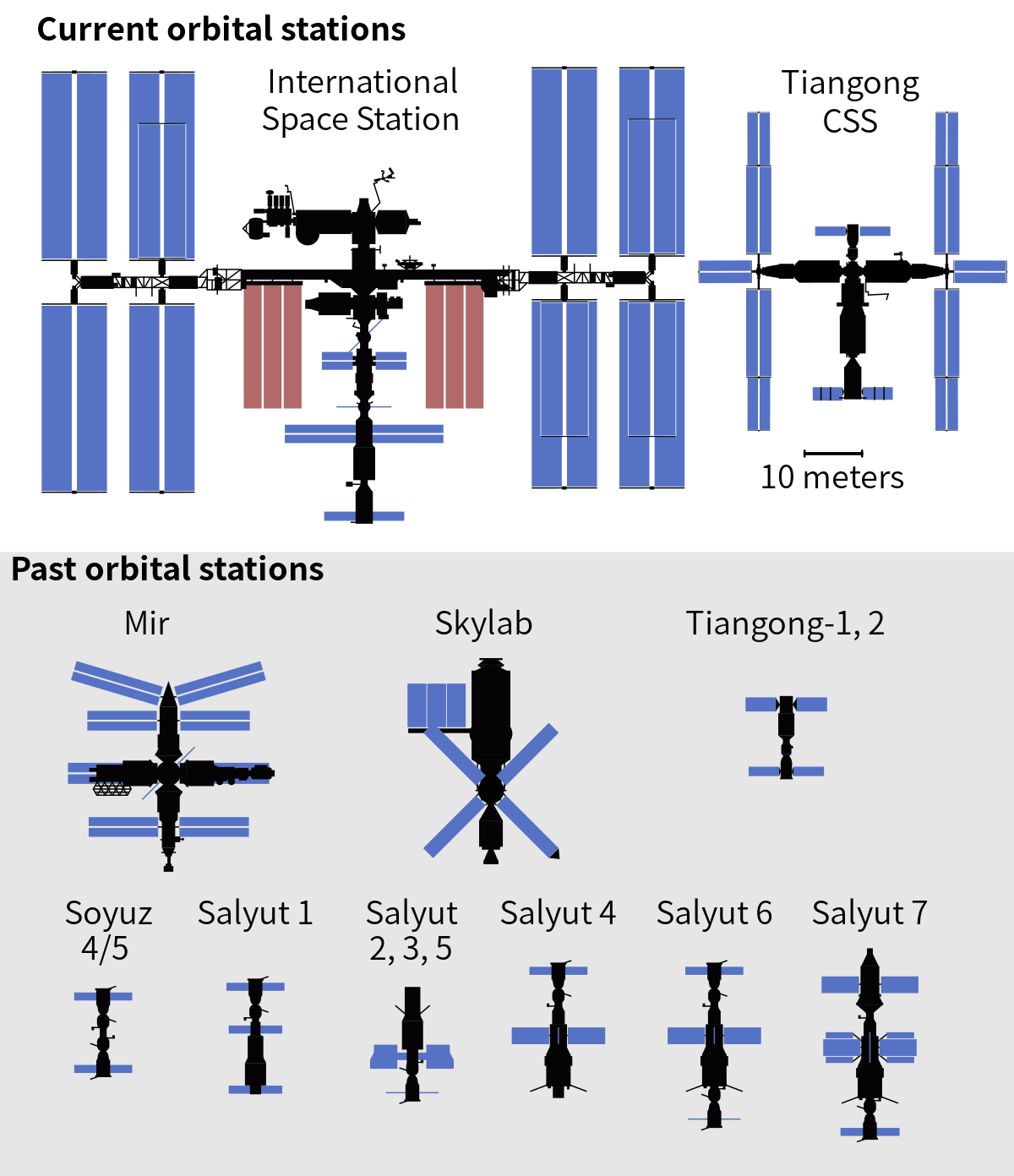
Here is a comprehensive list of space stations that have been launched, categorized by their respective programs and countries:
Soviet Union/Russia
- Salyut 1 (1971) - First space station, equipped for scientific studies.
- Salyut 2 (1973) - Military reconnaissance platform; suffered explosion after achieving orbit.
- Kosmos 557 (1973) - Scientific station; crippled after achieving orbit.
- Salyut 3 (1974) - Military reconnaissance platform.
- Salyut 4 (1974) - Scientific station; operated until its systems were exhausted.
- Salyut 5 (1976) - Military reconnaissance platform.
- Salyut 6 (1977) - First second-generation Salyut, operated as a highly successful scientific station.
- Salyut 7 (1982) - Follow-up to Salyut 6, had to be repeatedly rescued.
- Mir (1986) - First modular space station, used for more than a decade.
United States
- Skylab (1973) - First U.S. space station; supported solar studies and biomedical experiments.
International
- International Space Station (ISS) (1998-present) - A collaborative effort involving NASA, Roscosmos, ESA, JAXA, and CSA.
China
- Tiangong 1 (2011) - Experimental space station.
- Tiangong 2 (2016) - Experimental space station.
- Tiangong Space Station (TSS) (2021-present) - China's first long-term space station.
Planned and Proposed Space Stations
- Lunar Gateway (2025) - NASA, ESA, CSA, JAXA; part of the Artemis program.
- Axiom Station (Late 2026) - Axiom Space; will eventually detach from the ISS.
- Russian Orbital Service Station (2027) - Roscosmos; Russia's next-generation space station.
- Starlab (2028) - NanoRacks, Voyager Space, Lockheed Martin, Airbus; commercial platform.
- StarMax (2026) - Gravitics; provides significant habitable volume.
- Orbital Reef (Second half of 2020s) - Blue Origin, Sierra Space; commercial station in LEO.
- Bharatiya Antariksha Station (2035) - ISRO; India's own space station.
- Haven-1 (2025) - Vast; scheduled to be the world's first commercial space station.
These space stations have played significant roles in advancing human space exploration and scientific research in microgravity environments[1][2][3][4][5][6][7][8][9][10][11][12][13][14][15][16][17].
Citations:
[1] https://en.wikipedia.org/wiki/List_of_space_stations
[2] https://airandspace.si.edu/stories/editorial/first-space-stations
[3] https://www.spacecentre.co.uk/news/space-now-blog/space-stations/
[4] https://en.wikipedia.org/wiki/Space_station
[5] https://www.britannica.com/technology/space-station
[6] https://www.nasa.gov/international-space-station/
[7] https://www.issnationallab.org/about/iss-timeline/
[8] https://www.britannica.com/topic/International-Space-Station
[9] https://spacecrew.com/blog/future-space-stations
[10] https://www.britannica.com/explore/space/space-station/
[11] https://www.nasa.gov/history/25-years-ago-nasa-partners-begin-space-station-assembly/
[12] https://www.spacefoundation.org/space_brief/space-stations/
[13] https://www.space.com/16748-international-space-station.html
[14] https://nasa.fandom.com/wiki/Space_station
[15] https://www.encyclopedia.com/science/news-wires-white-papers-and-books/space-stations-history
[16] https://rammb.cira.colostate.edu/dev/hillger/ISS-related_launches.htm
[17] https://www.nasa.gov/international-space-station/space-station-visiting-vehicles/