I-Space, Max Boisot
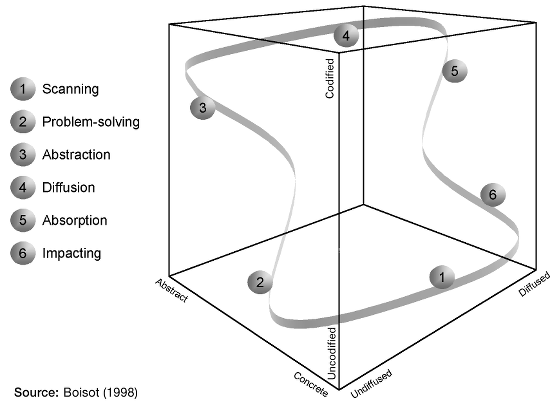
- I-Space has three axes: Abstraction, Codification, and Diffusion.
[
2D diagram: Codification (x-axis) & Diffusion (y-axis)
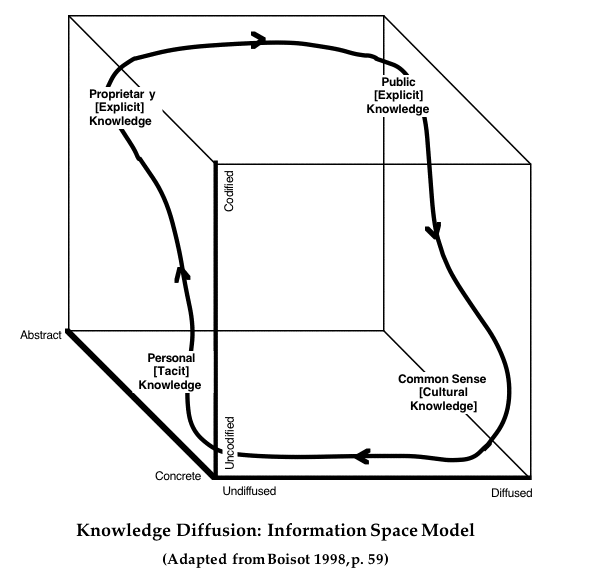
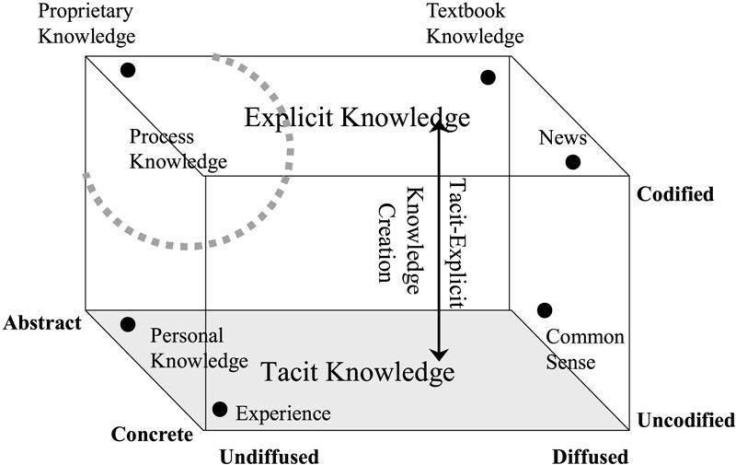
- Codification Axis
- Represents the extent of codification or formalization of information
- Range is the degree to which information is written down, standardized, and structured
- Tacit Knowledge is less codified and more implicit,subjective, personal, and difficult to articulate
- Explicit Knowledge is more formalized, structured, and easily communicated
- Diffusion Axis
- Represents the extent information is diffused or widely shared within an organization or network
- Range is the degree to which information is localized, shared, and made accessible
- Local Knowledge is held by a few individuals or groups, limited in scope and distribution
- Global Knowledge is widely disseminated and shared
Information landscape into four quadrants
- Zone of Certainty (High Codification, High Diffusion)
- Well-established, standardized knowledge that is accessible to many
- Textbooks, manuals, and widely accepted best practices
- Zone of Ambiguity (Low Codification, High Diffusion)
- Informal, experiential knowledge that is difficult to formalize
- Shared experiences, stories, and narratives.
- Zone of Complexity (High Codification, Low Diffusion)
- Specialized knowledge, technical documents, or proprietary information
- Accessible to a limited audience
- Zone of Ignorance (Low Codification, Low Diffusion)
- Information in this quadrant is neither highly codified nor widely shared
- May represent undiscovered or overlooked knowledge
- Zone of Certainty (High Codification, High Diffusion)
2D diagram: Codification (x-axis) & Abstraction (y-axis)
- Abstraction Axis
- Represents the extent knowledge varies in generalizability,applicability of concepts across various contexts, and distance from specific, real-world instances
- Range is the degree to which knowledge answers the Why question requiring more effort to understand to answering the What & How questions that can be readily applied
- Abstract Knowledge is highly conceptual and involves theories, models, and principles that guide decision-making and problem-solving
- Concrete Knowledge is specific, tangible, and grounded in real-world experiences involving facts, data, and specific procedures or practices
Zone of Acceptable Abstraction
- See Importance of Silos for discussion
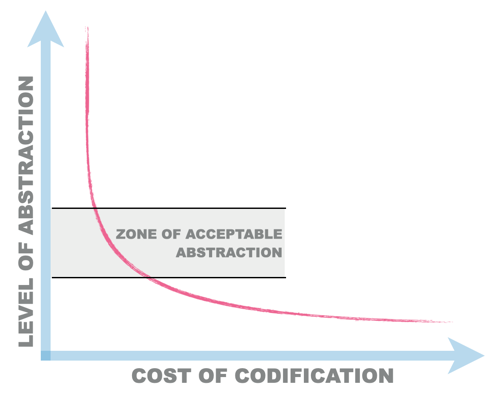
- See Importance of Silos for discussion