Abductive Reasoning
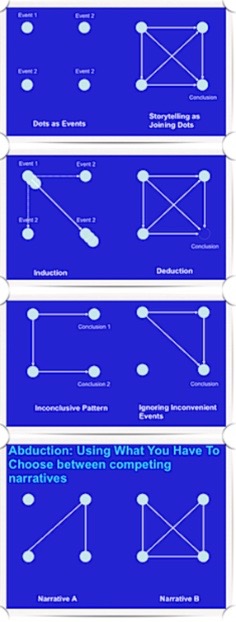
SenseMaker® is one of the first tools that allows for abductive methods of research. Most forms of research in many scientific disciplines are based on inductive reasoning, which delivers probabilities based on an assumption of repeatable events. Abduction deals with high levels of uncertainty and is all about finding the most plausible route between apparently unconnected things.
Abduction is associated with innovation, weak signal detection and ambiguity. It can also be considered as a method of delivering coherent hypothesis. Using SenseMaker® on large volumes of self-signified micro-narratives allows us to shift from plausibility to probability while maintaining the abductive capability to make novel and interesting connections.
Prediction or forecasting in open social systems is more akin to conjecture based on informed judgment.Instead of logical deduction or induction, scenario planning the range of possible futures employs something called abductive inference or creative abduction. Khisty explains:
While trend extrapolation is based on inductive inference, and theoretical forecasting is based on deductive logic, informed judgment refers to knowledge based on experience, intuition, and insight. Informed judgments are often based on abductive inference, that is, the process of reasoning that begins with claims about the future and then works backwards to the information and assumption necessary to support claims. However, inductive, deductive, and abductive inferences are never completely separable in practice.165
Unlike deduction, which looks backward in time at logic and historical experience, creative abduction makes claims about possible futures and explores what new agents, structures, systemic interactions, etc. will have to occur in order to arrive at the possible future. Doing so for each possible scenario creates some of the Indications and Warning necessary to determine where the system is trending in the cone of uncertainty, which can also demonstrate flaws in the existing appreciation of the context.