Emergent Strategy
Planning is useful. But in a world where change is happening fast than ever before — more and more things don’t go according to plan. There was a time when we could refer to the past to help predict the future — but that’s wishful thinking now.
The Responsive Manifesto outlines several tensions which organisations must learn to manage (including experimentation and planning). Experimentation, or learning by doing, is something that is difficult for scale-ups to do well. On the other end of the spectrum, trial and error is the key capability of upstarts. Startups move quickly and break things, precisely because they can pivot so easily.
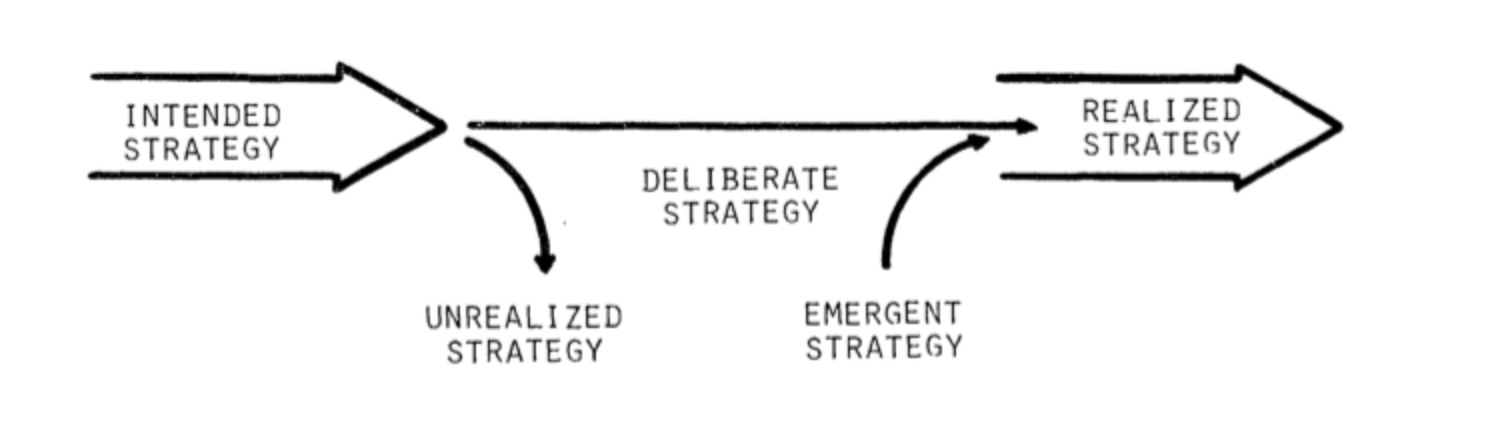 An emergent strategy, writes McGill Professor Karl Moore, is the, “View that strategy emerges over time as intentions collide with and accommodate a changing reality. Emergent strategy is a set of actions, or behaviour, consistent over time.”
Rooted in the management philosophy of Moore’s colleague Henry Mintzberg, an emergent strategy provides the compass by which to foster and realise a new practice that was never “expressly intended”. It can’t be neatly stored inside a pre-ordained plan, for the simple fact that it must bubble up from within the organisation.
Whatever size your business, being agile amidst the unknown and responsive to new opportunities is the name of the game. A healthy business practice means maintaining an emergent strategy that champions learning through experimentation and attaches no stigma to failure.
What is the Estuarine Framework all about?
One of the principles of managing a complex system is starting journeys with a general sense of direction rather than having specific goals. A complex system is so deeply entangled that the same thing is unlikely to happen the same way twice other than by accident. Setting specific outcome-based targets creates perverse incentives; think of Stratherns variation on Goodhart’s Law: the minute a measure becomes a target, it ceases to be a measure. Too many change initiatives start with senior executives locked away in a room with some expensive consultants and a flip chart or two, and they create a shared vision of a desired future state. The subsequent change initiatives then seem to use that vision as a North Star or similar goal for the organisation and seek to close the gap.
In contrast, complexity approaches start by describing the present and then identifying where we can go next, with the constraint of a general idea of the general direction of travel. This approach, doing the next right thing (to quote Frozen II) and looking again, is more pragmatic and adaptive. Starting a journey opens you to novelty, while hyper-focus on goals means you blind yourself to opportunities that, if you had known about them, could be more desirable. Visionary targets also tend to fall into the Estuarine Framework’s counter-factual zone, where change is realistically too hard.