Cynefin Framework
“The Framework guides us to make sense of the world so that we can skillfully act in it.”
Cynefin, pronounced kuh-nev-in, is a Welsh word that signifies the multiple, intertwined factors in our environment and our experience that influence us (how we think, interpret and act) in ways we can never fully understand.
The Cynefin® framework was developed to help leaders understand their challenges and to make decisions in context. By distinguishing different domains (the subsystems in which we operate), it recognises that our actions need to match the reality we find ourselves in through a process of sense-making. This helps leaders cultivate an awareness of what is really complex and what is not and respond accordingly, so that no energy is wasted in overthinking the routine but they also never try to make the complex fit into standard solutions.
The Cynefin framework is and has been used in almost every conceivable sector: whether strategy, police work, international development, public policy, military, counterterrorism, safety, energy, healthcare, sales or education it has had something to offer.
Cynefin has been adopted by the European Commission’s Policy Department as the main strategic framework, and a field guide on Leading and Managing in Crisis.
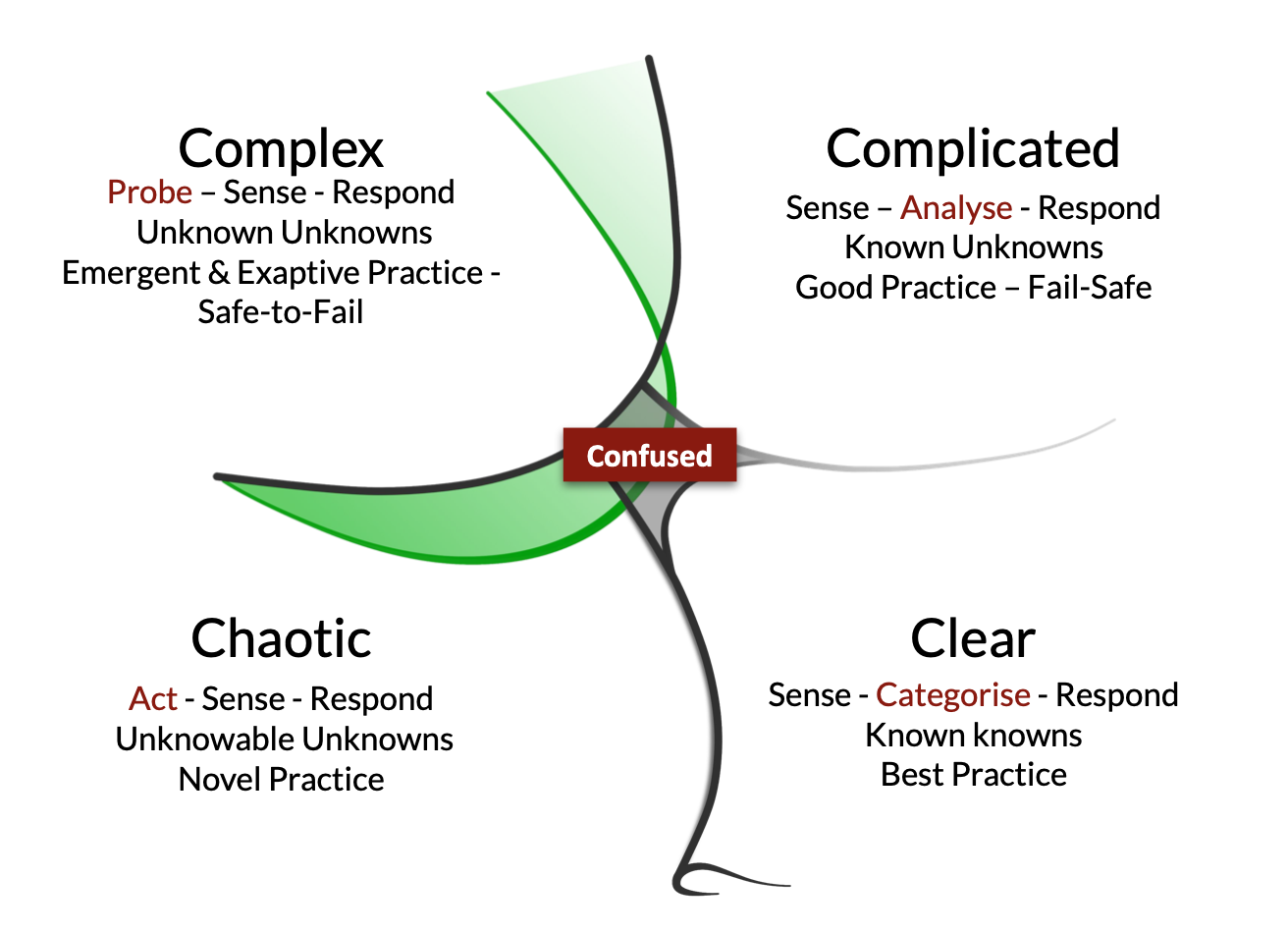
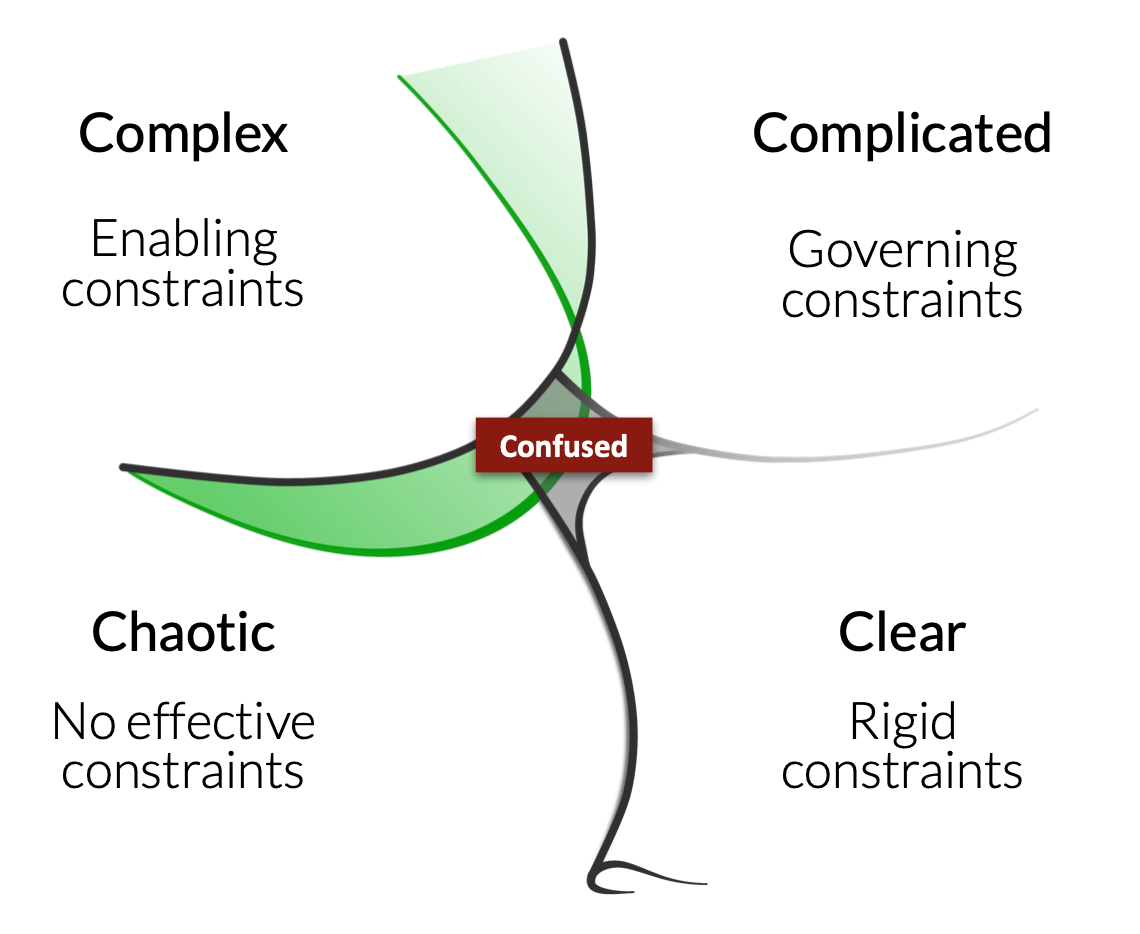
Cynefin, basically, is a framework which originates in natural science, which I think has been part of its strength. So it identifies ordered systems with repeating relationships between cause and effect. Which are either obvious, i.e. everybody can see what they are and everybody buys into them, or they’re complicated, they require analysis or some kind of investigation or expertise, and then complex systems, which are ones which are non-causal, they’re dispositional. So there aren’t repeating relationships between cause and effect, the sheer number of things interacting with what’s going on, means you haven’t got repeatable patterns that you can rely on to any degree. And then finally the chaotic systems, which are ones with the absence of constraints, which if they happen accidentally are a disaster, but if you can create them deliberately, it can be used for mass sensing for sophisticated decision support.
The principle behind Cynefin, is to say that you need to, first of all, work out what type of system you’re in. That’s called Ontological Awareness, and then what type of knowledge you can have and how you make decisions changes according to the system. That’s actually very revolutionary, because for the past twenty or thirty years it was Systems Thinking. People have assumed that all systems are ordered, they can be engineered, they can be designed, they can be predicted.
The Cynefin Framework does not imply a differentiated value between the domains. Only on the Ordered side does a focus on efficiency through optimization of the separate parts of the system make sense. The reductionist approach to a complex system will never bear fruit. Likewise, traditional command and control-style management approaches are impossible to implement in the complex domain.
Instead, complex systems are best managed by setting boundaries and adding or removing path-forming attractors (i.e. fixed points in the time-space of possible states). Constant monitoring and probing through small-scale experiments facilitate continuous development of the complex system towards a desired outcome (Snowden & Boone 2007). This resonates well with Holling’s comments on how to manage resilient ecological systems (Holling 1996: 38-41).
Beyond the basic framework, Dave has been actively developing Cynefin – did you know that Cynefin has sub-domain models? And, that there are narrative-defined boundaries between domains? Recent developments include thinking about defining domains through constraints, and moving through domains by understanding energy, knowledge and resource flows in and organisation, and how “gradients” can be manipulated to manage these flows.
Boundary between Obvious and Complicated domains is human-imposed, not a physical change in state.