Metis and Techne knowledge
The Arguments
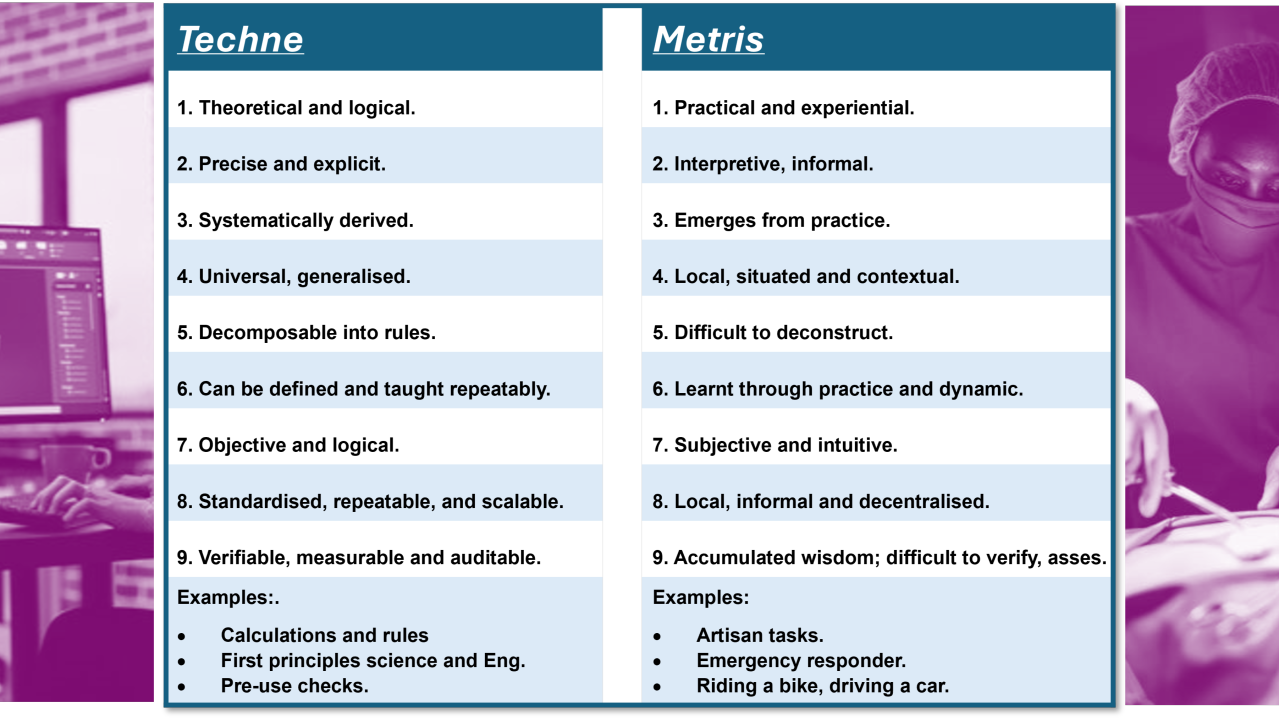
In the conclusion of ‘Thinking Like a State’, Scott argued that many failed attempts to control complexity and impose order from above arise from not recognising the value of practical skills, ‘experience-based intelligence’ and local knowledge. This is an advancement on mere tacit knowledge. He describe the accumulated wisdom, knowhow and the local knowledge that emerges from and is embedded in local experience Metis. This is contextual, practical and flexible skills and knowledge. The opposite of Metis is Techne which is the abstract, universal technical and scientific knowledge that is objective, empirical, logical and often deployed by experts (yes, people like me with our spreadsheets, pretty models, nice theories and neat frameworks).
Scott argued that many of the large-scale government-led change programmes and attempts to order society stem from prioritising Techne over Metis. Bureaucrats and technical specialists attempt to impose order, rationality and change onto others using Techne-based logic and experience. Techne dominates, dismisses and denies the local experience that is Metis. Now, at this point you may be thinking what has this got to do with work or the world of safety, quality or sustainability. Well several leading figures have applied Scott’s arguments to safety and quality within healthcare, maritime, aviation, indeed a range of safety-related fields. Scott’s arguments that local expertise, knowledge and knowhow is being overshadowed and even dismissed in favour of formal processes, competencies and expertise is one of the tensions running though contemporary debates in safety. Scott’s two forms of knowledge provide a useful window through which to view these discussions.
Scott makes a second argument. Not only do dismiss Metis knowledge and skill in favour of the technical, scientific and formal knowledge that is Techne, but many of the advancements that we think were developed through Techne methods (i.e. research, studies, scientific breakthroughs, etc) were actually on closer examination, retrospective capturing long held experienced-based intelligence. Put simply, the knowledge and insights were long known by local experts and communities, but only become widely known when they were formalised through studies and research. He cites many medical ‘breakthroughs’ such as penicillin, smallpox, malaria, scurvy as examples. We can equally looks to disasters for the dominance and over-confidence in Techne knowledge over Metis, including the building of a Japanese nuclear power plant about historic tsunami markers. You may know of other examples where local knowledge and experienced was dismissed in favour of external expertise. Scott summarises this second argument:
“A recurrent theme of Western philosophy and science, including social science, has been the attempt to reformulate systems of knowledge in order to bracket uncertainty and thereby permit the kind of logical deductive rigour possessed by Euclidean geometry”
There are strong parallels between Scott’s arguments, notably the prioritisation of Techne over Metis and the world of Naturalistic Decision Making. Not sure the two ever met or collaborated, but the argument Scott makes for local expertise and knowhow has strong parallels within Gary Klein’s critiques of logic-based decision-making.
Scott advises that Metis is most appropriate to complex material and social tasks where the uncertainties are so daunting that we must trust our experienced intuition and feel our way. Techne is most suitable to activities that ‘have a singular end or goal, an end that is specifiable apart from the activity itself, and one susceptible to quantitative measurement. But we must attempts to capture Metis in formal procedures of rational decision making are inherently problematic.