Navigating Complexity: Implementing Change during Unpredictable Times

Change transformations are characterized as being top-driven, aggressive, and hugely disruptive. Numerous surveys cite around 70% is the likely rate of failure for these kinds of programs. While it's easy to blame people resisting change, we put the fault on the approach taken. This session will present an evolutionary rather than a transformational approach to implementing change. This alternative recognizes real world complexity, unexpected variations in working conditions, and deploys a model that focuses on building resilience and sustainability.
There are many models available to those looking to implement change within their organization. Several view organizations as a machine and its people as components. These models outline a linear staged-process: evaluate readiness, design a strategy, develop a plan, execute the plan, close the project. The common beliefs are that idealistic future goals and objectives can be defined, gaps will be closed by changing processes, introducing technology, adjusting worker behaviour, and driving performance using metrics. They assume that the future can be reasonably and rationally predicted.
But what if the change outcome you desire faces complexity in terms of future uncertainty, turbulence, hidden conflicts, deep mistrust? Deploying an inappropriate change method can lead to the emergence of unintended negative consequences and increase the likelihood of change initiative failure. We must appreciate why we cannot ignore, manage, simplify, nor control complexity; rather, our plans need to absorb and navigate through it.
A traditional change initiative typically begins with a big launch and expires when the funding runs out. The evolutionary approach consciously starts small and scales by shaping the organization’s culture.
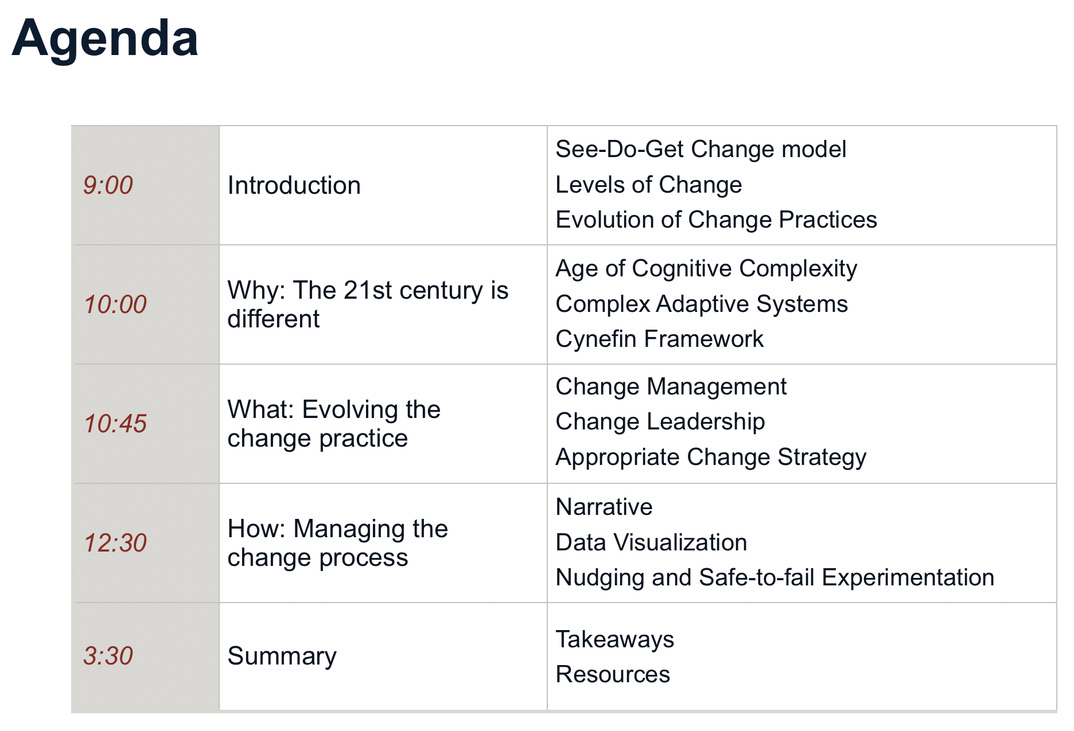
The prime message in this session on implementing change is to make sense and influence the evolutionary potential of the present rather than invest heavily in a future that one faithfully hopes will materialize.
After the session, participants will be able to:
- Understand why different thinking is required in the 21st century.
- Determine what appropriate change strategy to develop, and
- Learn how to use three tools to implement change: narrative inquiry, data visualization and safe-to-fail experiments.
Engineering and geoscience professionals and associates involved in implementing change or being impacted by a change initiative.