Distinction between a Complex and a Complex Adaptive System (CAS)
Complex systems and complex adaptive systems are related concepts, but they have distinct characteristics and implications. Both terms refer to systems that exhibit complexity, but the "adaptive" aspect sets complex adaptive systems apart from more general complex systems.
Complex System:
A complex system is a system composed of numerous interconnected components that interact and influence each other in nonlinear and often unpredictable ways. These interactions give rise to emergent properties and behaviors that cannot be easily deduced from the properties of individual components. Complex systems can be found in various domains, such as physics, biology, economics, and social sciences. Examples include weather patterns, ecosystems, and financial markets.
Complex Adaptive System:
A complex adaptive system is a subset of complex systems that has the additional feature of adaptability or the ability to change and evolve in response to internal and external influences. In complex adaptive systems, the components not only interact with each other but also have the capability to modify their behaviors or structures based on feedback and experiences from their environment. This adaptability allows the system to respond to changes, learn from interactions, and potentially improve its performance over time.
Key Differences:
- Adaptability: The primary distinction between a complex system and a complex adaptive system is the ability of the latter to adapt and learn. Complex adaptive systems can adjust their behaviors, strategies, or structures based on feedback and changing conditions, enhancing their ability to navigate uncertain and dynamic environments.
- Evolution: Complex adaptive systems often exhibit evolutionary dynamics, where certain behaviors or traits that lead to improved fitness or performance become more prevalent over time. This evolution can lead to the emergence of new patterns or strategies within the system.
- Learning: Complex adaptive systems can learn from experiences and interactions, leading to the acquisition of knowledge and the refinement of behaviors. This learning process contributes to the system's ability to make better decisions and responses in the future.
- Feedback: Adaptability in complex adaptive systems relies on feedback mechanisms that enable the system to assess the outcomes of its actions and adjust accordingly. Positive and negative feedback loops play a significant role in shaping the system's behavior.
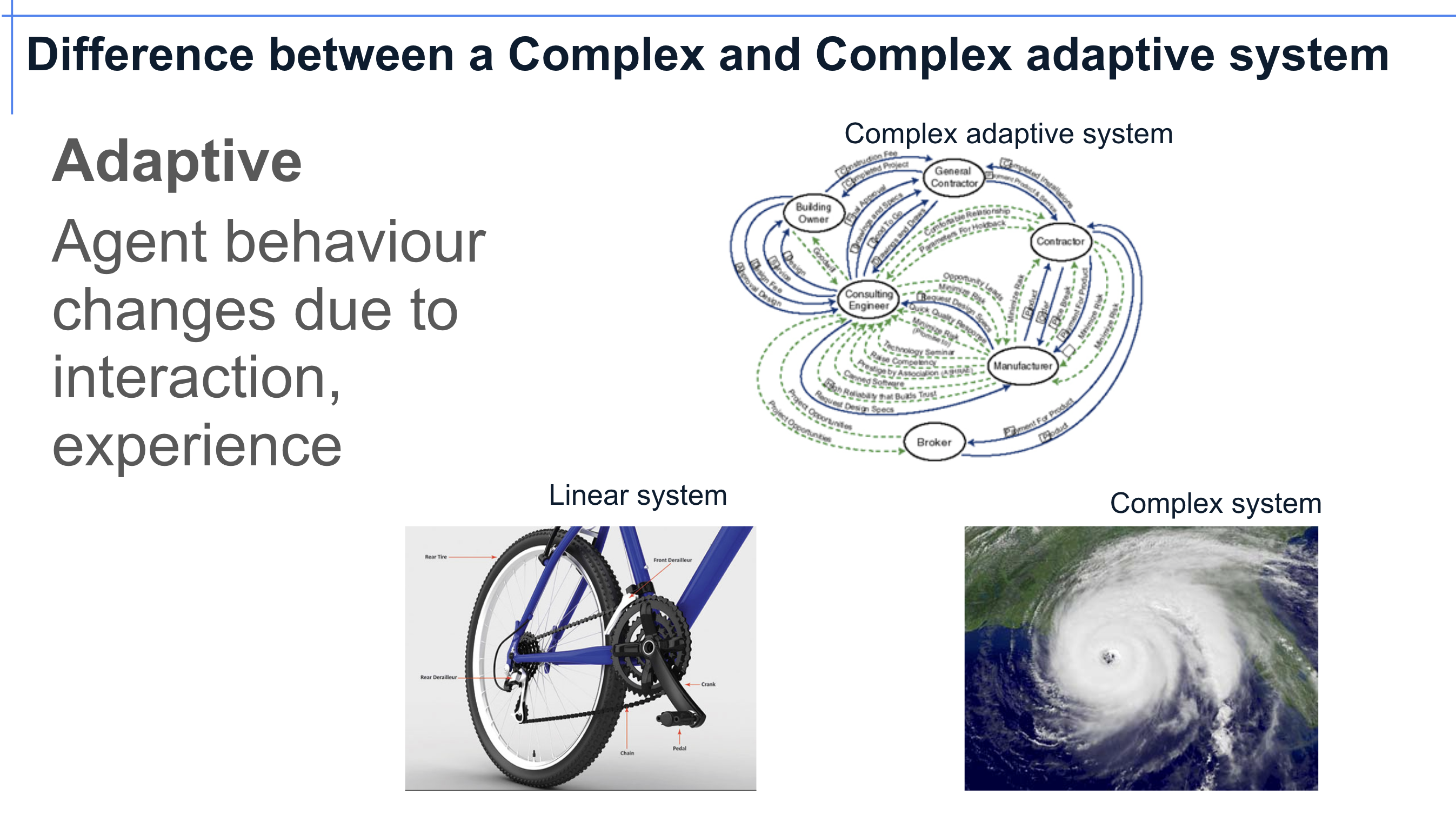
- Human agents in a CAS adapt to survive
- Compare to a linear system: Parts of a bicycle don’t change behaviour
- Compare to a complex system: Hurricane does not adapt nor learn and thus eventually dies out