3 Basic Systems in the Real World
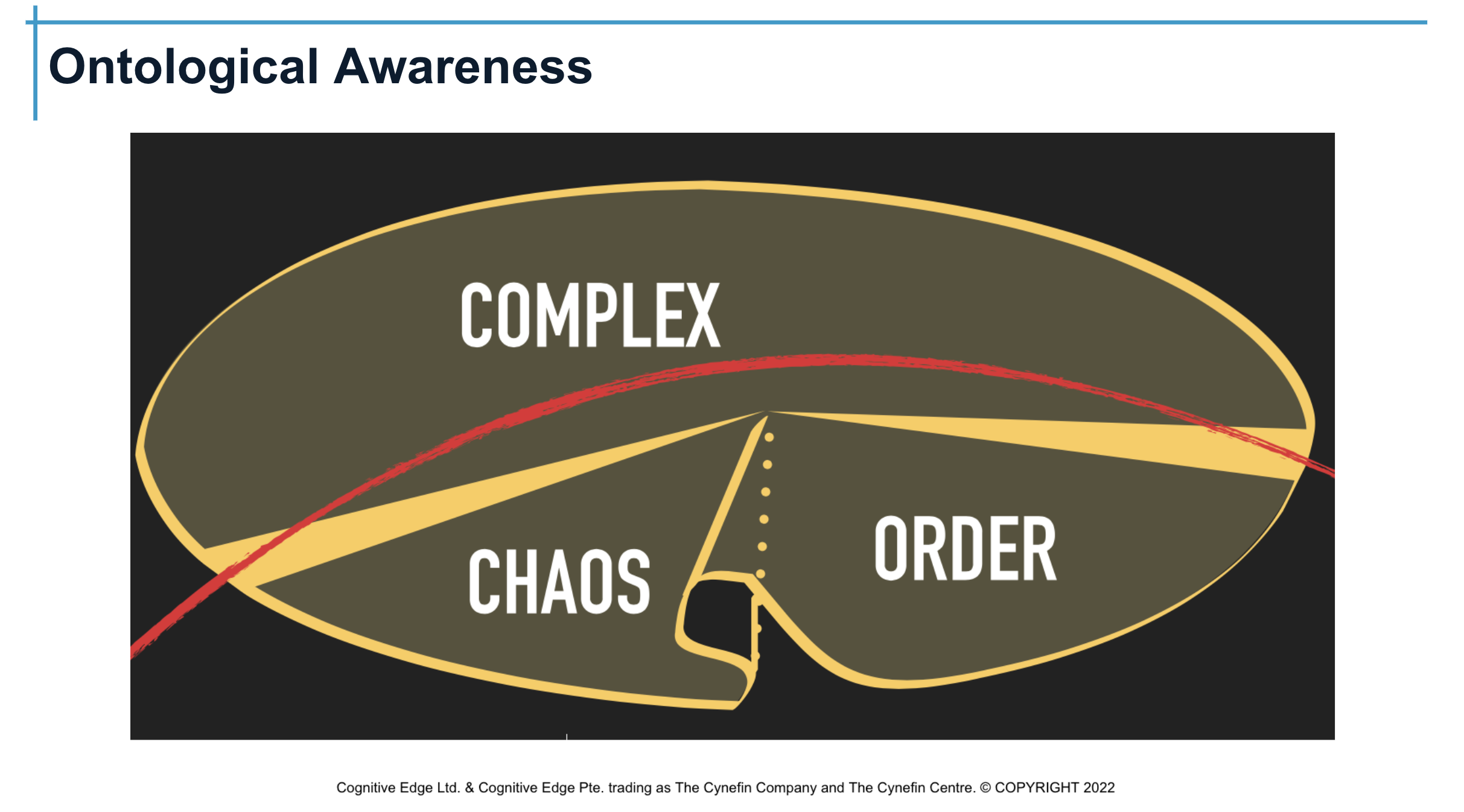
Ontological Awareness is determining what type of system you’re in
- In the real world, there are various ways to categorize systems
- One commonly used is based on behavior and what type of knowledge is present
- This is a single plane diagram of the 3 basic systems in the real world - Order , Complex, Chaos
- You’ll also hear Order called Deterministic and Chaos referred to Stochastic
- These 3 are not mutually exclusive
- You can move between systems except for the Chaos/Order boundary
- This is a physical cliff you can plunge down into Chaos
- Think of a piece of paper folded over to form an edge that you can fall
- Some of you may have heard the term Edge of Chaos
- If you’re familiar with the idea of “systems within systems”, we can talk about the diagram as a framework
- With 3 subsystems being nested in a Complex Adaptive System
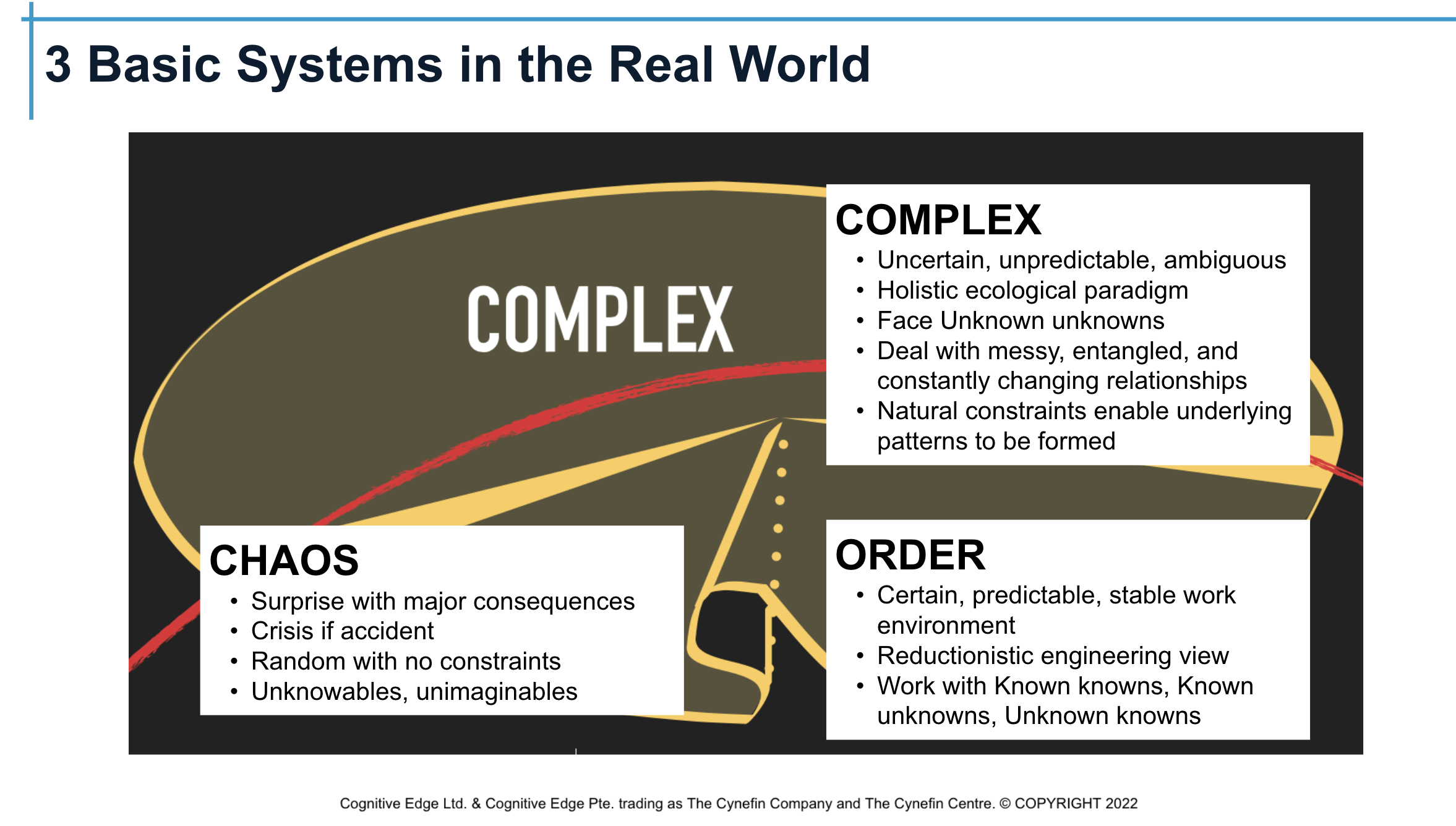
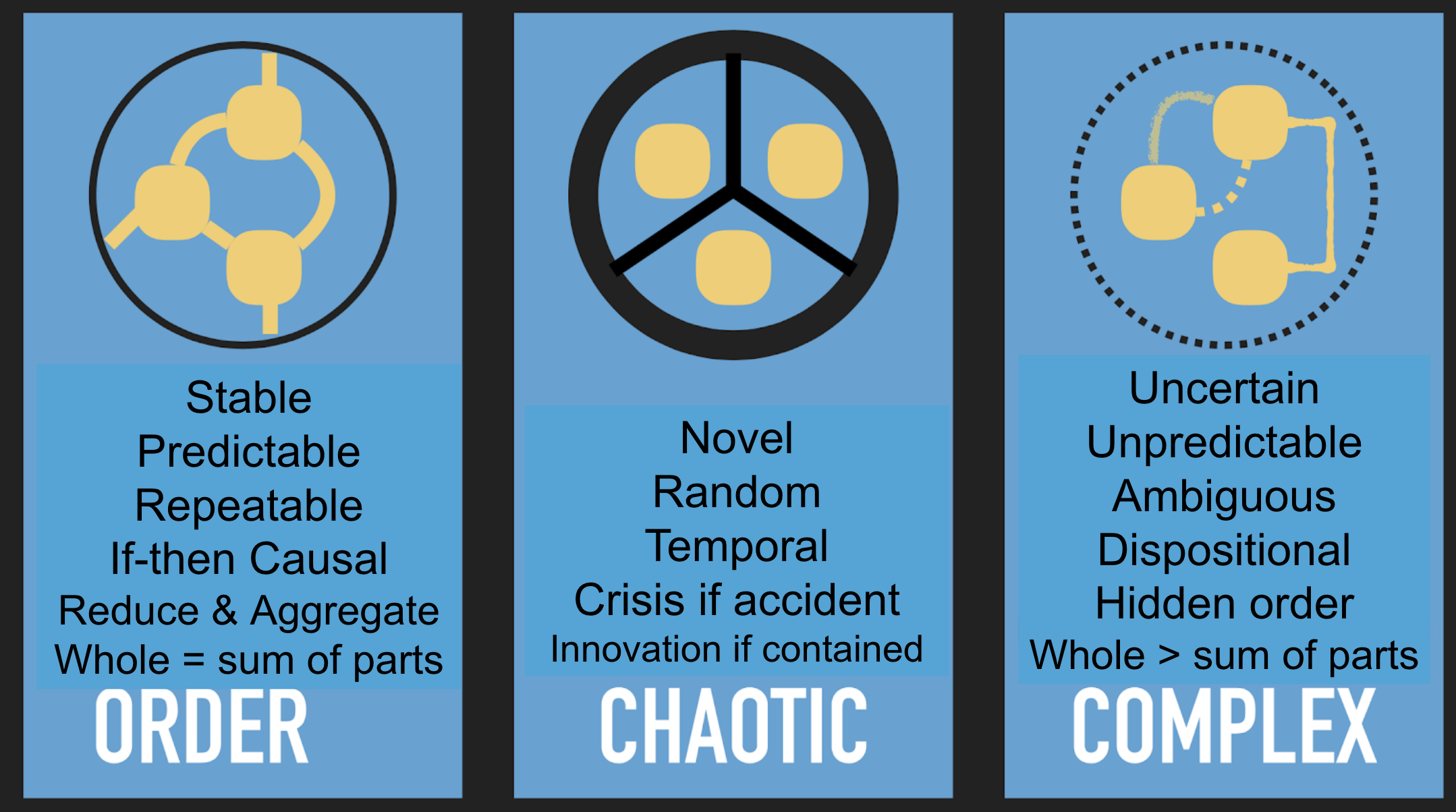
Order System
- This is where most of our formal education and training in Systems Thinking takes place
- We like being here because it’s certain, predictable, and stable
- IF we do this, THEN we get that
- We play with Known knowns, Known unknowns which we call Risk
- And Unknown Knowns - things you don’t know but someone else does
- This is Tacit knowledge - unwritten things that only exist in a person’s brain
- We can reduce complicated problems into manageable components. Think of Lego bricks
Complex System
- We can’t break down complex problems. Think of Mayonnaise. We can’t separate out the oil, vinegar, water and ingredients.
- It’s also irreversible.
- We have to work with the whole otherwise we would ignore the new properties that emerge - flavour, taste, smell
- It’s why in Complexity, the whole is greater than the sum of its parts
- While that sounds like a real bummer, it also means we can take a small piece called a fractal to accurately represent the whole
- A spoonful of mayonnaise tastes like the whole jar
- That’s what we do in a Monte Carlo simulation. We generate random numbers or sampling techniques based on the fractal patterns
Chaos System
- Everything is random and variable
- In our framework definition, entering Chaos is unexpected, a surprise
- If you enter from Order, it’s a plunge down the cliff with major consequences
- If the consequences are negative, it’s an accident, an injury, or worse, fatality
- If Unknowables or Unimaginables are factors, we have Taleb’s Black Swans
- If consequences are positive, we call that Serendipity
- Examples include the discovery of penicillin by Alexander Fleming, the development of the microwave oven, and the invention of Post-it notes
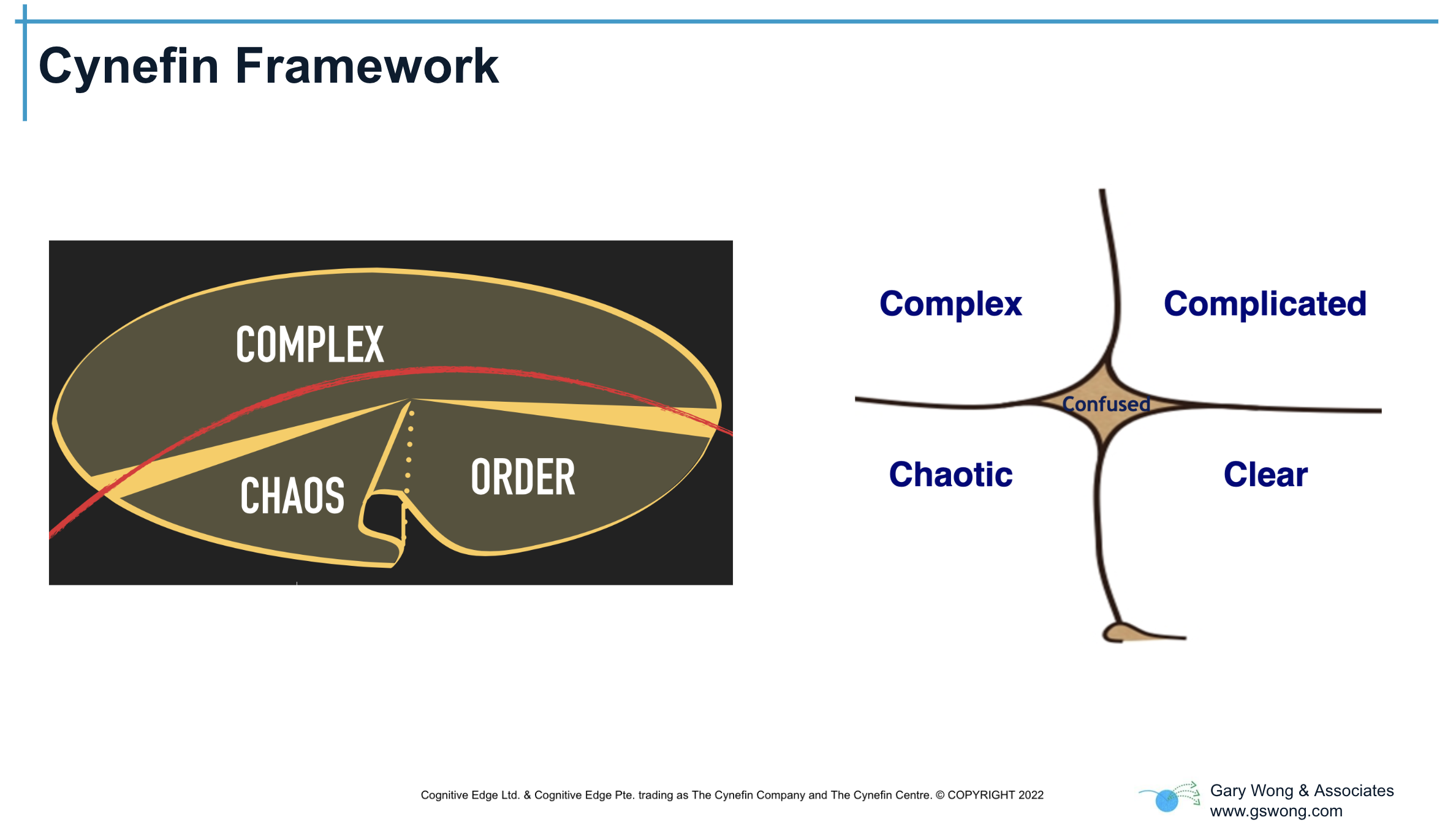
- Let’s improve our view of the real world by making the following additions
- Let’s split Order into 2 domains: Complicated & Clear
- Add 1 domain in the middle
- Confused is the state of not knowing where you are
- This is the Cynefin Framework
- To get the language right, it’s not a 2x2 model with 5 quadrants
- With Cynefin, you can describe where you are in the Present
- It’s a Sense-making Framework to support decision-making