Using SenseMaker® as a Research Tool
Click here to access MDPI article.
- There is growing interest in studying processes of human sensemaking, as this strongly influences human and organizational behavior as well as complex system dynamics due to the diverse lenses people use to interpret and act in the world
- The Cognitive Edge SenseMaker® tool is one method for capturing and making sense of people’s attitudes, perceptions, and experiences
- It is used for monitoring and evaluation; mapping ideas, mind-sets, and attitudes; and detecting trends and weak signals
- However, academic literature describing the tool-set and method is lacking
- This introduction aims to guide researchers in choosing when to use SenseMaker and to facilitate understanding of its execution and limitations
- SenseMaker can provide nuanced insight into system-level patterns of human sensemaking that can provide insight to nudge systems towards more desirable futures, and enable researchers to measure beyond what they know
- SenseMaker is both a tool and a method for collective inquiry into people’s attitudes, perceptions, experiences, and reflections
- Conceptually SenseMaker is grounded in insights gleaned from complex adaptive systems and the cognitive sciences applied to the analysis of social systems
- It links micro-narratives with human sensemaking to create advanced decision support, research, and monitoring capability
- The narrative-based method and accompanying software support the process of sensemaking of patterns in complex social systems and allows one to assess and monitor their continuously evolving nature
- SenseMaker differs significantly from other narrative-based research methods that typically involve immersive field-based observations and multiple in-depth interviews
- The latter can result in an intermingling of the views, voices, and values of the researcher and the research participants
- SenseMaker method replaces immersive interviews by the researcher, as micro-narratives are sourced from people’s lived experiences by facilitators from the community
- However, narratives may also be obtained directly using collection tools available from a webpage or as an application (app) on a smart device
- SenseMaker is a form of distributed ethnography, as it transfers the onus of interpretation of narratives from the researcher to participants
- Through this self-signification, SenseMaker removes ethnographic coding and expert re-interpretation, as participants assign meaning to their own micro-narratives, which enables large scale explorations, reduces researcher bias, and allows for more objective analysis
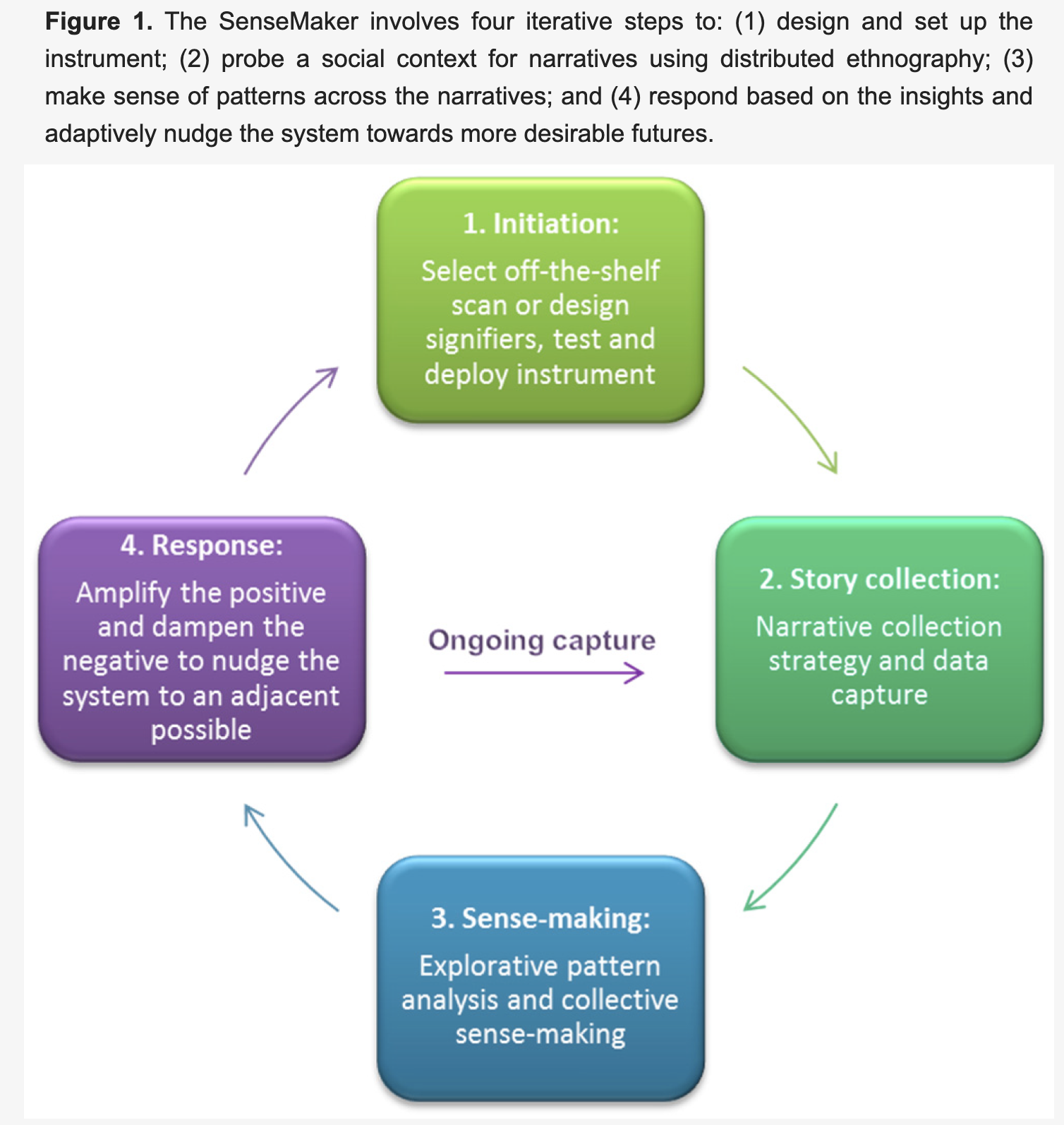
- SenseMaker is a mixed method that combines first-hand narratives with the statistical authority of quantitative data
- Research questions are built into the SenseMaker instrument as signifiers (concepts that anchor the plotting of micro-narratives in space)
- A signification framework consists of predetermined questions that guide the inquiry, solicit micro-narratives, and clarify interpretations which extract associated meanings of the narratives from participants
- Signification takes place when participants answer signifier questions on the micro-narrative they shared, and in the background numerical coordinates are associated with the micro-narrative relative to the signification framework
- This innovation provides linked qualitative and quantitative data that can be assessed in parallel
- When the set of signifiers is plotted in SenseMaker, it displays mathematical patterns that reveal a map of the social landscape, to detect and distil variations in patterns of cognition
- Thus, the signification framework becomes the basis for exploring the relevance of patterns, underlying relationships, norms, and dynamics in a social system