Assemblage
Assemblage_theory (Cynefin Wiki)
Assemblage
- What are the patterns of belief and understanding that act as constraints on behaviour, that act as attractor wells from which it may be difficult to escape?
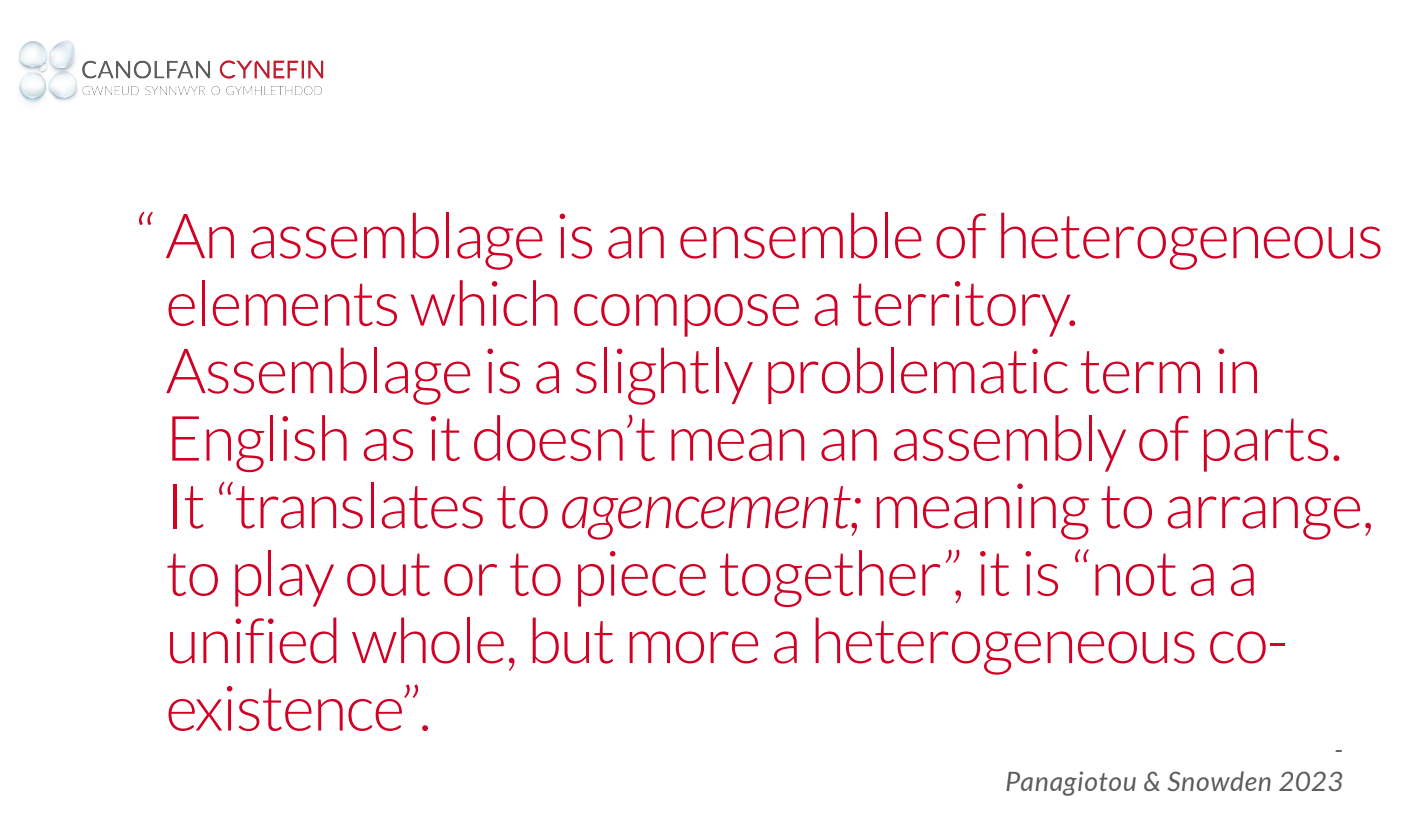
- An assemblage refers to a collection or arrangement of things, often diverse or disparate elements, brought together in a particular context or setting
- It can involve physical objects, ideas, people, or various components combined in a specific way to create a whole or serve a particular purpose
- Assemblages are dynamic, heterogeneous networks—they’re not fixed systems but evolving constellations of people, practices, technologies, norms, and institutions
- In different fields and contexts, the term "assemblage" can have various meanings:
- Art: In art and aesthetics, an assemblage is a form of sculpture or artistic composition created by assembling found objects or materials into a new, often abstract, or symbolic arrangement
- Ecology: In ecology, an assemblage refers to a group of species that coexist in a particular habitat or ecosystem. It represents the combination of organisms found in a specific ecological community
- Philosophy: The term has been used in philosophical discussions, particularly in the works of Gilles Deleuze and Félix Guattari, to describe the coming together of different elements, concepts, or entities in a dynamic and interconnected manner
- Social Sciences: In anthropology and sociology, assemblage theory is used to analyze how social entities and structures are constructed from various elements and how they interact within a particular context
- Assemblages are adaptive, non-linear, and often self-organizing, making them ideal for mapping in Cynefin or Estuarine Frameworks
- Assemblage is an emergent and constantly emerging pattern of beliefs and attitudes which exert pressure on the system and create what is known as a strange attractor in complexity science or a trope in narrative theory
- Assemblages are not just territories; they are the very fabric of the system
- They are not something we can be trained out of or choose to voluntarily escape; they have a real impact on the current situation
- There are examples in our citizen engagement project and the EU Field Guide