Complex Responsive Processes (CRP) model
The Ralph Stacey model, also known as the Complex Responsive Processes (CRP) model, is a theoretical framework developed by Ralph D. Stacey, a British organizational theorist and professor. The model offers insights into the dynamics of complex social systems, particularly organizations.
The CRP model departs from traditional management theories, which assume that organizations can be planned, controlled, and managed with predictability. Instead, it embraces complexity and unpredictability as inherent features of social systems.
Key principles of the Ralph Stacey model include:
- Complex Social Systems: The model views organizations as complex social systems that are continuously evolving and interacting. It recognizes that the behavior and outcomes of these systems emerge from the interactions of individuals within them.
- Non-Linearity: The CRP model rejects linear cause-and-effect relationships and emphasizes the non-linear and unpredictable nature of human interactions. It acknowledges that small changes or interactions within the system can lead to significant and unexpected outcomes.
- Equivocality and Multiple Realities: The model recognizes that different individuals within an organization may have diverse interpretations of reality, and multiple perspectives can coexist simultaneously. This creates ambiguity and equivocality, making decision-making and problem-solving complex.
- Organizational Politics and Power: The model acknowledges that organizational dynamics are influenced by power relationships and political behaviors. Different stakeholders within the organization may have competing interests and goals, leading to conflict and negotiation.
- Reflexivity: The CRP model encourages participants to engage in continuous reflection and learning. Reflexivity helps individuals and groups to understand the patterns of behavior that emerge in complex systems and to adapt their actions accordingly.
The Ralph Stacey model is used to understand and navigate the complexity of organizations and to embrace uncertainty and ambiguity as a natural part of organizational life. It emphasizes the importance of acknowledging different perspectives and fostering open communication to create more adaptive and resilient organizations.
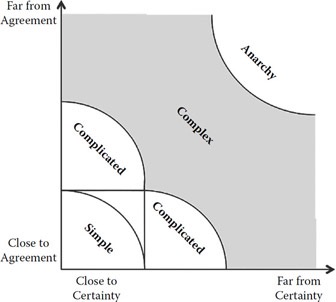
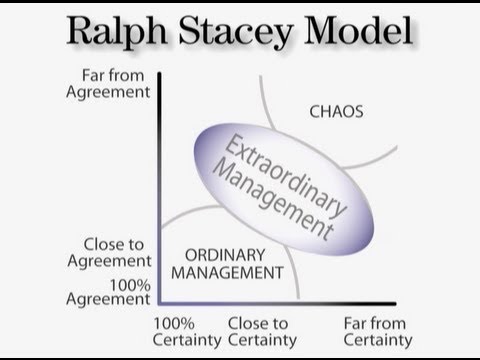
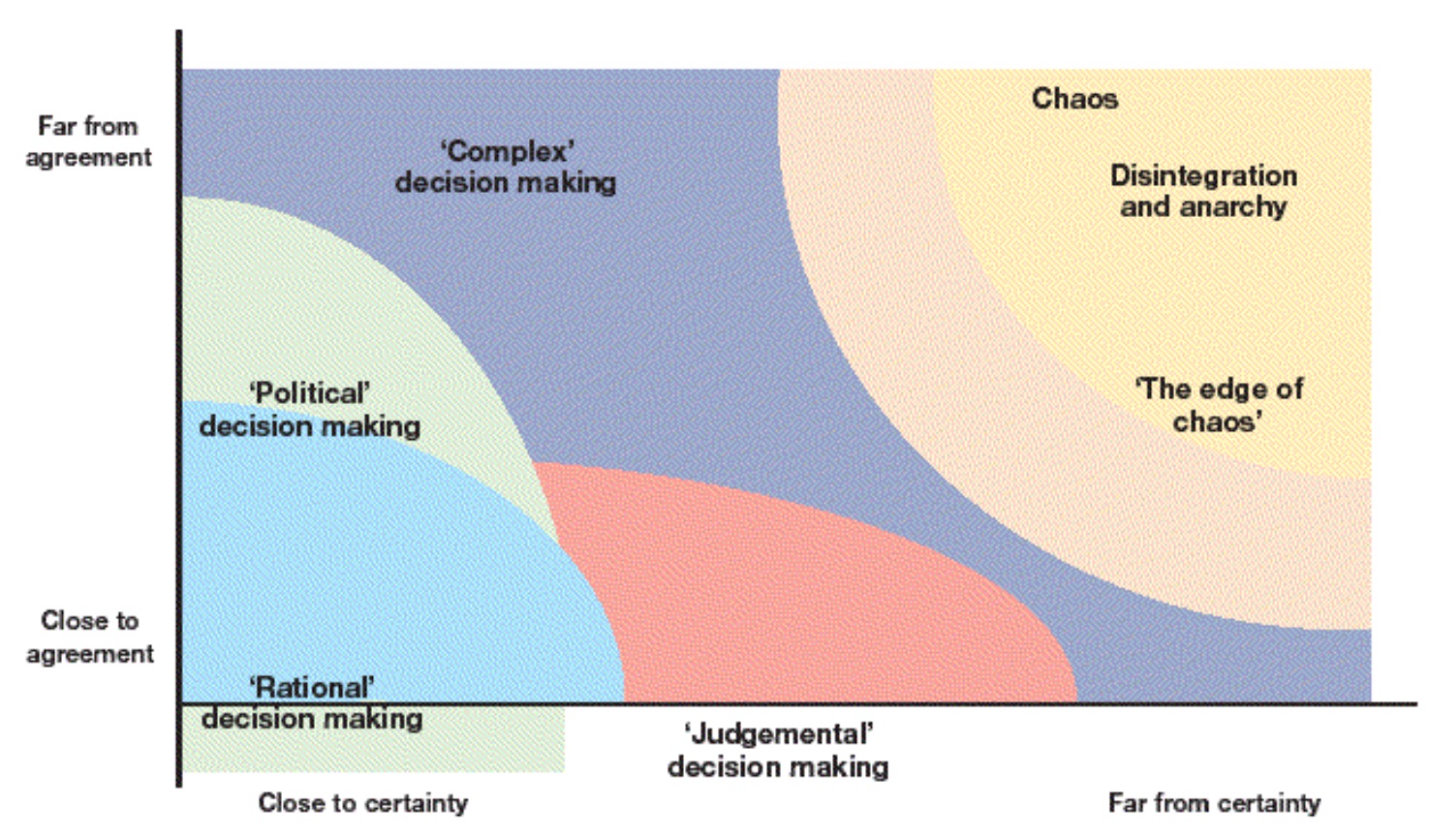
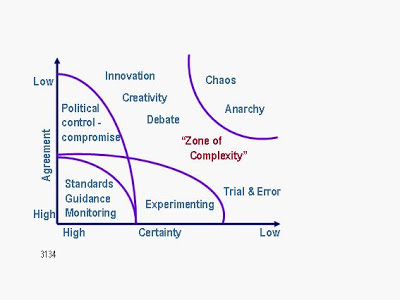
Stacey analysed complexity on two dimensions, the degree of certainty and the level of agreement and, based on these two dimensions, developed the matrix with the following zones: (i) close to agreement, close to certainty: in this zone, we can find simple projects where traditional project management techniques work well and the goal is to identify the right process to maximize efficiency and effectives; (ii) far from agreement, close to certainty: in this case, coalitions, compromise, and negotiation are used to solve this type of situations; (iii) close to agreement, far from certainty: in this case, traditional project management techniques may not work and leadership approaches must be used to solve this type of situations; and (iv) far from agreement far from certainty: this is the zone of anarchy with a high level of uncertainty and where traditional management techniques will not work.