Using the Genome - CRISPR
Clustered Regularly Interspaced Short Palindromic Repeats
While the potential opened up by the genomic revolution could be used to improve human health, it will also go far beyond this. The instructions for every life-form are encoded in its genome. In the last few years, new, smarter techniques for manipulating genes have come to the fore, and have generated a range of future prospects that could well have remained in the realm of science fiction. Much of this has been the result of a remarkable innovation by Jennifer Doudna and Emmanuelle Charpentier, who recently invented what has be the world’s most powerful genome engineering technique. It is called CRISPR and was developed as a new system to manipulate DNA.
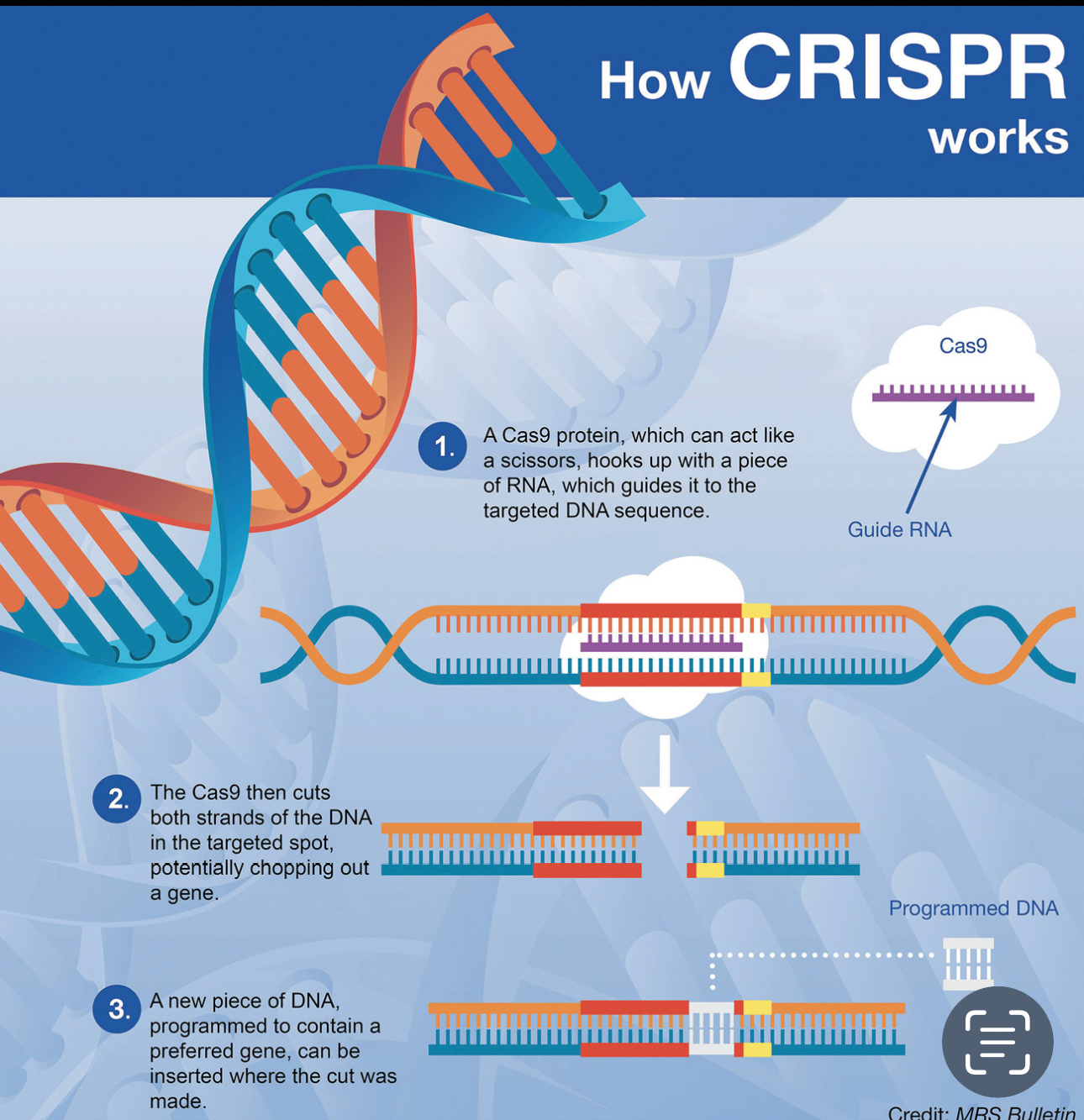
It has allowed us to look more closely at the function of particular genes, by kicking them into action or shutting them down, or by cutting the DNA at precise locations to allow the sequence in the gap to be changed or added to. In theory, this means you could precisely remove a faulty version of a gene responsible for diseased cells and replace it with the "healthy," correctly functioning version. But this technology is also enabling new tricks beyond genome editing.
In the future, it has the capability to help us figure out what the 98 percent of DNA that does not code for proteins is up to, which will take us beyond the alphabet of the genome to its grammar and punctuation. Part of this will be through our ability to turn genes on and off at will. Work has already begun on using light to control the location, timing, and reversibility of changes that we can introduce to the genome. This is an intersection with another fast-developing field, known as optogenetics—in which cells are controlled using light and which is currently being used in laboratories to deepen our understanding of the brain. In the next two decades it is hoped that the field will give us intriguing insights into a range of conditions, including neurodegenerative diseases such as Parkinson's, epilepsy, Alzheimers, stroke, and hearing loss, which lack effective therapies at the moment. In addition, "CRISPR pills"—edible DNA sequences customized to instruct drug-resistant bacteria to self-destruct—are currently being developed.
We are already starting to see many other applications of CRISPR related technologies—from the vital (preventing rhe loss of bee colonies) to the frivolous (dogs, mini-pigs, and koi carp as pets available in customizable colors). In the next few decades this technology could also create sophisticated biological circuits that convert cells into biofuel factories, for example by creating farm animals resistant to infection. In addition, there are plans for "CRISPR chickens," in which the tools for CRISPR editing will be integrated directly into the birds' genomes. Applications will include so-called "farmaceuticals"—like transgenic chickens whose eggs contain a drug to help with cholesterol problems.
There are also plans that could see the semi-resurrection of extinct animals. Work has started that looks at editing elephant embryos to make woolly mammoth-like arctic elephants and pigeon embryos to bring back a version of the passenger pigeon we hunted to oblivion in the nineteenth century.