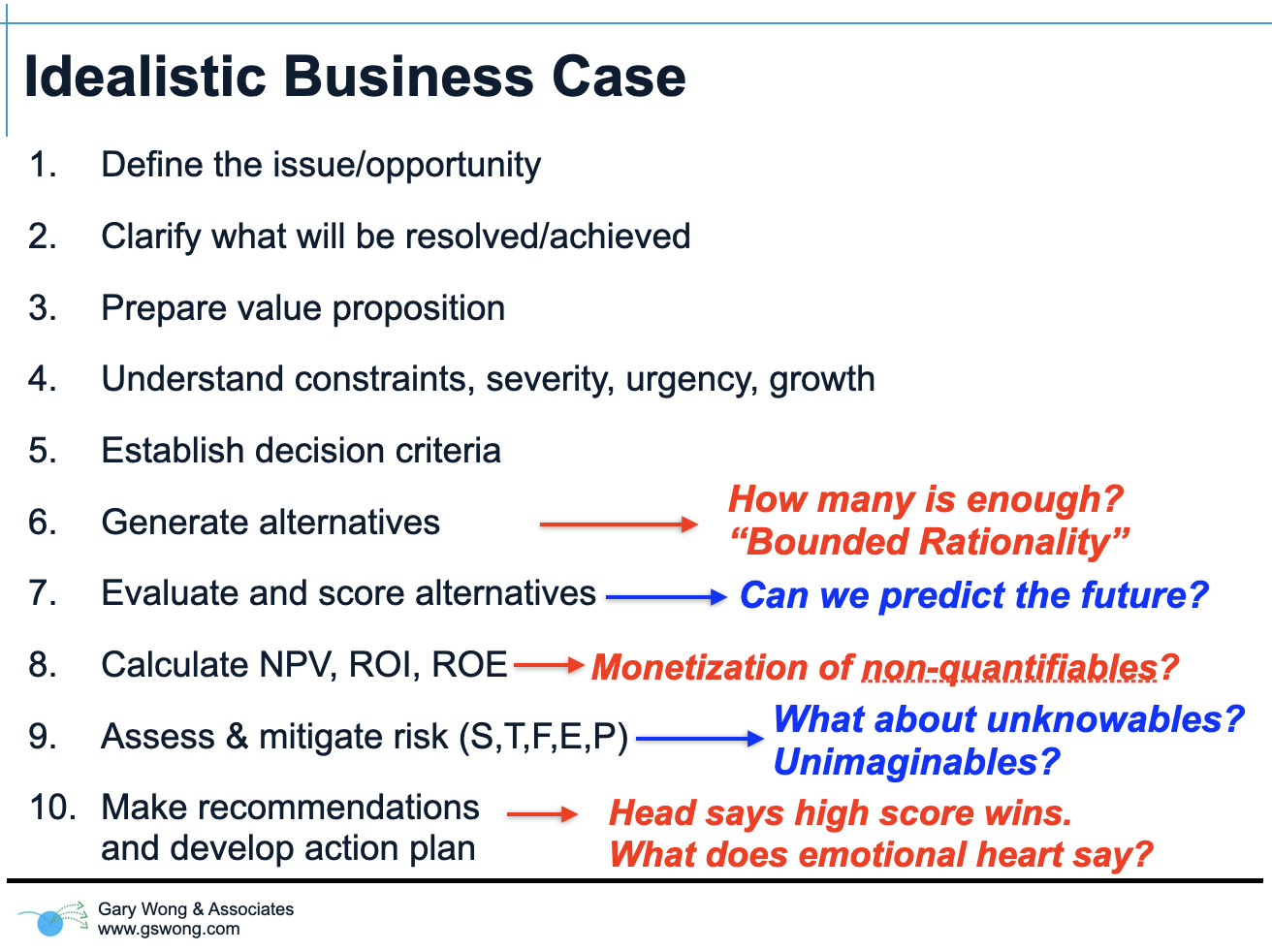
Business Case in Order system
- Why Business Case fits in an Order System (Cynefin Complicated and Clear domains}
- Business case assumes predictability, linearity, and control
- Business case specifies an idealistic future state that can be reached following a linear roadmap or blueprint
- Milestones and KPIs measure progress towards set targets
- Clear Domain
- Cause and effect are obvious
- Business case works because inputs and outputs are known knowns and predictable
- Example: Installing a new production line with known efficiency gains
- Clear Domain
- Complicated Domain
- Cause and effect require expert analysis but are still discoverable
- Deal with known unknowns
- Identify as a risk and statistically assign a Frequency and Severity metric
- Business case is valid here because experts can model scenarios, calculate NPV, ROI, IRR, and provide evidence-based recommendations
- Example: Implementing a new CRM system with estimated costs and forecasted benefits
- Complicated Domain

Business Case approach, while widely used in decision-making, has faced several criticisms:
- Narrow Focus on Financial Returns – Critics argue that the Business Case approach often prioritizes short-term financial gains over broader social, environmental, or ethical considerations.
- Lack of Flexibility – Some studies suggest that business cases tend to be rigid, assuming a fixed solution rather than allowing for adaptive strategies that respond to evolving challenges.
- Overemphasis on Measurable Outcomes – The approach tends to favor quantifiable benefits, making it difficult to justify investments in areas like diversity, sustainability, or employee well-being, which may have long-term but less tangible impacts.
- Potential for Bias – Business cases are often developed by internal teams with vested interests, leading to selective data presentation that supports predetermined conclusions rather than objective analysis.
- Failure to Address Systemic Issues – Some critics argue that the Business Case approach focuses on individual projects rather than addressing broader systemic challenges, such as inequality or climate change