13th Amendment
The original 13th amendment can be found here.
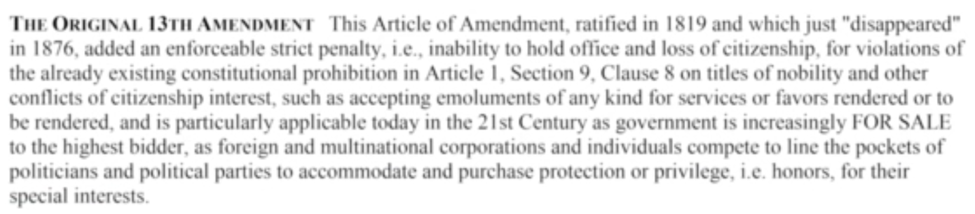
The following is extracted from the article found on the above tab “Refutation of Dodge (see the article for footnotes, citations):
On January 18, 1810, Republican Senator Philip Reed introduced a constitutional amendment addressing the acceptance of titles of nobility by American citizens." It was referred to a select committee of three, and twice afterwards to a larger committee of five, which submitted several versions of the amendment to the Senate. The amendment was approved by the Senate by a vote of 19 to 5 on April 27, 1810, in the following form:
If any citizen of the United States shall accept, claim, receive, or
retain, any title of nobility, or honor, or shall, without the consent of
Congress, accept any present, pension, office or emolument, of any
kind whatever, from any Emperor, King, Prince or foreign Power,
such person shall cease to be a citizen of the United States, and shall be incapable of holding any office of trust or profit under them, or
either of them.
The House of Representatives then approved the amendment on May 1, 1810 by a vote of 87 to 3, and TONA was submitted to the states for ratification.
No debates about the amendment are recorded in the Annals of Congress or contemporary newspapers, so the reasons for its proposal are a matter of some speculation. One theory is that TONA was a reflection of the general animosity to foreigners evident in the United States before the War of 1812.This animosity manifested itself in a number of fashions. Henry Clay, for example, only with difficulty succeeded in limiting a Kentucky bill prohibiting the citation of British court decisions or treatises to works written after July 4, 1776.39 A similar bill was passed in Pennsylvania in 1810.Georgia's constitution of 1777, in force until 1789, excluded any person who held or claimed a title of nobility from voting or holding office. It is therefore understandable, Ames states, that in addition to finding nearly unanimous support in Congress, TONA found strong support in some states, for example passing both houses of the Pennsylvania legislature unanimously.
Another theory attributes TONA to the reaction against the involvement of Napoleon Bonaparte's younger brother, Jirme Bonaparte, in American public life the preceding decade. His American wife from 1803 until 1806, Elizabeth Patterson, was from a prominent Baltimore Republican family, and in 1809 was granted an annuity by the French government with hints of a title to follow. Republican Representative Nathaniel Macon of North Carolina is recorded to have said, when voting on TONA, that "he considered the vote on this question as deciding whether or not we were to have members of the Legion of Honor in this country."'
An article published decades later in Niles' National Register, a national newsweekly published in Baltimore, refers to an amendment having been adopted to prevent any person but a native-born citizen from becoming President of the United States. While this statement is in error, as is the article's statement that the Federalists introduced the amendment (if it meant to refer to Reed's amendment), the article does state that the amendment was introduced out of concern about Jirdme Bonaparte. Modern historians have speculated that Reed may have introduced the amendment on behalf of concerned Marylanders, as well as to outflank the Federalists, transforming TONA into a nonpartisan measure not meriting debate.
Twelve states ultimately ratified TONA, not enough to make it part of the Constitution under Article V of the Constitution."' Secretary of State John Quincy Adams, through President James Monroe, reported to Congress in 1818 that the following actions had transpired:
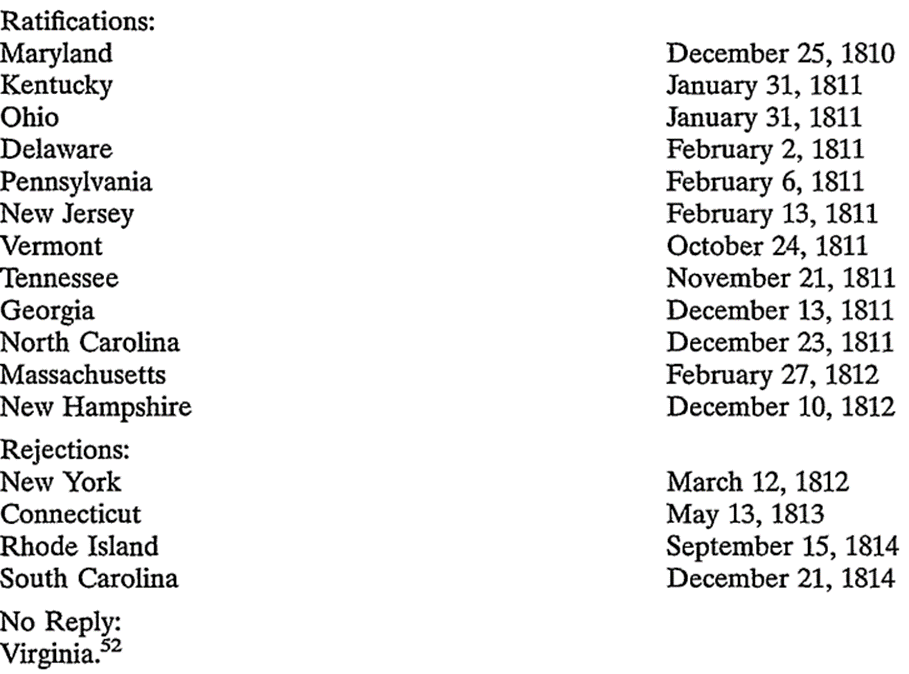
Adams' report is dated February 3, 1818; Monroe's letter is dated February 4, 1818; and the House of Representatives is recorded to have received it on February 6, 1818. See 31 ANNALs OF CONG. 866 (1818).
Adams' original report did not include definitive information on South Carolina; the state Senate was known to have approved the amendment on November 29, 1811, but the action of the state House of Representatives was unknown. See Amendment proposed to the Constitution in relation to titles of nobility, &c. at 478. Monroe on February 28, 1818 transmitted to Congress a letter from Governor Andrew Pickens dated February 14, 1818 received by Adams reporting that the state House had rejected the amendment. See 478-79; 31 ANNALS OF CONG. 1074 (1818).
Although Virginia did not reply to Adams' inquiry, its own legislative journals record that the state rejected TONA on February 14, 1811. See JOURNAL OF THE SENATE OF THE COMMONWEALTH OF VIRGINIA (Richmond, Thomas Ritchie, 1810 [1811), Even the Governor of Virginia three years after the fact was unsure; in a letter to the Virginia Senate and House of Delegates on January 25, 1814, James Barbour wrote that:
I have received a letter from the Secretary of State, [James Monroe] requesting to be advised whether the Legislature of Virginia had agreed to, or rejected, an amendment proposed to the Constitution of the United States, which had for its object the prevention of any citizen accepting any title of nobility, present, pension, or office, from any foreign prince or power. Upon reference to the archives of this Department, no official document can be found which justifies a reply affirmatively or negatively. I submit to the Legislature the propriety of adopting some mode by which the difficulty may be obviated.
JOURNAL OF THE HOUSE OF DELEGATES OF THE COMMONWEALTH OF VIRGINIA (Richmond, Samuel Pleasants, 1813-1814. It appears that Barbour's request was never answered until now. One should note that, as far as this Author is aware, these facts have never before appeared in print; all past commentators merely cited Adams' report or a source relying upon it.
Confusion, however, persisted for many years as to whether TONA had become part of the Constitution. The most prominent inclusion of TONA as part of the Constitution was its appearance in the 1815 edition of United States Statutes at Large (the "Bioren ediion")., Congress authorized its publication in 1814, as to replace the first official compilation of the laws of the United States, which had been authorized in 1795. James Monroe, then Secretary of State, appointed John B. Colvin to edit the new edition. Not able to conclude whether TONA had been ratified, Colvin made the following prefatory remarks in the first volume:
There has been some difficulty in ascertaining whether the amendment proposed, which is stated as the thirteenth... has, or has not,been adopted by a sufficient number of the state legislatures to authorize its insertion as part of the constitution? The secretary of state very readily lent every suitable aid to produce full information on the question; but the evidence to be found in the office of that department is still defective. It has been considered best, however, to publish the proposed amendment in its proper place, as if it had been adopted, with this explanation, to prevent misconception.
After the amendment also appeared in copies of the Constitution printed for members of the Fifteenth Congress, Republican Representative Weldon Nathaniel Edwards of North Carolina proposed a resolution on December 31, 1817 to ask President Monroe to provide the House of Representatives with information as to "the number of States which have ratified the 13th article of the amendments .... The resolution was approved without opposition. Monroe's response, incorporating the information gathered by John Quincy Adams, was that TONA had not become part of the Constitution.
See Constitution of the United States, NILEs' WEEKLY REG., Vol. XIV, Apr. 25, 1818, at 150.
Continue reading on the above tab “Refutation of Dodge”.
Titles of nobility are emoluments. Article I, Section 10 already says there can be no titles of nobility. The original 13th Amendment was the remedy.
The original 13th Amendment was replaced with a 13th Amendment on slavery.
David Dodge
In the winter of 1983, archival research expert David Dodge, and former Baltimore police investigator Tom Dunn, were searching for evidence of government corruption in public records stored in the Belfast Library on the coast of Maine.
By chance, they discovered the library's oldest authentic copy of the Constitution of the United States (printed in 1825). Both men were stunned to see this document included a 13th Amendment that no longer appears on current copies of the Constitution. Moreover, after studying the Amendment's language and historical context, they believed the principle intent of this "missing" 13th Amendment was to prohibit lawyers from serving in government. So began a seven year, nationwide search for the truth surrounding the most bizarre Constitutional puzzle in American history -- the unlawful removal of a ratified Amendment from the Constitution of the United States. Since 1983, Dodge and Dunn have uncovered additional copies of the Constitution with the "missing" 13th Amendment printed in at least eighteen separate publications by ten different states and territories over four decades from 1822 to 1860. In June of this year (1991), Dodge uncovered the evidence that this missing 13th Amendment had indeed been lawfully ratified by the state of Virginia and was therefore an authentic Amendment to the American Constitution. If the evidence is correct and no logical errors have been made, a 13th Amendment restricting lawyers from serving in government was ratified in 1819 and removed from US Constitution during the tumult of the Civil War. Since the Amendment was never lawfully repealed, it is still the Law today. The implications are enormous.
The story of this "missing" Amendment is complex and at times confusing because the political issues and vocabulary of the American Revolution were different from our own. However, there are essentially two issues: What does the Amendment mean? and, Was the Amendment ratified? Before we consider the issue of ratification, we should first understand the Amendment's meaning and consequent current relevance.
See the above tabs for more information.
The Current 13th Amendment:
Section 1
Neither slavery nor involuntary servitude, except as a punishment for crime whereof the party shall have been duly convicted, shall exist within the United States, or any place subject to their jurisdiction.
Section 2
Congress shall have power to enforce this article by appropriate legislation.