GENIUS Act 2025
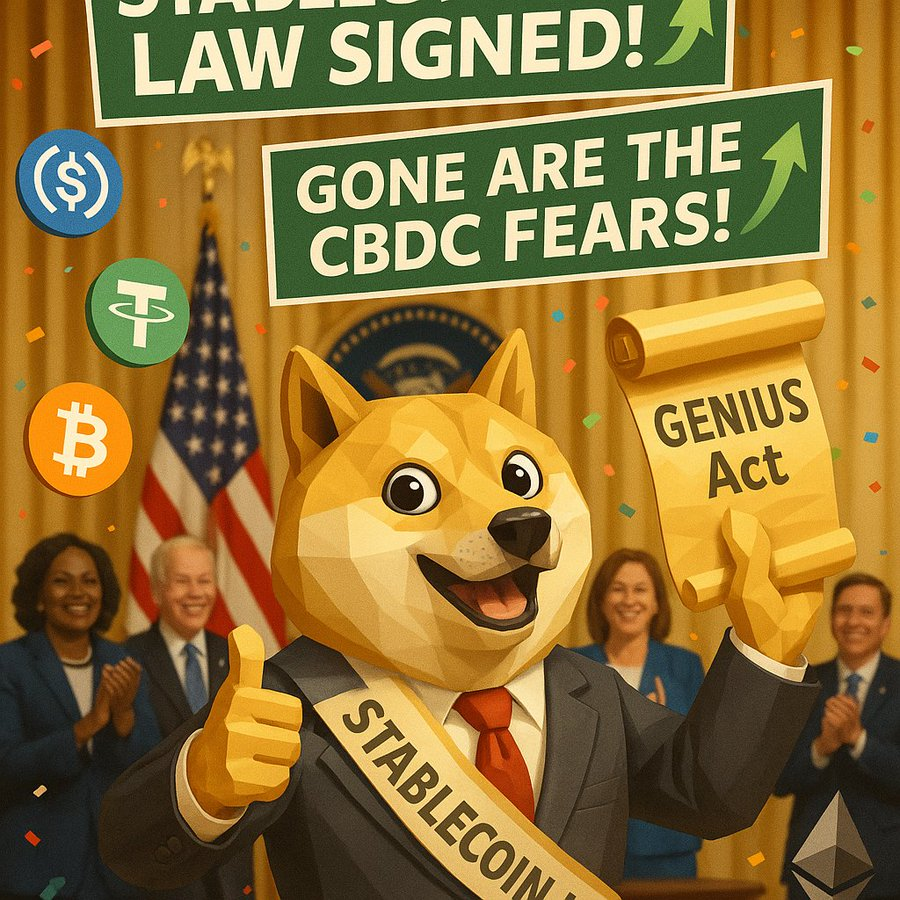
BOMBSHELL: Global Banks PANIC After Trump Signs IT Into Law!

The GENIUS Act (Guiding and Establishing National Innovation for U.S. Stablecoins Act of 2025) is a U.S. federal law passed by Congress in July 2025, aimed at creating a comprehensive regulatory framework for payment stablecoins a type of cryptocurrency designed to maintain a stable value by being pegged to assets like the U.S. dollar. It represents the first major U.S. legislation specifically targeting stablecoin regulation, addressing consumer protection, financial stability, and national security while fostering innovation in digital finance.
Key Provisions of the GENIUS Act
- Definition of Payment Stablecoins
- A payment stablecoin is defined as a digital asset used for payments or settlements, redeemable for a fixed monetary value, and designed to maintain a stable value relative to a fiat currency (typically the U.S. dollar).
- Stablecoins are explicitly excluded from being classified as securities, commodities, or investment company products under federal law, creating a distinct regulatory category.
- Regulation of Issuers
- Permitted Issuers: Only specific entities can issue payment stablecoins in the U.S., including:
- Subsidiaries of insured depository institutions (e.g., banks or credit unions).
- Federal-qualified nonbank payment stablecoin issuers.
- State-qualified issuers with stablecoin issuance of $10 billion or less.
- Federal and State Oversight: Issuers can choose federal or state regulation, but those with over $10 billion in issuance must be overseen by a federal regulator unless granted a waiver.
- Prohibited Activities: Issuers cannot pay interest or yield on stablecoins and are barred from marketing them as legal tender, U.S.-guaranteed, or FDIC-insured.
- Reserve Requirements
- Issuers must maintain 100% reserves in highly liquid assets (e.g., U.S. currency, short-term Treasuries, or Federal Reserve deposits) to back stablecoins on a one-to-one basis.
- Reserves must be segregated from operational funds and cannot include riskier assets like corporate debt or equities.
- Diversification and interest rate risk management standards are mandated to prevent destabilizing runs.
- Consumer Protections
- Transparency: Issuers must provide monthly public disclosures of reserve composition and annual audited financial statements for those with over $50 billion in market capitalization.
- Bankruptcy Protections: In case of issuer insolvency, stablecoin holders have "superpriority" claims over other creditors for redemption, ensuring they are prioritized for repayment from reserves and other assets.
- Marketing Standards: It is illegal to misrepresent stablecoins as backed by the U.S. government or as legal tender.
- Anti-Money Laundering (AML) and Compliance:
- Issuers must comply with the Bank Secrecy Act, implementing robust AML and know-your-customer (KYC) programs to prevent illicit activities like money laundering or terrorist financing.
- Foreign stablecoin issuers must register with U.S. authorities to operate in the U.S. market.
- International Coordination
- The Act encourages the U.S. Treasury to establish reciprocal agreements with other jurisdictions to ensure interoperability and facilitate international stablecoin transactions.
- It aims to promote the U.S. dollar’s dominance in the global digital asset ecosystem.
- Regulatory Framework
- A dual federal and state supervisory system is established, with federal oversight by agencies like the Office of the Comptroller of the Currency (OCC), Federal Reserve, and FDIC.
- A Stablecoin Certification Review Committee determines whether state regulatory regimes meet federal standards, with a process for states to appeal denials.
- Transition Period
- The Act provides an 18-month transition period or 120 days after federal regulators issue final implementing regulations, whichever is earlier, for issuers to comply.
Legislative Background
- Introduction and Passage: Introduced by Senator Bill Hagerty (R-TN) on May 21, 2025, the GENIUS Act passed the Senate on June 17, 2025, with a bipartisan vote of 68-30, supported by 18 Democrats. It passed the House on July 17, 2025, with a 308-122 vote and was sent to President Trump for signing.
- Companion Legislation: The House’s STABLE Act (Stablecoin Transparency and Accountability for a Better Ledger Economy Act) has similar goals but differs in regulatory details. A conference committee is expected to reconcile differences between the two bills.
- Bipartisan Support: The Act garnered support from both parties, with sponsors including Senators Tim Scott (R-SC), Kirsten Gillibrand (D-NY), Cynthia Lummis (R-WY), and Angela Alsobrooks (D-MD).
Implications
- For Consumers and Investors
- The Act enhances trust in stablecoins by ensuring full reserve backing and transparency, reducing risks seen in past failures like TerraUSD.
- It protects consumers by prioritizing their claims in issuer bankruptcies and enforcing strict marketing standards to prevent misleading claims.
- For the Crypto Industry
- Provides regulatory clarity, encouraging banks, fintechs, and retailers to issue stablecoins, potentially increasing competition and innovation.
- Critics argue it may favor industry insiders and limit decentralization by restricting issuance to regulated entities, potentially sidelining smaller or decentralized stablecoin projects.
- For Financial Institutions
- Banks and fintechs gain a clear legal pathway to issue stablecoins, enabling real-time, programmable payments that could challenge traditional systems like ACH or FedNow.
- Smaller banks may face challenges adapting to tokenized payment infrastructure.
- For the U.S. Economy
- The Act aims to maintain U.S. dollar dominance in digital finance, potentially making stablecoin issuers major holders of U.S. Treasuries by 2030.
- Critics warn it could lead to financial instability by allowing a proliferation of stablecoins, reminiscent of unstable 19th-century banking systems.
Criticisms and Controversies
- Conflict of Interest Concerns: Some Democrats, like Senator Elizabeth Warren, criticized the Act for lacking guardrails to prevent conflicts of interest, particularly citing President Trump’s crypto ventures (e.g., USD1 stablecoin).
- Big Tech Restrictions: The Act prohibits large nonfinancial firms (e.g., Amazon, Google) from issuing stablecoins, which some argue stifles competition and innovation.
- Weak Regulations: Critics, including Senator Jeff Merkley, argue the Act’s regulations are too industry-friendly and fail to adequately protect consumers or address illicit trading.
- Financial Stability Risks: Some experts, like Dr. Eichengreen, warn that allowing numerous entities to issue stablecoins could recreate unstable, fragmented financial systems, risking economic crises.
- Decentralization Concerns: Posts on X suggest the Act may limit decentralized stablecoins, favoring established financial institutions.
Current Status
- The GENIUS Act was passed by the House on July 17, 2025, and is awaiting President Trump’s signature, who has expressed strong support.
- It faced resistance from some conservatives who wanted it combined with other crypto bills (e.g., the CLARITY Act and Anti-CBDC Act), but negotiations resolved these issues.
Tax and Accounting Implications
- Stablecoins remain treated as property for federal tax purposes, meaning transactions (purchases, redemptions, exchanges) may trigger taxable events.
- Non-permitted issuers’ stablecoins cannot be classified as cash equivalents, affecting balance sheet reporting.
- U.S. persons using foreign stablecoins may face additional reporting requirements under FATCA and FBAR.
Broader Context
- The GENIUS Act is part of a broader push for crypto regulation, alongside bills like the Digital Asset Market Clarity Act and Anti-CBDC Surveillance State Act.
- It responds to the growing stablecoin market (valued at ~$238–250 billion) and aims to address regulatory gaps exposed by past crypto failures like FTX and TerraUSD.
Relation to CBDCs
- A CBDC is a digital currency issued and backed directly by a central bank, such as the Federal Reserve, representing a direct liability of the central bank. It is designed for retail or wholesale use and could provide a government-controlled digital alternative to cash.
- Unlike stablecoins, which are issued by private entities (e.g., banks or companies), a CBDC is a centralized digital currency with potential for direct government oversight, raising concerns about privacy and surveillance.
- Relationship Between the GENIUS Act and CBDCs
- Functional Similarities: Some analysts argue that stablecoins issued under the GENIUS Act, particularly by federally regulated banks, could function similarly to a retail CBDC. These stablecoins would be fully backed by dollar reserves, offer instant settlement, and be integrated into payment systems, mimicking CBDC-like features such as tokenized dollar representation and programmability.
- De Facto CBDC Concerns: Critics suggest the GENIUS Act could inadvertently create a “shadow” or “de facto” CBDC system by enabling banks to issue digital dollars that operate like a CBDC but are mediated through private institutions rather than the Federal Reserve. This avoids direct central bank issuance while achieving similar outcomes, such as digital dollar accessibility.
- Anti-CBDC Legislation: The GENIUS Act was passed alongside the Anti-CBDC Surveillance State Act, which explicitly prohibits the Federal Reserve from issuing a retail CBDC directly to consumers. This reflects a preference for private-sector stablecoins over a centralized CBDC, addressing concerns about government surveillance and control.
- Regulatory Distinction: The GENIUS Act emphasizes private-sector innovation under a dual federal-state regulatory framework, distinguishing it from a CBDC, which would be centrally issued. The Act’s proponents argue it fosters competition and decentralization, unlike a CBDC, which could concentrate financial control.
- Criticisms and Concerns
- Centralization Risks: Some analysts claim the GENIUS Act could undermine crypto’s decentralized ethos by tying stablecoins to Fed-controlled assets (e.g., Treasuries), effectively making them extensions of central bank influence without needing a formal CBDC.
- Surveillance Potential: There are concerns that stablecoins under the GENIUS Act, with requirements for AML compliance and the ability to freeze or blacklist non-compliant coins, could enable government oversight similar to a CBDC, particularly if regulators can control transactions.
- Conflict with Anti-CBDC Stance: Confusion exists due to President Trump’s executive order banning CBDCs, with some arguing the GENIUS Act contradicts this by creating a framework that could resemble a CBDC. However, supporters clarify that the Act’s focus on private issuers and the Anti-CBDC Surveillance State Act’s provisions ensure no direct Fed-issued CBDC.
- Supportive Arguments
- Proponents of the GENIUS Act argue it avoids the need for a CBDC by modernizing the financial system through regulated private stablecoins, which can achieve similar benefits (e.g., instant payments, global dollar adoption) without centralized control.
- The Act is seen as a way to maintain U.S. financial leadership by promoting dollar-backed stablecoins globally, countering other countries’ CBDC initiatives (e.g., China’s digital yuan).
- Public Sentiment on X
- Posts on X reflect polarized views. Some users celebrate the GENIUS Act as a pro-crypto move that avoids a CBDC while enabling innovation. Others express skepticism, arguing it creates a government-regulated digital currency resembling a CBDC, undermining decentralization.
- Misinformation or confusion persists, with some claiming the GENIUS Act authorizes a CBDC, which is incorrect given the explicit prohibition in the Anti-CBDC Surveillance State Act.
Conclusion
The GENIUS Act does not create or authorize a CBDC but establishes a framework for private-sector stablecoins that could functionally resemble a CBDC in certain aspects, such as instant settlement and dollar pegging. By enabling banks and regulated entities to issue stablecoins under strict oversight, it offers a private-sector alternative to a centralized CBDC, aligning with efforts to block direct Federal Reserve issuance (e.g., via the Anti-CBDC Surveillance State Act). However, critics warn that the Act’s regulatory requirements and potential for government influence over stablecoins could blur the line between private stablecoins and a CBDC-like system. The debate hinges on whether this framework preserves decentralization or subtly extends central bank control through private intermediaries.
Effects on Bitcoin and XRP
Potential Impacts on Bitcoin and XRP : Regulatory Clarity for Stablecoins, Not Bitcoin/XRP:Direct Impact Limited: The GENIUS Act does not directly regulate non-stablecoin cryptocurrencies like Bitcoin (a decentralized store of value) or XRP (used primarily for cross-border payments via Ripple’s network). These assets fall outside the Act’s scope, which is specific to dollar-pegged stablecoins.
Indirect Regulatory Pressure: The Act’s clear framework for stablecoins could set a precedent for stricter regulation of other cryptocurrencies. If stablecoins gain widespread adoption under federal oversight, regulators might push for similar AML/KYC requirements for Bitcoin and XRP, especially for exchanges or custodians handling these assets.
Market Competition: Stablecoin Dominance: The Act could boost adoption of regulated stablecoins (e.g., USDC, Tether under compliance) for payments and DeFi applications due to their stability and regulatory legitimacy. This might reduce demand for volatile cryptocurrencies like Bitcoin and XRP in certain use cases, such as payments or remittances, where stablecoins offer lower price volatility.
XRP’s Niche: XRP, used by Ripple for cross-border payments, could face competition from regulated stablecoins optimized for similar purposes. If stablecoins become the preferred medium for fast, low-cost international transfers under the GENIUS Act, XRP’s market share in this sector could be challenged, though its decentralized nature and global network may maintain its appeal.
Bitcoin’s Store of Value: Bitcoin, primarily a store-of-value asset, is less likely to compete directly with stablecoins. However, increased mainstream adoption of stablecoins could divert investment from Bitcoin in markets prioritizing transactional utility over speculative value.
Institutional and Retail Adoption:Positive Spillover: The GENIUS Act’s pro-crypto stance (favoring regulated digital assets) could signal broader acceptance of blockchain technology, potentially benefiting Bitcoin and XRP by encouraging institutional investment and infrastructure development (e.g., custody solutions, trading platforms).
On-Ramp Effects: Regulated stablecoins could serve as a gateway for new users entering the crypto market, increasing liquidity and exposure for Bitcoin and XRP. For example, users might convert fiat to stablecoins and then trade into Bitcoin or XRP.
Privacy and Decentralization Concerns:Surveillance Risk: The Act’s AML/KYC and compliance requirements for stablecoins could normalize stricter oversight in the broader crypto ecosystem. Bitcoin’s pseudonymous nature and XRP’s transaction transparency might face scrutiny if regulators extend similar rules to decentralized cryptocurrencies, particularly on centralized exchanges.
Push for Decentralization: Some crypto users, wary of the GENIUS Act’s regulatory controls (e.g., ability to freeze non-compliant stablecoin wallets), may gravitate toward fully decentralized assets like Bitcoin to avoid perceived government overreach. This could bolster Bitcoin’s appeal among privacy-focused users.
Global Implications: Dollar-Centric Focus: The Act promotes dollar-backed stablecoins to maintain U.S. financial dominance, potentially marginalizing non-dollar-based cryptocurrencies. Bitcoin, being global and not tied to any fiat currency, may remain unaffected, but XRP’s role in cross-border payments could face challenges if dollar-based stablecoins dominate international transactions.
Competition with CBDCs Abroad: By countering foreign CBDCs (e.g., China’s digital yuan), the Act could indirectly support global crypto markets by keeping digital finance private-sector-driven, benefiting decentralized assets like Bitcoin and XRP in jurisdictions wary of centralized digital currencies.
Sentiment on X: X posts reveal mixed views. Some users see the GENIUS Act as a bullish signal for crypto, legitimizing digital assets and potentially benefiting Bitcoin and XRP through increased market confidence. Others worry it prioritizes centralized stablecoins, potentially sidelining decentralized cryptocurrencies or imposing stricter regulations on them.
Specific concerns about XRP include Ripple’s ongoing legal battles with the SEC (unrelated to the GENIUS Act but part of the broader regulatory landscape), which could amplify if stablecoin regulations set a precedent for classifying XRP as a security.
Specific Considerations Bitcoin:As a decentralized, non-pegged cryptocurrency, Bitcoin is less directly affected by the GENIUS Act. Its primary use case (store of value) differs from stablecoins’ transactional focus.
Potential benefits include increased crypto market legitimacy and infrastructure growth, but risks include regulatory creep toward stricter oversight of Bitcoin transactions on exchanges.
Bitcoin’s fixed supply and decentralized nature could attract users skeptical of regulated stablecoins, reinforcing its role as “digital gold.”
XRP: XRP competes more directly with stablecoins in the payments space, particularly for cross-border transactions. The GENIUS Act’s push for regulated stablecoins could challenge Ripple’s market if banks adopt stablecoins over XRP for cost and compliance reasons.
However, XRP’s established global network and partnerships (e.g., with financial institutions) may mitigate this, especially in regions less aligned with U.S. dollar dominance.
Regulatory clarity for stablecoins could pressure Ripple to further clarify XRP’s legal status, especially post-SEC lawsuit.