Republic
See also: Democracy vs Republic
HOW SCOUNDRELS CORRUPTED OUR REPUBLICAN FORM OF GOVERNMENT
Noun.[L. respublica, The public thing. All things which are made public; rights and claims held in common for the benefit of all.]
- A commonwealth; a state in which the exercise of the delegated sovereign power is lodged in representatives elected by the people. In modern usage, it differs from a democracy or democratic state, in which the people exercise the powers of sovereignty in person. Yet the democracies of Greece are often called republics.
- Common interest; the public. A traditional republic is defined as: n., a state or nation in which the supreme power rests in all the citizens entitled to vote (the electorate) and is exercised by representatives elected, directly or indirectly, by them and are responsible to them (the electorate) to develop, preserve, and conserve the property of the state. In practice, de facto: Title to all property and rights are vested in the State, which presumably secures them, and allocates them for the benefit of all according to vote of representatives, who grant privileges to corporations which consolidates property and power into the hands of those who enjoy privilege and immunity.
Random House Webster’s Unabridged Dictionary - republic, n. 1. a State in which the supreme power rests in the body of citizens entitled to vote and is exercised by representatives chosen directly or indirectly by them.
republic n 1 : a government having a chief of state who is not a monarch and is usually a president; also : a nation or other political unit having such a government 2 : a government in which supreme power is held by the citizens entitled to vote and is exercised by elected officers and representatives governing according to law; also : a nation or other political unit having such a form of government
In the context of the United States, both definitions apply.
Constitutional Preambles
In the constitution of any real republic the operative word is “establish” and “ordain”. The People existed in their own individual sovereignty before the constitution was enabled. When the People “establish” a constitution, there is nothing in the word “establish” that signifies that they have yielded any of their sovereignty to the agency they have created. To interpret otherwise would convert the republic into a democracy.
The foundation of our republican form of government is all the following as a group:
- Sovereign power held by the People through their direct participation in the affairs of government as jurists and voters.
"The sovereignty of a state does not reside in the persons who fill the different departments of its government, but in the People, from whom the government emanated; and they may change it at their discretion. Sovereignty, then in this country, abides with the constituency, and not with the agent; and this remark is true, both in reference to the federal and state government."
Spooner v. McConnell, 22 F. 939, 943
"There is no such thing as a power of inherent sovereignty in the government of the United States .... In this country sovereignty resides in the people, and Congress can exercise no power which they have not, by their Constitution entrusted to it: All else is withheld."
[Juilliard v. Greenman, 110 U.S. 421, (1884)]
- All powers exercised by government are directly delegated to those serving in government by the people, both collectively and individually.
"The question is not what power the federal government ought to have, but what powers, in fact, have been given by the people... The federal union is a government of delegated powers. It has only such as are expressly conferred upon it, and such as are reasonably to be implied from those granted. In this respect, we differ radically from nations where all legislative power, without restriction or limitation, is vested in a parliament or other legislative body subject to no restriction except the discretion of its members." (Congress)
[U.S. v. William M. Butler, 297 U.S. 1 (1936)]
"The Government of the United States is one of delegated powers alone. Its authority is defined and limited by the Constitution. All powers not granted to it by that instrument are reserved to the States or the people."
[United States v. Cruikshank, 92 U.S. 542 (1875)]
"It is again to antagonize Chief Justice Marshall, when he said: 'The government of the Union, then (whatever may be the influence of this fact on the case), is emphatically and truly a government of the people. In form and in substance it emanates from them. Its powers are granted by them, and are to be exercised directly on them and for their benefit. This government is acknowledged by all to be one of enumerated powers.' 4 Wheat. 404, 4 L.Ed. 601."
[Downes v. Bidwell, 182 U.S. 244 (1901)]
The implication is that the people AS INDIVIDUALS are EQUAL to the government in the eyes of the law because you can’t delegate what you don’t have:
“Derativa potestas non potest esse major primitiva.
The power which is derived cannot be greater than that from which it is derived.”
Nemo dat qui non habet. No one can give who does not possess. Jenk. Cent. 250.
Nemo plus juris ad alienum transfere potest, quam ispe habent. One cannot transfer to another a right which he has not. Dig. 50, 17, 54; 10 Pet. 161, 175.
Nemo potest facere per alium quod per se non potest. No one can do that by another which he cannot do by himself.
Qui per alium facit per seipsum facere videtur. He who does anything through another, is considered as doing it himself. Co. Litt. 258.
Quicpuid acquiritur servo, acquiritur domino. Whatever is acquired by the servant, is acquired for the master. 15 Bin. Ab. 327.
Quod per me non possum, nec per alium. What I cannot do in person, I cannot do by proxy. 4 Co. 24.
What a man cannot transfer, he cannot bind by articles.
[Bouvier’s Maxims of Law, 1856;
SOURCE: http://famguardian.org/Publications/BouvierMaximsOfLaw/BouviersMaxims.htm]
3.. Separation of powers between three branches of government. That separation is described in:
Government Conspiracy to Destroy the Separation of Powers, Form #05.023 https://sedm.org/Forms/FormIndex.htm |
4.. Distinct separation of property rights between PUBLIC and PRIVATE. By “public” we mean GOVERNMENT property. That separation is described in:
Separation Between Public and Private Course, Form #12.025 https://sedm.org/Forms/FormIndex.htm |
Without ALL of the above, every government becomes corrupt and turns into a de facto government as described in:
De Facto Government Scam, Form #05.043 https://sedm.org/Forms/FormIndex.htm |
The concept of separation of powers is called the “Separation of Powers Doctrine”:
"Separation of powers. The governments of the states and the United States are divided into three departments or branches: the legislative, which is empowered to make laws, the executive which is required to carry out the laws, and the judicial which is charged with interpreting the laws and adjudicating disputes under the laws. Under this constitutional doctrine of "separation of powers," one branch is not permitted to encroach on the domain or exercise the powers of another branch. See U.S. Constitution, Articles I-III. See also Power (Constitutional Powers)."
[Black’s Law Dictionary, Sixth Edition, p. 1365]
Here is how no less than the U.S. Supreme Court described the purpose of this separation of powers:
"We start with first principles. The Constitution creates a Federal Government of enumerated powers. See U.S. Const., Art. I, 8. As James Madison wrote, "[t]he powers delegated by the proposed Constitution to the federal government are few and defined. Those which are to remain in the State governments are numerous and indefinite." The Federalist No. 45, pp. 292-293 (C. Rossiter ed. 1961). This constitutionally mandated division of authority "was adopted by the Framers to ensure protection of our fundamental liberties." Gregory v. Ashcroft, 501 U.S. 452, 458(1991) (internal quotation marks omitted). "Just as the separation and independence of the coordinate branches of the Federal Government serves to prevent the accumulation of excessive power in any one branch, a healthy balance of power between the States and the Federal Government will reduce the risk of tyranny and abuse from either front." Ibid.
[U.S. v. Lopez, 514 U.S. 549 (1995)]
The founding fathers believed that men were inherently corrupt. They believed that absolute power corrupts absolutely so they avoided concentrating too much power into any single individual.
"When all government, domestic and foreign, in little as in great things, shall be drawn to Washington as the center of all power, it will render powerless the checks provided of one government on another and will become as venal and oppressive as the government from which we separated."
[Thomas Jefferson to Charles Hammond, 1821. ME 15:332]
"Our government is now taking so steady a course as to show by what road it will pass to destruction; to wit: by consolidation first and then corruption, its necessary consequence. The engine of consolidation will be the Federal judiciary; the two other branches the corrupting and corrupted instruments."
[Thomas Jefferson to Nathaniel Macon, 1821. ME 15:341]
"The [federal] judiciary branch is the instrument which, working like gravity, without intermission, is to press us at last into one consolidated mass."
[Thomas Jefferson to Archibald Thweat, 1821. ME 15:307]
"There is no danger I apprehend so much as the consolidation of our government by the noiseless and therefore unalarming instrumentality of the Supreme Court."
[Thomas Jefferson to William Johnson, 1823. ME 15:421]
"I wish... to see maintained that wholesome distribution of powers established by the Constitution for the limitation of both [the State and General governments], and never to see all offices transferred to Washington where, further withdrawn from the eyes of the people, they may more secretly be bought and sold as at market."
[Thomas Jefferson to William Johnson, 1823. ME 15:450]
"What an augmentation of the field for jobbing, speculating, plundering, office-building and office-hunting would be produced by an assumption of all the State powers into the hands of the General Government!"
[Thomas Jefferson to Gideon Granger, 1800. ME 10:168]
"I see,... and with the deepest affliction, the rapid strides with which the federal branch of our government is advancing towards the usurpation of all the rights reserved to the States, and the consolidation in itself of all powers, foreign and domestic; and that, too, by constructions which, if legitimate, leave no limits to their power... It is but too evident that the three ruling branches of [the Federal government] are in combination to strip their colleagues, the State authorities, of the powers reserved by them, and to exercise themselves all functions foreign and domestic."
[Thomas Jefferson to William Branch Giles, 1825. ME 16:146]
"We already see the [judiciary] power, installed for life, responsible to no authority (for impeachment is not even a scare-crow), advancing with a noiseless and steady pace to the great object of consolidation. The foundations are already deeply laid by their decisions for the annihilation of constitutional State rights and the removal of every check, every counterpoise to the engulfing power of which themselves are to make a sovereign part."
[Thomas Jefferson to William T. Barry, 1822. ME 15:388]
They instead wanted an egalitarian and Utopian society. They loathed the idea of a king because they had seen how corrupt the monarchies of Europe had become by reading the history books. They loathed it so much that they specifically prohibited titles of nobility in Article 1, Section 9, Clause 8:
U.S. Constitution; Article 1, Section 9, Clause 8
No Title of Nobility shall be granted by the United States: And no Person holding any Office of Profit or Trust under them, shall, without the Consent of the Congress, accept of any present, Emolument, Office, or Title, of any kind whatever, from any King, Prince or foreign State.
So the founders instead distributed and dispersed political power into several independent branches of government that have sovereign power over a finite sphere and prohibited the branches from assuming each others duties. This, they believed, would prevent collusion against their rights and liberties. They therefore divided the government into the Executive, Legislative, and Judicial branches and made them independent of each other, and assigned very specific duties to each. In effect, these three branches became “foreign” to each other and in constant competition with each other for power and control.
The founders further dispersed political power by dividing power between the several states and the federal government and gave most of the power to the states. They gave each state their own seats in Congress, in the Senate. They made the states just like “foreign countries” and independent nations so that there would be the greatest separation of powers possible between the federal government and the states:
Syllabus of Case
"_The States between each other are sovereign and independent_. They are distinct and separate sovereignties, except so far as they have parted with some of the attributes of sovereignty by the Constitution. _They continue to be nations, with all their rights, and under all their national obligations, and with all the rights of nations in every particular_; except in the surrender by each to the common purposes and objects of the Union, under the Constitution. The rights of each State, when not so yielded up, remain absolute."
[Bank of Augusta v. Earle, 38 U.S. (13 Pet.) 519, 10 L.Ed. 274 (1839)]
Then the founders created multiple states so that the states would be in competition with each other for citizens and for commerce. When one state got too oppressive or taxed people too much, the people could then move to an economically more attractive state and climate. This kept the states from oppressing their citizens and it gave the people a means to keep their state and their government in check. Then they put the federal government in charge of regulating commerce among and between the states, and the intention of this was to maximize, not obstruct, commerce between the states so that we would act as a unified economic union and like a country. Even so, they didn’t want our country to be a “nation” under the law of nations, because they didn’t want a national government with unlimited powers. They wanted a “federation”, so they called our central government the “federal government” instead of a “national government”. To give us a “national government” would be a recipe for tyranny:
“By that law the several States and Governments spread over our globe, are considered as forming a society, not a NATION. It has only been by a very few comprehensive minds, such as those of Elizabeth and the Fourth Henry, that this last great idea has been even contemplated. 3rdly. and chiefly, I shall examine the important question before us, by the Constitution of the United States, and the legitimate result of that valuable instrument. “
[Chisholm v. Georgia, 2 Dall. (U.S.) 419, 1 L.Ed. 440 (1794)]
The ingenious founders also made the people the sovereigns in charge of both the state and federal governments by giving them a Bill of Rights and mandating frequent elections. Frequent elections:
- Ensured that rulers would not be in office long enough to learn enough to get sneaky with the people or abuse their power.
- Kept the rulers accountable to the people and provided a prompt feedback mechanism to make sure politicians and rulers were incentivized to listen to the people.
- Created a stable political system that would automatically converge onto the will of the majority so that the country would be at peace instead of at war within itself.
The founders even gave the people their own house in Congress called the House of Representatives, so that the power between the states, in the Senate, and the People, in the House, would be well-balanced. They also made sure that these sovereign electors and citizens were well armed with a good education, so they could keep their government in check and capably defend their freedom, property, and liberty by themselves. When things got rough and governments became corrupt, these rugged and self-sufficient citizens were also guaranteed the right to defend their property using arms that the U.S. Constitution said in the Second Amendment that they had a right to keep and use. This ensured that citizens wouldn’t need to depend on the government for a handout or socialist benefits and wouldn’t have to worry about having a government that would plunder their property or their liberty.
Finally, the founding fathers created the institution of trial by jury, so that if government got totally corrupt and passed unjust laws that violated God’s laws, the people could put themselves back in control through jury nullification. This also effectively dealt with the problem of corrupt judges, because both the jury and the grand jury could override the judge as well when they detected a conflict of interest by judging both the facts and the law. Here is how Thomas Jefferson described the duty of the jury in such a circumstance:
"_It is left... to the juries, if they think the permanent judges are under any bias whatever in any cause, to take on themselves to judge the law as well as the fact. They never exercise this power but when they suspect partiality in the judges; and by the exercise of this power they have been the firmest bulwarks of English liberty._"
[Thomas Jefferson to Abbe Arnoux, 1789. ME 7:423, Papers 15:283]
Then the founders separated church and state and put the state and the church in competition with each other to protect and nurture the people. We talked about this church/state separation and dual sovereignty earlier in section 4.3.6.
The design that our founding fathers had for our political system was elegant, unique, unprecedented, ingenious, perfectly balanced, and inherently just. It was founded on the concept of  Natural Order and Natural Law, which as we explained in section 4.1 are based on the sequence that things were created. This concept made sense, even to people who didn’t believe in God, so it had wide support among a very diverse country of immigrants from all over the world and of many different religious faiths. Natural Law and
 Natural Order unified our country because it was just and fair and righteous. That is the basis for the phrase on our currency, which says:
“E Pluribus Unum”
…which means: “From many, one.” Our system of Natural Law and  Natural Order also happened to be based on God’s sovereign design for self-government, as we explained throughout chapter 4. The founders also recognized that liberty without God and morality are impossible:
"We have no government armed with the power capable of contending with human passions unbridled by morality and religion. Avarice [greed], ambition, revenge, or gallantry [debauchery], would break the strongest cords of our Constitution as a whale goes through a net. Our Constitution was made only for a moral and religious people. It is wholly inadequate to the government of any other."
[John Adams, 2nd President]
So the founders included the requirement for BOTH God and Liberty on all of our currency. They put the phrase “In God We Trust” and the phrase “Liberty” side by side, and they were probably thinking of the following scripture when they did that!:
“Now the Lord is the Spirit; and where the Spirit of the Lord is, there is liberty.”
[2 Cor. 3:17, Bible, NKJV]
By creating such distinct separation of powers among all the forces of government, the founders ensured that the only way anything would get done within government was exclusively by informed consent and not by force or terror. The Declaration of Independence identifies the source of ALL "just" government power as "consent". Anything not consensual is therefore unjust and tyrannical. An informed and sovereign People will only do things voluntarily and consensually when it is in their absolute best interests. This would ensure that government would never engage in anything that wasn't in the best interests of everyone as a whole, because people, at least theoretically, would never consent to anything that would either hurt them or injure their Constitutional rights. The Supreme Court described this kind of government by consent as "government by compact":
“In Europe, the executive is synonymous with the sovereign power of a state…where it is too commonly acquired by force or fraud, or both…In America, however the case is widely different. _Our government is founded upon compact [consent expressed in a written contract called a Constitution or in positive law]. Sovereignty was, and is, in the people._”
[Glass v. The Sloop Betsy, 3 (U.S.) Dall 6]
Here is the legal definition of “compact” to prove our point that the Constitution and all federal law written in furtherance of it are indeed a “compact”:
“Compact, n. An agreement or contract between persons, nations, or states. Commonly applied to working agreements between and among states concerning matters of mutual concern. A contract between parties, which creates obligations and rights capable of being enforced and contemplated as such between the parties, in their distinct and independent characters. A mutual consent of parties concerned respecting some property or right that is the object of the stipulation, or something that is to be done or forborne. See also Compact clause; Confederacy; Interstate compact; Treaty.”
[Black’s Law Dictionary, Sixth Edition, p. 281]
Enacting a mutual agreement into positive law then, becomes the vehicle for expressing the fact that the People collectively agreed and consented to the law and to accept any adverse impact that law might have on their liberty. Public servants then, are just the apparatus that the sovereign People use for governing themselves through the operation of positive law. As the definition above shows, the apparatus and machinery of government is simply the “rudder” that steers the ship, but the "Captain" of the ship is the People both individually and collectively. In a true Republican Form of Government, the REAL government is the people individually and collectively, and not their "public servants". That is the true meaning of the phrase "a government of the people, by the people, and for the people" used by Abraham Lincoln in the Gettysburg Address.
Our de jure Constitutional Republic started out as a perfectly balanced and just system indeed. But somewhere along the way, it was deliberately corrupted by evil men for personal gain. Just like Cain (in the Bible) destroyed the tranquility and peace of an idyllic world and divided the family of Adam by first introducing murder into the world, greedy politicians who wanted to line their pockets corrupted our wonderful system and brought evil into the government. How did it happen? They did it with a combination of force, fraud, and the corrupting influence of money. This process can be shown graphically and described in scientific terms over a period of years to show precisely how it was done. We will now attempt to do this so that the process is crystal clear in your mind. What we are trying to show are the following elements in our diagram:
- The distinct sovereignties _between_ governments:
1.1. States
1.2. The federal government
- The sovereignties _within_ governments:
2.1. Executive branch
2.2. Legislative branch
2.3. Judicial branch
- The hierarchy of sovereignty between all the sovereignties based on their sequence of creation.
- The corrupting influence of force, fraud, and money, including the branch that initiated it, the date it was initiated, and the object it was initiated against.
To meet the above objectives, we will start off with the diagram found in section 5.1.1 and expand it with some of the added elements found in the  Natural Order diagram found earlier in section 4.1. To the bottom of the diagram, we add the Ten Commandments, which establishes the “Separation of Church v. State”. The first four commandments in Exodus 20:2-11 establish the church and the last six commandments found in Exodus 20:12-17 define how we should relate to other people, who Jesus later called our “neighbor” in Matt. 22:39. The main and only purpose of government is to love and protect and serve its inhabitants and citizens, who collectively are "neighbors". What results is a schematic diagram of the initial political system that the founders gave us absent all corruption. This is called the “De jure U.S. Government”. It is the _only_ lawful government we have and its organization is defined by our Constitution. It's organization is also defined by the Bible, which we also call "Natural Law" throughout this document.
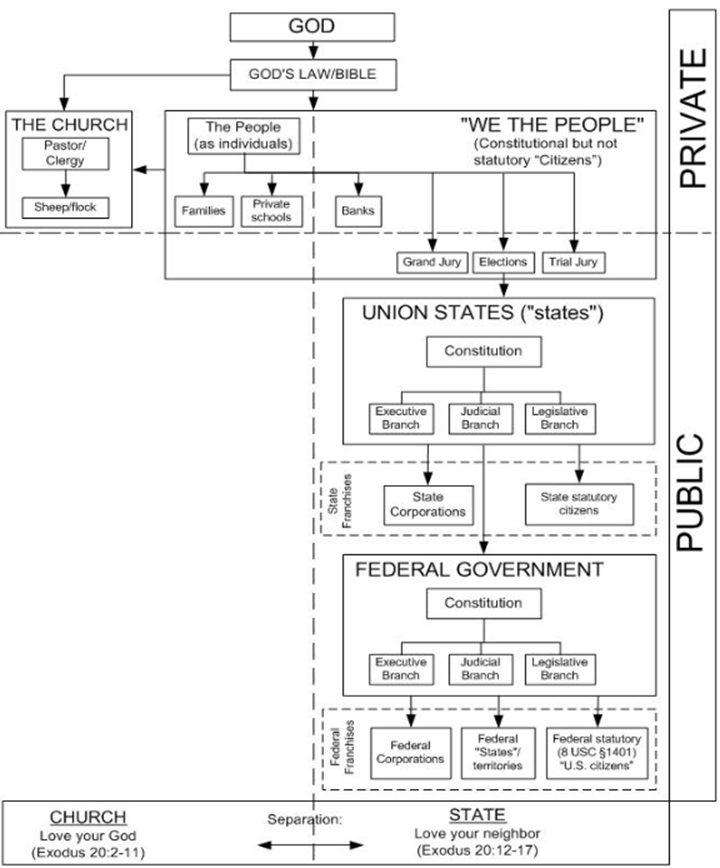
Each box in the above diagram represents a sovereignty or sovereign entity that helps distribute power throughout our system of government to prevent corruption or tyranny. The arrows with dark ends indicate an act of creation by the sovereign above. That act of creation carries with it an implied delegation of authority to do specific tasks and establishes a fiduciary relationship between the creator, and his subordinate creation. The above system as shown functions properly and fully and provides the best defense for our liberties _only_ when there is _complete_ separation between each sovereignty, which is to say that _all actions_ performed and _all choices_ made by any one sovereign:
- Are completely free of fraud, force, conflict of interest, or duress.
- Are accomplished _completely voluntarily_, which is to say that they are done for the mutual benefit of _all_ parties involved rather than any one single party exercising undue influence.
- Involve _fully informed_ consent made with a _full awareness_ by all parties to the agreement of all rights which are being surrendered to procure any benefits acquired.
- Are done mainly or exclusively for the benefit of the sovereign above the agent who is the actor.
- Are done for _righteous reasons_ and noble intent, meaning that they are accomplished for the benefit of _someone else_ rather than one’s own personal or financial benefit. This requirement is the foundation of what a fiduciary relationship means and also the _only_ way that conflicts of interest and the corruption they can cause can be eliminated.