Antifa
Videos
The Philosophy of Antifa

The Troubling Ties Between Antifa and the Southern Poverty Law Center
Antifa: Rise of the Black Flags
Antifa’s origins trace back to Germany in the 1930s, but modern iterations emerged in the 1970s–1980s across Europe as responses to neo-Nazism and far-right resurgence. It is not a single centralized "group" but a loose network of autonomous collectives that self-identify as Antifa or use similar branding (e.g., Antifaschistische Aktion). Based on historical and contemporary sources, below is a summary of European countries where Antifa or Antifa-inspired groups have been documented as active, focusing on those using the "Antifa" label or directly linked to it. I've included key historical periods and estimated durations of activity where data is available. Durations are approximate, as the movement is fluid and often underground during repressive periods.Country
Key Historical Periods and Activities
Estimated Duration of Activity - ~90 years total (1932–present, with interruptions 1933–1944 and 1946–1970s); modern continuous phase ~50 years (1970s–present).
Germany
Originated as Antifaschistische Aktion in 1932 under the Communist Party; dissolved in 1933 under Nazi rule; brief post-WWII revival (1944–1945) in anti-Nazi committees; modern resurgence in the 1970s–1980s via student and autonomist movements opposing neo-Nazis; activities include blocking far-right rallies (e.g., Dresden), protests (e.g., 2017 G20 in Hamburg), and clashes with extremists; monitored as far-left extremism by authorities.
Italy
Emerged pre-WWII (1920s–1930s) with groups like Arditi del Popolo opposing Mussolini's fascism; post-WWII resistance through partisans; modern groups active in anti-far-right protests and coalitions. ~100 years (1920s–present, with peaks in 1920s–1940s and resurgence post-1970s).
United Kingdom
Gained momentum in 1936 with the Battle of Cable Street against the British Union of Fascists; post-WWII groups like the 43 Group; modern Antifa-inspired networks (e.g., Anti-Fascist Action in 1980s) involved in protests against far-right marches; part of international networks like Antifa-Net. ~90 years (1930s–present, with modern resurgence ~40 years since 1980s).
Sweden
Modern groups like Antifascistisk Aktion formed in 1993; Revolutionary Front active in political violence; responses to far-right parties like Sverigedemokraterna; attacks on ~30 years (1993–present); tied to far-right rise over past 20–25 years.
France
Pre-WWII (1920s–1930s) confrontations with far-right groups; WWII resistance; modern Antifa groups active in protests against racism and fascism, including clashes with police and far-right.
~100 years (1920s–present, with modern phase ~50 years since 1970s).
Spain
1930s during Spanish Civil War (e.g., militias against Franco); post-WWII guerrilla resistance into 1960s; modern groups oppose far-right and participate in anti-fascist
~90 years (1930s–present, with interruptions post-1975 democratization).
Greece
Modern surge in 2010s amid economic crisis and Golden Dawn's rise; activities include protests, riots after 2013 murder of anti-fascist rapper Pavlos Fyssas; contributed to Golden Dawn's 2020 ban.
~15 years (2010s–present); broader anti-fascism since WWII.
Netherlands
Modern decentralized groups; no specific origin date, but active in far-left activism; recent debates over banning as "terrorist" organization (2025).
~40–50 years (1970s resurgence–present, aligned with broader European trends).
Hungary
Recent activity (2020s) against neo-Nazi events like Day of Honor rally; 2023 violence in Budapest; government moves to classify as terrorist group (2025).
~5 years (2020s–present); not highly active historically due to government control.
Austria
Modern activity noted in left-wing extremism; 2022 training camps for protests and self-defense.
~5–10 years (recent, tied to EU monitoring).
Ukraine
Decentralized groups operating amid political instability; no detailed history provided.
Antifa in the United States
Antifa in the United States is a decentralized, left-wing political movement focused on opposing fascism, white supremacy, racism, and far-right ideologies through direct action. It is not a single organization but a loose network of autonomous groups influenced by anarchist, communist, and socialist principles. The movement emphasizes "no platforming" far-right figures, community mutual aid, and militant resistance rather than relying on state institutions like police.
While most activities are nonviolent (e.g., research, protests, doxxing), some involve physical confrontations, property damage, and black bloc tactics for anonymity. Antifa's U.S. roots draw from European anti-fascist efforts in the 1930s but emerged distinctly in the late 1980s as a response to neo-Nazi and skinhead activity.
Historical Overview and Duration
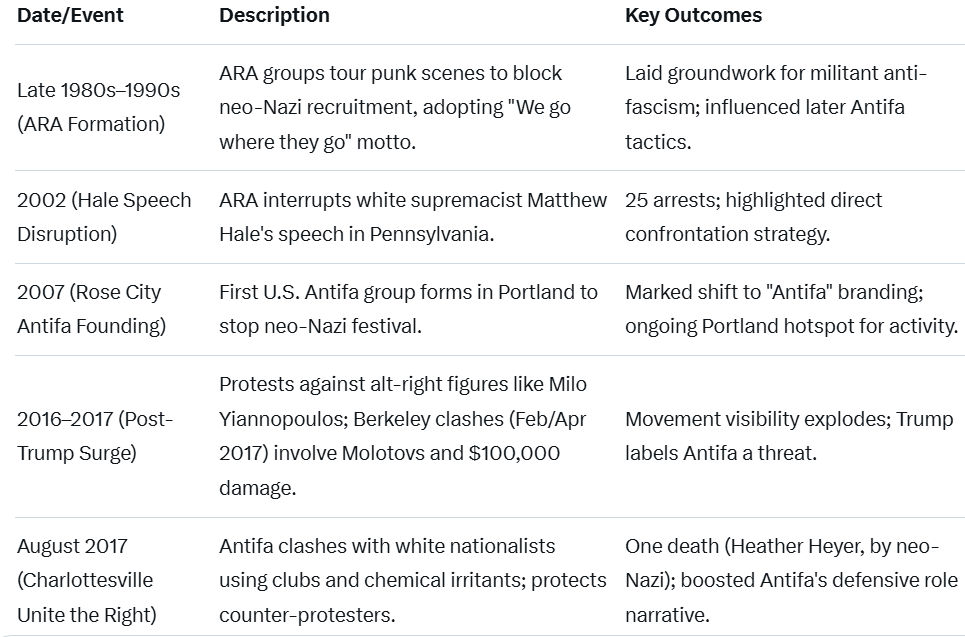
Modern U.S. Antifa traces to the Anti-Racist Action (ARA) network, formed in 1987–1988 to counter white supremacist recruitment in punk scenes. The first group explicitly using the "Antifa" name, Rose City Antifa, was founded in 2007 in Portland, Oregon, by former ARA members to disrupt a neo-Nazi music festival. The movement expanded rapidly after Donald Trump's 2016 election, amid rising alt-right visibility, and has remained active through protests against police violence and far-right rallies. As of 2025, approximately 200 groups operate nationwide, concentrated in urban areas like Portland, Berkeley, and New York.Estimated duration: ~38 years (1987–present), with formalized "Antifa" branding ~18 years (2007–present). Activity is continuous but peaks during far-right surges or social unrest.
Key Activities
- Direct Action and Confrontations: Disrupting far-right events via counter-protests, often using black bloc attire, improvised weapons (e.g., clubs, fireworks, chemical irritants), and tactics like de-arresting allies from police.
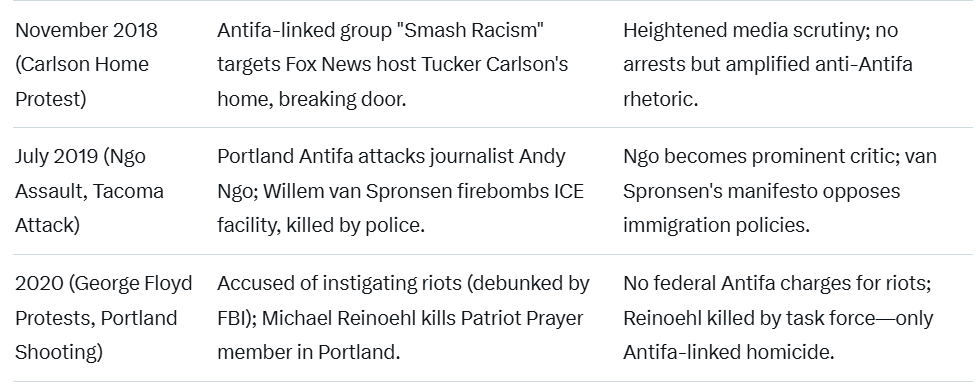
- Research and Exposure: Monitoring extremists online, doxxing (publicly identifying) them, and pressuring employers or venues to deny platforms.
- Mutual Aid: Organizing disaster relief (e.g., 2017 Hurricane Harvey), sanctuary networks for immigrants, and community defense.
- Ideology and Organization: Anti-capitalist, anti-state; coordinated via encrypted apps (e.g., Signal) and social media, without central leadership. Adherents view violence as a defensive escalation against perceived fascist threats.
Scholars and federal assessments (e.g., FBI, DHS) describe Antifa as an ideology rather than a structured group, with far-left violence far less lethal than right-wing extremism—only one confirmed Antifa-linked fatality in recent decades.
Notable Events
Recent Developments (as of October 2025)
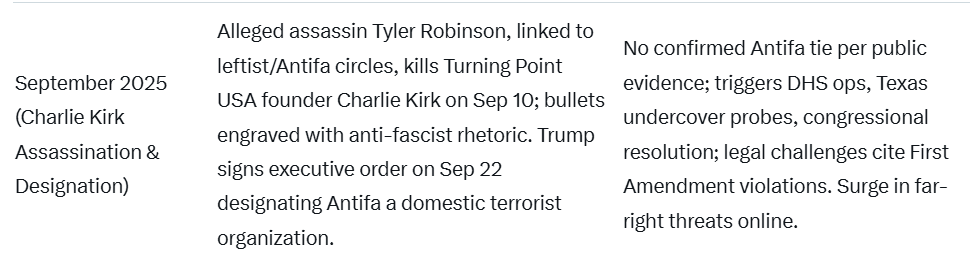
The Sep 22 executive order directs agencies to investigate and dismantle Antifa networks, framing it as an "anarchist enterprise" behind violence like armed standoffs and doxxing. Critics, including legal experts and ACLED, argue it's unconstitutional, as no domestic terrorism statute allows such designations for ideologies.
Post-designation, Texas AG Ken Paxton launched undercover ops against "leftist terror cells" (Oct 7), and DHS announced enhanced enforcement (Sep 26). The Kirk assassination, while unproven as Antifa-coordinated, has fueled politicization, echoing 2020 patterns. Far-right groups have ramped up threats, while Antifa activity appears subdued but ongoing in mutual aid and online monitoring. Federal data continues to rank white supremacists as the top domestic threat.