Pf - Expression reprogramming during liver development
Expression is highly variable during liver development: The switch is concentrated at hepatocyte entry and the sporozoite-to-trophozoite conversion; the mid-to-late liver transcriptome is comparatively stable by pairwise testing.
A more sensitive time-course model on the liver samples alone (quadratic in time, library batch blocked) still finds 811 genes (20% of tested) changing progressively across days 2–6, so late development is fine-tuning rather than a second wholesale switch — consistent in spirit with the paper's maSigPro result of 1,510 temporally regulated genes.
Peak-stage assignment of the 2,477: sporozoite 1,410, day 2 18, day 4 47, day 5 322, day 6 680.
Expression variation during liver development - Sporozoites
8-26 Claude Science: Yes — for P. falciparum it rests on one dataset, not on single-cell data
There is no single-cell transcriptomics of P. falciparum liver stages. Every single-cell liver-stage atlas is in another species: P. berghei (PMID 36352220, Nature 2022, 66 citations) and P. vivax (PMID 35443155, Cell Host Microbe 2022, 101 citations; PMID 36093191, 58; hypnozoite RBPs PMID 37392389, 22).
For P. falciparum the only genome-wide, time-resolved resource is bulk RNA-seq of parasites recovered from human liver-chimeric mice: GSE220039 (PMID 39891010, Nat Microbiol 2025, 20 citations; preprint PMID 36711670, 11) — days 2, 4, 5, 6 post-infection, three biological replicates each, with salivary-gland sporozoites as t₀ (sporozoite reference PRJNA344838, PMID 29539423, 129 citations). A 2025 review covers the landscape and its gaps (PMID 40263025). So I re-analysed that dataset from raw counts rather than taking the published figures on trust.
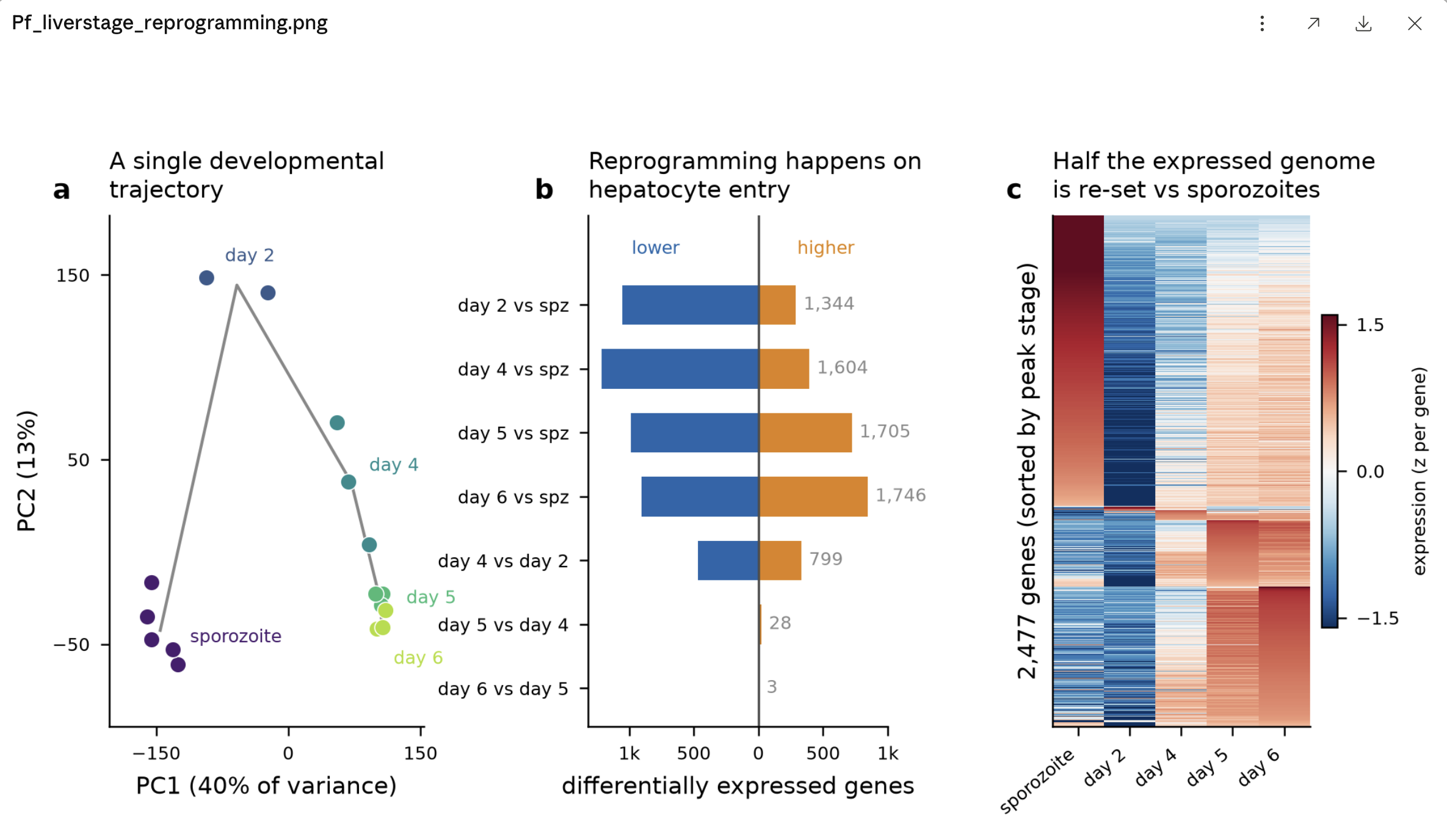
(a) PCA of parasite transcriptomes after rarefying every library to a common 9,481 parasite reads (16 libraries; the 376-read day-2 library excluded); points are libraries, the line joins stage centroids. (b) Differentially expressed genes (|log2FC| > 1, FDR < 0.05) from limma-voom on 4,891 filtered genes. (c) Stage-mean expression, z-scored per gene, of the 2,477 genes differentially expressed versus sporozoites, rows sorted by peak stage.
The quantitative case for "massive"
| Contrast | DEGs | % of 4,891 tested | % lower than sporozoite |
|---|---|---|---|
| day 2 vs sporozoite | 1,344 | 27.5 | 78.5 |
| day 4 vs sporozoite | 1,604 | 32.8 | 75.6 |
| day 5 vs sporozoite | 1,705 | 34.9 | 57.7 |
| day 6 vs sporozoite | 1,746 | 35.7 | 51.7 |
| union of the four | 2,477 | 50.6 | — |
About half the expressed genome is reset relative to the sporozoite, and early intrahepatic development is dominated by shutdown — which reproduces the published statement that ~70% of DEGs are less abundant with 28–36% higher.
When it happens: day 2 → day 4 gives 799 DEGs, day 4 → day 5 only 28, day 5 → day 6 only 3. The switch is concentrated at hepatocyte entry and the sporozoite-to-trophozoite conversion; the mid-to-late liver transcriptome is comparatively stable by pairwise testing. A more sensitive time-course model on the liver samples alone (quadratic in time, library batch blocked) still finds 811 genes (20% of tested) changing progressively across days 2–6, so late development is fine-tuning rather than a second wholesale switch — consistent in spirit with the paper's maSigPro result of 1,510 temporally regulated genes. Peak-stage assignment of the 2,477: sporozoite 1,410, day 2 18, day 4 47, day 5 322, day 6 680.
Two things to watch in this dataset
- Depth drives the naive ordination. Day-2 libraries yield only 376–21,687 parasite reads, and in a PCA of all 17 libraries PC1 correlates with parasite read depth at Spearman rho = 0.77. Rarefying every library to a common 9,481 reads drops that to rho = 0.18 while preserving the developmental ordering along PC1 (sporozoite −145 → day 2 −58 → day 4 +72 → day 5 +104 → day 6 +106). Panel (a) uses the rarefied version.
- ComBat-seq with default arguments erases the effect of interest. Four of the five sporozoite libraries are the external PRJNA344838 batch, so batch correction without a stage covariate removes the sporozoite-versus-liver signal: the same contrasts then return 7–211 DEGs instead of 1,344–1,746. Handling batch in the design recovers the published magnitudes. Both variants are in the summary table.
Caveats: bulk data, so these are population averages with no single-cell or spatial resolution for P. falciparum; one host model and parasite line (FRG huHep, NF54); days 3 and 7+ unsampled, so the switch is bracketed only between days 2 and 4; day-2 numbers are the least reliable. Model assumption diagnostics were not assessed.
- Pf_liverstage_reprogramming_report.md — dataset survey, methods, full results and caveats
- Pf_liverstage_DE_summary.csv — DEG counts for all contrasts under three analysis variants
- liverstage_reprogramming_genes.csv — the 2,477 reprogrammed genes with stage z-scores and peak stage
- Pf_liverstage_dataset_landscape.csv — candidate datasets with PMIDs, DOIs and citation counts