Julia Gillard HIGHLIGHTED
FROM: Misogyny highlighted
Misogyny was discussed worldwide in 2012 because of a viral video of a speech by Australian Prime Minister Julia Gillard. Her parliamentary address is known as the Misogyny Speech.
In the speech, Gillard powerfully criticised her opponents for holding her policies to a different standard than those of male politicians, and for speaking about her in crudely sexual terms.[41]
She was criticised for systemic misogyny, because earlier in the day her Labour Party had passed legislation cutting $728 million in welfare benefits to single mothers.[42]
Gillard's usage of the word "misogyny" promoted re-evaluations of the word's published definitions.
The Macquarie Dictionary revised its definition in 2012 to better match the way the word has been used over the prior 30 years.[43]
The book Down Girl, which reconsidered the definition using the tools of analytic philosophy, was inspired in part by Gillard.[10]: 83
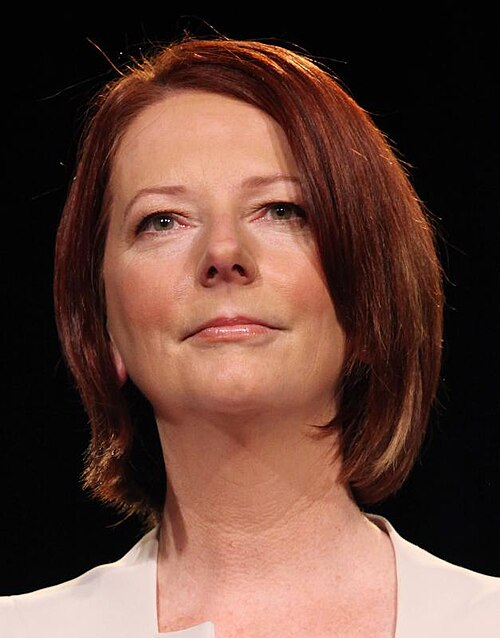
"Gillard" redirects here. For other uses, see Gillard (disambiguation).
Julia Eileen Gillard (born 29 September 1961) is an Australian former politician who served as the 27th prime minister of Australia from 2010 to 2013.
She held office as the leader of the Labor Party (ALP),
having previously served as the 13th deputy prime minister from 2007 to 2010.
She is the first and only woman to hold either office.
Born in Barry, Wales,
- Gillard migrated with her family
- to Adelaide in South Australia in 1966.
- She attended Mitcham Demonstration School and
- Unley High School.
- Gillard went on to study at the University of Adelaide,
- but switched to the University of Melbourne in 1982,
- where she graduated with a Bachelor of Laws in 1986 and
- a Bachelor of Arts in 1989.
- During this time,
- she was president of the Australian Union of Students
- from 1983 to 1984.
- In 1987,
- Gillard joined the law firm Slater & Gordon,
- eventually becoming a partner in 1990,
- specialising in industrial law.
- In 1996,
- she became chief of staff
- to John Brumby,
- the Leader of the Opposition in Victoria.
- Gillard was first elected
- to the House of Representatives at the 1998 election
- for the Victorian division of Lalor.
- Following the 2001 election,
- she was appointed to the shadow cabinet.
- In December 2006,
- Gillard became the running mate of Kevin Rudd
- in a successful leadership challenge
- to Kim Beazley,
- becoming deputy leader of the opposition.
- After Labor's victory at the 2007 election,
- she was appointed as deputy prime minister, and
- was also given the roles of
- Minister for Education,
- Minister for Employment and Workplace Relations, and
- Minister for Social Inclusion.
On 24 June 2010,
- after Rudd lost internal support
- within the Labor Party and
- resigned as leader,
- Gillard was elected
- unopposed
- as his replacement in a leadership spill, and
- was sworn in as prime minister.
- She led Labor
- through the 2010 election weeks later,
- which saw the first hung parliament
- since 1940.
- Gillard was able to form a minority government
- with the support of the Greens and
- three independents.
- During its term of office,
- the Gillard government
- introduced the National Disability Insurance Scheme (NDIS),
- the Gonski funding,
- oversaw the early rollout of the National Broadband Network (NBN), and
- controversially implemented a carbon pricing scheme.
- Her premiership was often undermined by party instability and
- numerous scandals,
- including the AWU affair and
- the Health Services Union expenses affair.
- Gillard and Rudd became embroiled in a lengthy political rivalry,
- resulting in Gillard losing the leadership
- of the party back to him
- in a June 2013 leadership spill.
- Her resignation as prime minister
- took effect the next day, and
- she announced her retirement from politics.
In the years following her retirement,
- Gillard has been a visiting professor
- at the University of Adelaide,
- the Senior Fellow
- at the Brookings Institution's Center for Universal Education,
- the chair of the Global Partnership for Education since 2014 and
- the chair of Beyond Blue
- from 2017 to 2023.
- She released her memoir,
- My Story,
- in 2014.
- In 2021,
- she became chair of
- the Wellcome Trust,
- succeeding Eliza Manningham-Buller.[1]
- Although Gillard often ranked poorly in opinion polls
- as prime minister,[2][3]
- her premiership has been more favourably received
- in retrospect.[4]
- Political experts often place her in
- the middle-to-upper tier
- of Australian prime ministers.[5]
SEE PDF FOR COMPLETE WIKIPEDIA ARTICLE DOWNLOADED:
Wednesday, September 30, 2026 11:09AM
Highlights and restructuring of the article are mine:
I AM SINCERELY UPDATED 9 30 2026
Thursday, October 01, 2026 06:51PM