Earth
Overview
Earth is the third planet from the Sun and the only place known in the universe where life has originated and found habitability. While large volumes of water can be found throughout the Solar System, only Earth sustains liquid surface water. Approximately 70.8% of Earth's surface is made up of the ocean, dwarfing Earth's polar ice, lakes, and rivers. The remaining 29.2% of Earth's surface is land, consisting of continents and islands.
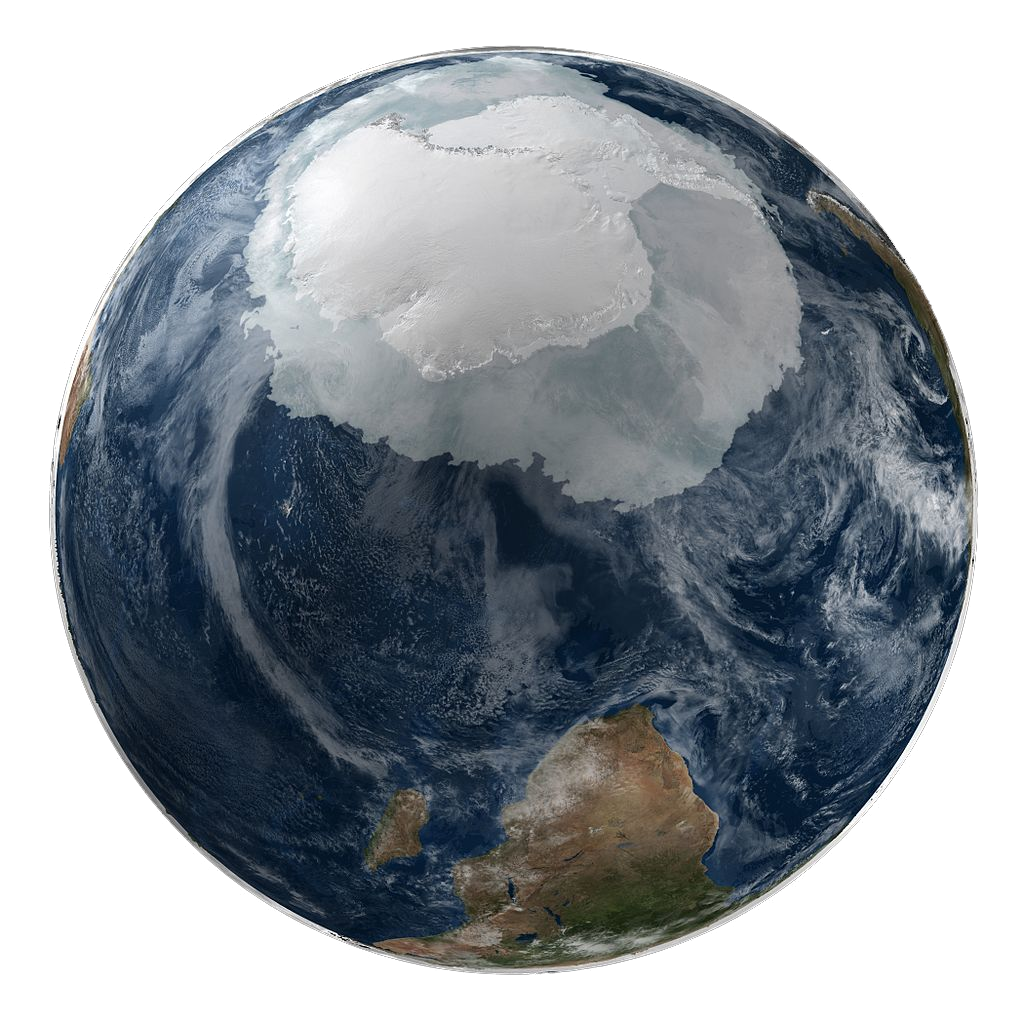
Earth's surface layer is formed of several slowly moving tectonic plates, which interact to produce mountain ranges, volcanoes, and earthquakes. Earth's liquid outer core generates the magnetic field that shapes the magnetosphere of Earth, deflecting destructive solar winds.
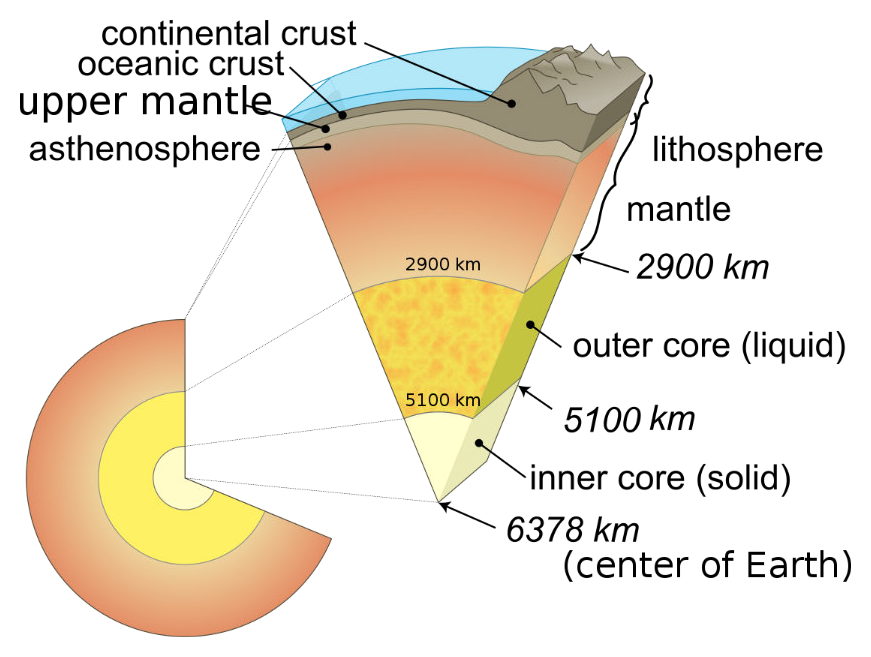
Depth[129] (km) | Component layer name | Density (g/cm3) |
|---|---|---|
| 0–60 | Lithosphere | — |
| 0–35 | Crust | 2.2–2.9 |
| 35–660 | Upper mantle | 3.4–4.4 |
| 660–2890 | Lower mantle | 3.4–5.6 |
| 100–700 | Asthenosphere | — |
| 2890–5100 | Outer core | 9.9–12.2 |
| 5100–6378 | Inner core | 12.8–13.1 |
Internal structure
Earth's interior, like that of the other terrestrial planets, is divided into layers by their chemical or physical (rheological) properties. They are commonly categorized as:
- Lithosphere
- Crust, Upper Mantle
- Lower Mantle
- Asthenosphere
- Outer Core
- Inner Core
The outer layer is a chemically distinct silicate solid crust, which is underlain by a highly viscous solid mantle. The crust is separated from the mantle by the Mohorovičić discontinuity. The thickness of the crust varies from about 6 kilometers (3.7 mi) under the oceans to 30–50 km (19–31 mi) for the continents. The crust and the cold, rigid, top of the upper mantle are collectively known as the lithosphere, which is divided into independently moving tectonic plates.
Earth is an ellipsoid with a circumference of about 40,000 km. It is the densest planet in the Solar System. Of the four rocky planets, it is the largest and most massive. Earth is about eight light-minutes away from the Sun and orbits it, taking a year (about 365.25 days) to complete one revolution. The Earth rotates around its own axis in slightly less than a day (in about 23 hours and 56 minutes). The Earth's axis of rotation is tilted with respect to the perpendicular to its orbital plane around the Sun, producing seasons. Earth is orbited by one permanent natural satellite, the Moon, which orbits Earth at 384,400 km (1.28 light seconds) and is roughly a quarter as wide as Earth. Through tidal locking, the Moon always faces the Earth with the same side, which causes tides, stabilizes Earth's axis, and gradually slows its rotation.