Protein Convertases
protein convertases
(:{Izzaguire 2019 Viruses Review pmid: 31505793:(style="color:#ff0000"):}:) PCs are eukaryotic serine proteases classified in the MEROPS Peptidase Database within the S8Bfamily. Furin, PC4, PC5, PACE4, and PC7 are part of the Kexin-like subfamily of PCs and localize tothe organelles of the constitutive protein secretion pathway [1].
- perform the proteolytic post-translational modification of a large variety of peptides and proteins in the trans-Golgi network, endosomes, and pericellular environment, and are critical regulators of central cellular processes, such as growth, proliferation, and differentiation [11–13].
- Kexin-like PCs are divided into two specificity groups: Furin - more reactive than the other; and the PC4/PC5/PACE4/PC7 [9]. differences in reaction specificity between the two groups are based on active-site and exosite determinants of reactivity.
- expression profile: cell-type dependent - most cells express some or all of them, except for PC4 (restricted to cell types in the testes, ovaries and the placenta).
- homology between PCs: conserved catalytic and regulatory P domains that share 50–65% amino acid sequence homology
- Furin, PC5, and PC7 are type I membrane-bound proteins, and furin and PC5 can be shed extracellularly
- PACE4 is a secreted protein
- Cleavage motif: composed of P4Arg—P3X—P2X—P1Arg—P1′X, where X is any amino acid residue, and cleavage occurs between the P1Arg and P1′X residues
see: Proprotein convertase - Wikipedia
| current PCSK nomenclature | Other common names | Other common names | Other common names | Other common names |
|---|---|---|---|---|
| PCSK1 | PC1, PC3 (new name: PC1/3) | PCSK2 | PC2 | |
| PCSK3 | Furin, Pace, PC1 | PCSK4 | PC4 | |
| PCSK5 | PC5, PC6 new name:PC5/6 | PCSK6 | PACE4 | |
| PCSK7 | PC7, PC8 | PCSK8 | Site 1 Protease, S1P,SKI | |
| PCSK9 | NARC-1 | NARC-1 | NARC-1 | NARC-1 |
PCs in diseases
(:{Izzaguire 2019 Viruses Review pmid: 31505793:(style="color:#ff0000"):}:) activation of bacterial toxins such as Shiga, anthrax, Clostridium, Pseudomonas, and diphtheria; and also, for the treatment of degenerative diseases such as metastatic cancer, Alzheimer’s, and osteoarthritis [2,4,5].
see also: Scamuffa 2006 FASEB pmid: 17012247 ; (Klein-Szanto 2017 pmid: 28456517)
Structures of Protein Convertases
(Henrich JMB 2005 pmid: 15571716) crystal structures of the soluble mouse furin and yeast kexin ectodomains -> architecture of the substrate binding clefts. Based on experimental - modelled the structures of the other human/mouse PCs. According to topology and to structure-based sequence comparisons, these other PCs closely resemble furin, with PC4, PACE4 and PC5/6 being more similar, and PC1/3, PC2 and PC7 being less similar to furin. Except for PC1 and PC2, this order of similarity is valid for the catalytic
Inhibitors of Protein Convertases
PCs in Coronavirus processing
(:{Izzaguire 2019 Viruses Review pmid: 31505793:(style="color:#ff0000"):}:) Furin is not the only protease that regulates the function of the coronavirus fusion protein. - membrane-bound TMPRSS, the lysosomal cathepsins, elastase, and coagulation factor Xa have also been implicated [54,55].
- The highly virulent MERS-CoV (Middle East respiratory syndrome coronavirus) is the only naturalvirus known to have PC cleavage site motifs at both the S1–S2 and S2′sites.
- MERS-CoV has an expanded tropism compared to other coronaviruses, so it is considered polytropic [58]. Only the S2′site in SARS-CoV(severe acute respiratory syndrome coronavirus) has a PC cleavage site motif [54,55]. The fact thatMERS-CoV and SARS-CoV are highly pathogenic, and that IBV-Beaudette is apathogenic is in line with these viruses reacting with proteases other than the PCs [61,62]. TMPRSS2 promotes SARS-CoVand MERS-CoV infection in vivo [63]. - Cov-2 has Furin site!!!
- The engineering of PC specificity at the cleavage sites of coronavirus S proteins can modify the virus tropism and virulence [64,65]. The conversion of a monobasic cleavage site into a polybasic site not only makes the virus susceptible to PC cleavage but also increases the chance of cleavage by other proteases that target single arginine residues, so it is not surprising that MERS-CoV is so pathogenic. Haben die Amerikaner vielleicht doch den Cov-2 gemacht ??!! ;-)
Mouse knock-outs of PC and effects
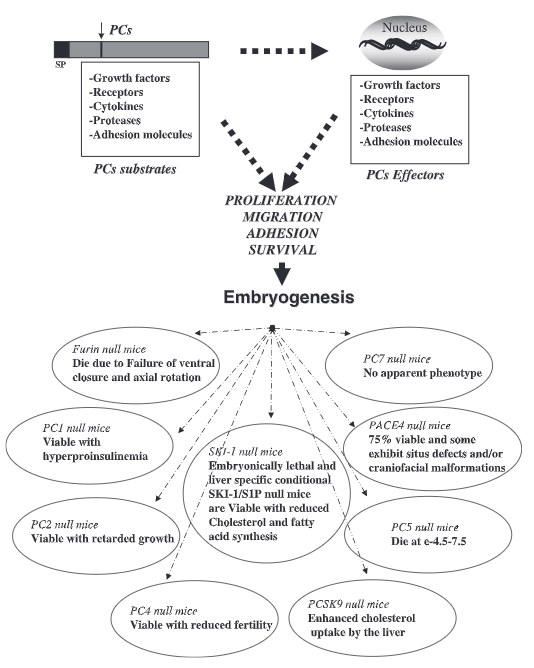
(Scamuffa 2006 FASEB pmid: 17012247 ) information gathered from the available PC null mice revealed that only the absence or dysfunction of furin, PC5/6, and SKI-1/S1P is lethal at early embryonic stages. KO mice of PC1/3 (PCSK1), PC2 (PCSK2) genes are viable despite the manifestation of hormonal and/or neuroendocrine deficiency. PC4 null mice are infertile or subfertile. PACE4 null mice are 75% viable and some exhibit craniofacial abnormalities. Tissuespecific conditional KO allowed the analysis of the function of some PCs in these tissues. Thus, liverspecific conditional SKI-1/S1P null mice exhibit disorganized lipid and fatty acid homeostasis due to the lack of SREBP-1 and SREBP-2 processing, and PCSK9 knockout mice show enhanced cholesterol uptake by the liver LDLR. Only mice with disrupted PC7 gene (PCSK7) failed to show any apparent abnormal phenotype