SARS-CoV2 Transcriptomic changes
High quality study
RNA-seq, SLAM-seq, Ribosome profiling in CoV2
check for seq-data
(pmid: 33979833) Nature 2021: Although several different proteins of SARS-CoV-2 have previously been implicated in shutting off host expression4–7, a comprehensive picture of the effects of SARS-CoV-2 infection on cellular gene expression is lacking. Here we combine RNA sequencing, ribosome profiling and metabolic labelling of newly synthesized RNA to comprehensively define the mechanisms that are used by SARS-CoV-2 to shut off cellular protein synthesis. We show that infection leads to a global reduction in translation, but that viral transcripts are not preferentially translated. Instead, we find that infection leads to the accelerated degradation of cytosolic cellular mRNAs, which facilitates viral takeover of the mRNA pool in infected cells.
several proteins of SARS-CoV-2 have previously been implicated in shutting off host expression4–7,
two independent biological replicates for the uninfected cells and cells collected at 8 h after infection
sequencing total RNA (without rRNA depletion). reveals an increase in the pool of mRNAs during infection, owing to the massive production of viral transcripts; however, the relative fraction of cellular mRNA is reduced by approximately twofold.
he majority of cellular RNAs are reduced during SARS-CoV-2 infection and that this reduction probably contributes to the shutting off of cellular protein synthesis.
evels of transcripts that mostly localize to the cytoplasm are reduced more in infected cells, as compared to transcripts that are mostly nuclear
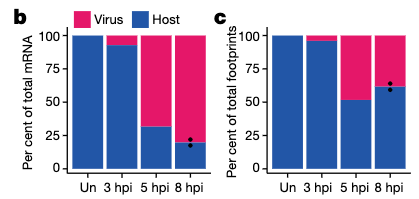
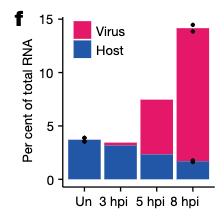
To directly evaluate mRNA decay, we used thiol (SH)-linked alkylation for the metabolic sequencing of RNA (SLAM-seq)17 on uninfected and SARS-CoV-2-infected cells (Extended Data Fig. 5a)
measure the half-lives of endogenous mRNAs on the basis of the incorporation of 4-thiouridine (4sU) into newly synthesized RNA, the conversion of 4sU into a cytosine analogue and the quantification of these U-to-C conversions by RNA-seq17,18. We obtained all of the characteristics of a high-quality SLAM-seq library: over 3,000 quantified genes, rising U-to-C mutation rates and an increase in the portion of labelled RNA over time, which was stronger in infected cells (indicating a faster turnover of RNA in infected cells) (Extended Data Fig. 5b–e). There was a strong correlation between the half-lives estimated from our measurements and estimates that were previously conducted19 in a different cell type (Extended Data Fig. 5f). Importantly, we observed a substantial reduction in the half-lives of cellular mRNAs upon SARS-CoV-2 infection
Nsp1 alone is not the answer
(pmid: 33979833) We observed a weak, but significant, correlation between the translation efficiency of cellular genes and the reduction in their mRNA half-life after infection (Extended Data Fig. 5i), which indicates that accelerated turnover of cellular transcripts in infected cells may be related to their translation. To assess the role of NSP1 in RNA degradation, we analysed RNA-seq data from cells transfected with NSP124, which revealed that ectopic NSP1 expression leads to weaker but similar signatures to those that we identified in infected cells