5' UTR - RNA Structures and functions
(5' PS)
PS of Betacoronavirus lineage B (ie SARS-CoV)
(pmid: 32398273)
(pmid: 32577650) variation in CoV-2: SL1 and flanking single-stranded regions contain nine of the twenty variants identified. In contrast, no rapidly emerging variants (MAF >0.005)are found in SL2 through SL4.
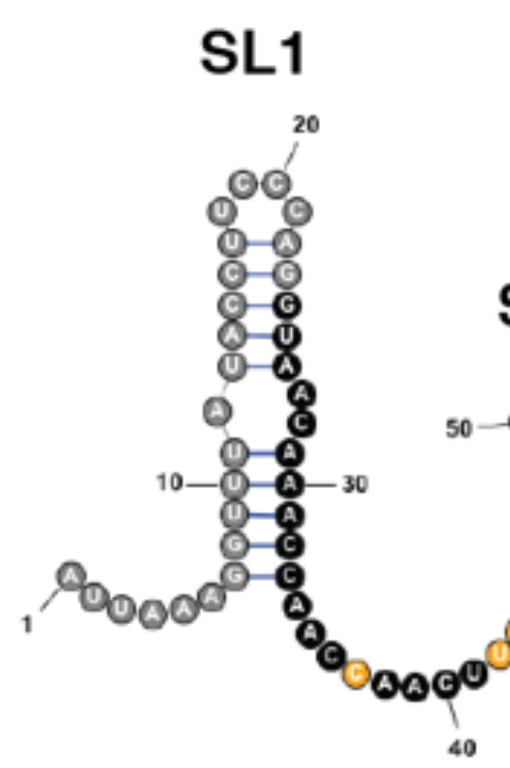
SL1
(pmid: 32577650) In MHV, stem loop 1 (SL1) plays a critical role in virus replication and is proposed to form long-range interactions with the 3 ́UTR(Zuniga et al. 2004; Li et al. 2008).
effect of variations: Most of the rapidly emerging variants in SL1 enhance the stem loop structure. This suggests that SL1 stabilization is not overly deleterious to virus replication. In MHV, by contrast, destabilizing mutations of the lower stem are well tolerated in a cell model of virus replication, but mutations that increase the stability the lower stem block replication(Li et al. 2008).
observations suggested that the lower portion of SL1 must be able to unfold and likely interacts with the 3’ UTR to assist in sgRNA transcription (Li et al., 2008)
in vivo SHAPE: (pmid: 32676598 Pyle 2020) bipartite domain architecturefor SL1
SL2
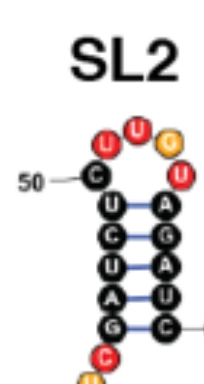
(Lan 2020 doi: 10.1101/2020.06.29.178343) The most evolutionarily conserved secondary structure in the 5’ UTR is stem loop 2 (SL2) and the structure of the MHV SL2 has been solved by NMR (Liu et al., 2009). C50 within the loop of SL2 has low reactivity, this is explained by the NMR structure, in which C50 and G53 (as numbered here) are paired.
Interestingly, the secondary structure but not the sequence of the stem was shown to be essential for replication: in a previous study, disruption of SL2 by three mutations on either side of the stem prevented MHV-A59 replication, but compensatory mutations restored nearly wildtype growth (Liu et al., 2007). Mutants of MHV-A59 with non-functional SL2 were able to transcribe minus-strand genomic RNA in cells but not minus-strand subgenomic RNAs, suggesting that SL2 plays a role in discontinuous transcription. Disruption of SL2 also reduced the rate of in vitro translation of a downstream luciferase reporter (Liu et al., 2007). To the best of our knowledge, the precise mechanism through which SL2 is required for viral replication remains unknown.
(pmid: 32577650) Stem Loop 2 (SL2) contains a highly conserved sequence and structural elements thought to play a role in sgRNA synthesis(Liu et al. 2007; Liu et al. 2009; Chen and Olsthoorn 2010; Lee et al. 2011).
(pmid: 32676598 Pyle 2020) SL2 pentaloop is stacked atop a 5-bp stem. In addition, the pentaloop adopts a canonical CUYG fold in which the uracilis flipped out
in vivo SHAPE: (pmid: 32676598 Pyle 2020)
SL3 - TRS
(pmid: 32577650) The structure of Stem loop3(SL3) is less well conserved, but it contains the leftmost transcription regulatory sequence (TRS-L) required for template switching in sgRNA production(Zuniga et al. 2004; Sola et al. 2005; Yang and Leibowitz 2015).
(pmid: 32398273) RNA secondary structure in the 5 ́ UTR exposes a critical sequence motif, the transcriptional regulatory sequence (TRS), that forms long-range RNA interactions necessary for facilitating the discontinuous transcription characteristic to coronaviruses (van den Born, et al. 2005).
located in SL3
(doi: 10.1101/2020.06.23.167916)
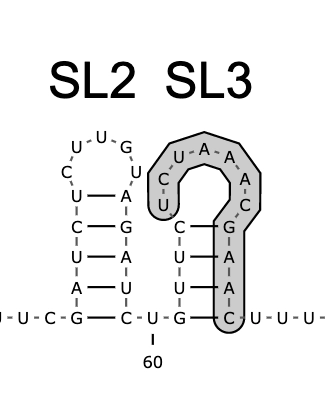
(Lan 2020 doi: 10.1101/2020.06.29.178343) The TRSs are short sequences that are critical for the transcription of subgenomic RNAs (sgRNAs), from which all proteins not encoded by ORF1ab are translated (Sola et al., 2015). The SARS-CoV-2 genome contains ten TRSs: one “leader TRS” (TRS-L) located in the 5’ UTR, and nine “body TRSs” (TRS-B), one preceding each open reading frame other than ORF1ab (Kim et al., 2020).
The nine TRS-Bs give rise to nine sgRNAs via discontinuous transcription (Sola et al., 2015). In this process, transcription of a minus-strand sgRNA begins at the 3’ end of the genomic RNA. When transcription reaches one of the TRS-Bs, the nascent transcript dissociates from the TRS-B and re-anneals to the TRS-L. Transcription resumes at the TRS-L and finishes at the 5’ end of the genomic RNA. Thus, each sgRNA contains a short 5’ “leader” sequence (69 nt from the 5’ end of the genome to TRS-L) followed by the TRSB and the portion of the genome downstream of the TRS-B. Nine of the ten TRSs in the SARS-CoV-2 genome contain the same core sequence (CS) of 6 nt (ACGAAC) flanked by short sequences that vary among the TRSs (Kim et al., 2020). The one exception is the TRS of ORF7b, whose CS is AAGAAC. Interestingly, while the CSs of SARS-CoV-2 and SARS-CoV are identical, the sequence differs substantially from the CSs of other closely related coronaviruses (Yount et al., 2003). Transcription regulating sequences - TRS
SL4
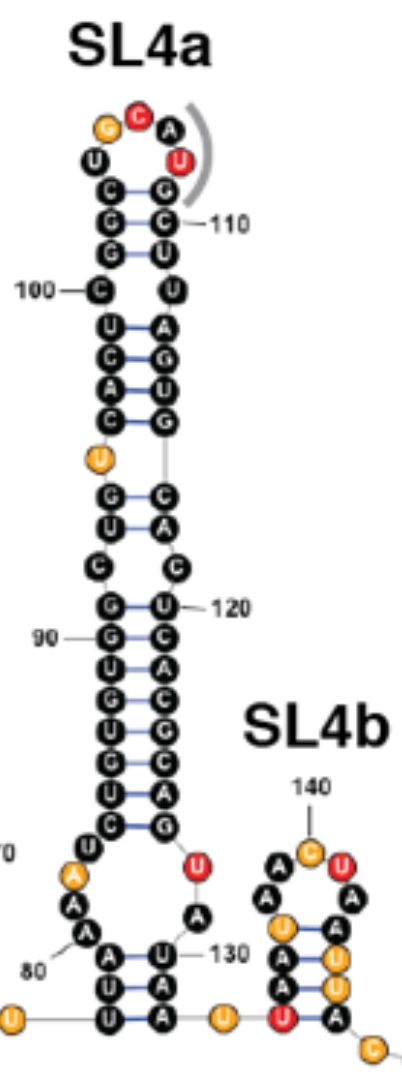
(pmid: 32577650) bulged Stem loop4 (SL4) contains an upstream open reading frame (uORF) that could reduce translation initiation at the ORF1a start codonand/or act as a spacer between 5 ́ structured elements and ORF1a(Raman et al. 2003; Yang et al. 2011; Wu et al. 2014).
(Lan 2020 doi: 10.1101/2020.06.29.178343) MHV found that SL4 was required for sgRNA synthesis and that deleting the entire SL4 was lethal (Yang et al., 2011). However, mutation or deletion of either the lower (SL4a) or upper (SL4b) part of SL4 merely impairs replication, with disruption of SL4a causing greater impairment (Yang et al., 2011). In addition, replacing the entire SL4 with a shorter, unrelated sequence that was predicted to fold into a stable stem loop impaired MHV growth but was not lethal (Yang et al., 2011). Based on these results, Yang et al. proposed that discontinuous transcription requires proper spacing between the stem loops upstream and downstream of the TRS, and SL4 maintains this space (Yang et al., 2011). SL4 also contains the start codon of a short open reading frame (nine codons in SARSCoV-2) known as the “upstream” ORF (uORF) (Madhugiri et al., 2014). In a study on MHV, disruption of the uORF start codon increased translation of ORF1a and modestly decreased viral replication (Madhugiri et al., 2014).
in vivo SHAPE: (pmid: 32676598 Pyle 2020) The SL4 of SARS-CoV-2 adopts a bipartite domain structure (Fig 2A, labeled SL4a, SL4b) similar to that reported for MHV(Kang et al., 2006, Yang et al., 2015). Importantly, the AUG of the predicted upstream ORF(uORF), which is phylogenetically conserved among β-coronaviruses (Raman et al., 2003), is found in the top-most stem loop of SL4a, meaning it would be accessible for recognition by a scanning ribosome(Fig 2A, uORF start codon indicated with solid greyline)
SL5
(pmid: 32577650) This region contains three stems (SL5a, SL5b, and SL5c) connected by a helical junction. There is considerable sequence divergence among the coronaviridae in this structure, but the overall fold is largely preserved(Chen and Olsthoorn 2010). In SARS-CoV-2, theSL5a stem occludes the initiation codon for ORF1a, suggesting this structure must open prior to translation initiation. However, the SL5a stem is essential for virus replication in a bovine coronavirus (BCoV) model (Brown et al. 2007).The role of SL5c is more controversial, with one study demonstrating that the stem is dispensable (Yang and Leibowitz 2015), while a previous study showed that it is required(Brown et al. 2007).
(doi: 10.1101/2020.06.23.167916) SL5ABC is conserved among betacoronaviruses, suggesting the essential roles of these stem-loops structures as cisacting regulatory elements in the life cycle of CoVs such as viral replication.
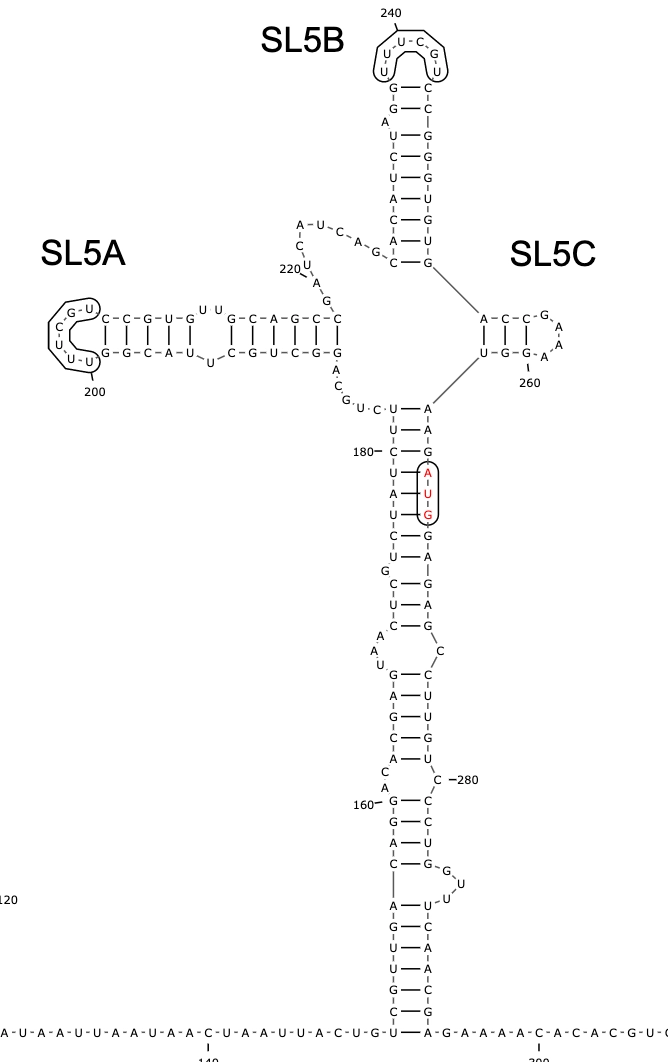
in vivo SHAPE: (pmid: 32676598 Pyle 2020) This includes UUCGU pentaloop motifs in SL5A and SL5B, and a GNRA tetraloop in SLC. Previous reports suggest this may represent a packaging signal for GroupIIB CoVs(Chen and Olsthoorn, 2010).
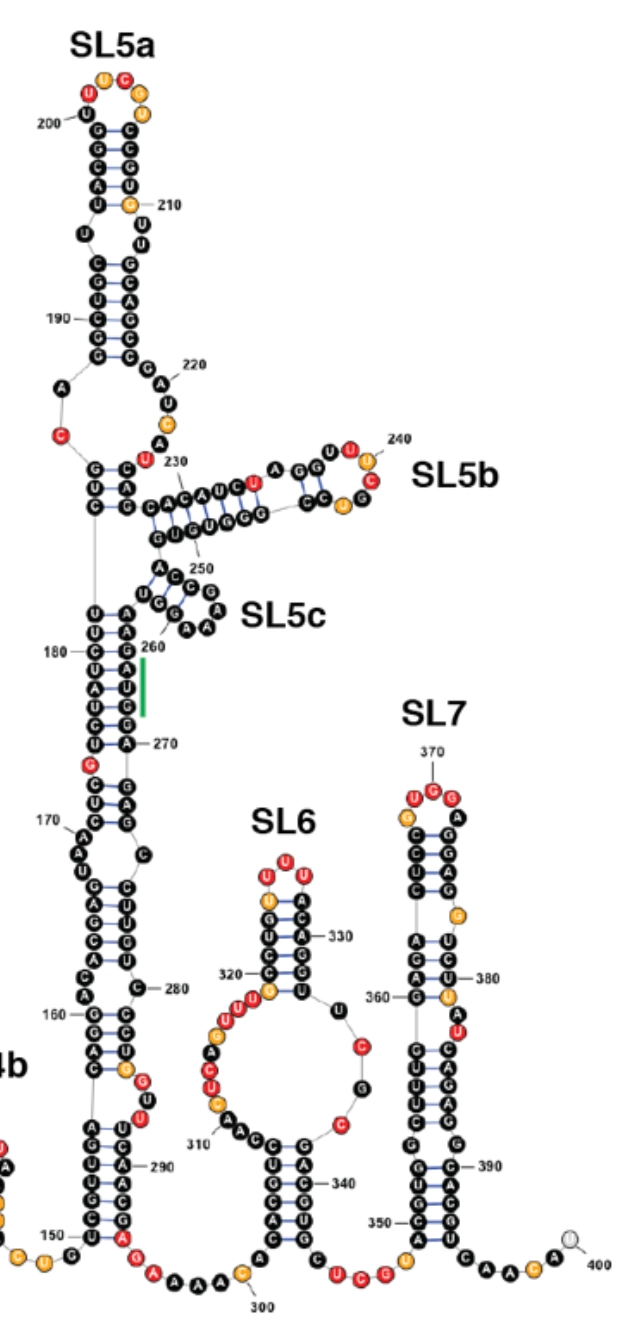
see above: SL6 and SL7 are predicted in the SARS-CoV-2 structure, and thein-vivoSHAPE data agree strongly support theexistence of these stems(Fig 2A, labeled SL6 and SL7). However, functional evidence for SL6 and SL7 is lacking in the literature for any coronavirus
(Lan 2020 doi: 10.1101/2020.06.29.178343) Mutations of SL6 that disrupt its secondary structure but preserve the amino acid sequence of nsp1 were not lethal in MHV, suggesting that SL6 is not essential (Yang et al., 2015)