NP - posttranslational modifications
PMID: 36627683 /2023
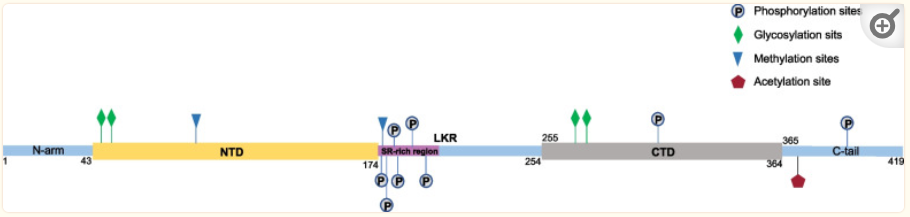
Phosphorylation
PMID: 35874957/2022 The phosphorylation of the SR domain of the N protein can decrease the degree of recruitment of RdRp components to condensates ^37. The interaction between N and Nsp3 is essential for viral replication. The N-terminal of N has an RNA-binding domain (N-NTD) that can bind the RNA genome, whereas, the C-terminal domain (N-CTD) can interact with the viral Nsp3 ^39.
(pmid: 32766587) N protein incorporated into virions is hypophosphorylated (25, 26). We and others have shown that N protein condensates in cells show a more liquid-like behavior than those assembled in vitro , and recent reports directly implicate phosphorylation of the S/R-rich region in this behavior difference (52, 56).
Arg methylation
(Cai Richard BioRxiv doi: 10.1101/2021.03.24.436822) PRMT1 methylates SARSCoV-2 nucleocapsid (N) protein at residues R95 and R177 within RGG/RG sequences.
required for its RNA binding capacity - a type I PRMT inhibitor (MS023) or substitution of R95K or R177K inhibited interaction with the 5’-UTR of the SARS-CoV-2 genomic RNA.
Methylation of N protein at R95 - suppress the formation of SGs. MS023 treatment or R95K substitution blocked N-mediated suppression of SGs.
With type I PRMT inhibitors being in clinical trials for cancer treatment, inhibiting arginine methylation to target the later stages of the viral life cycle such as viral genome packaging and assembly of virions may be an additional therapeutic application of these drugs.
Acetylation
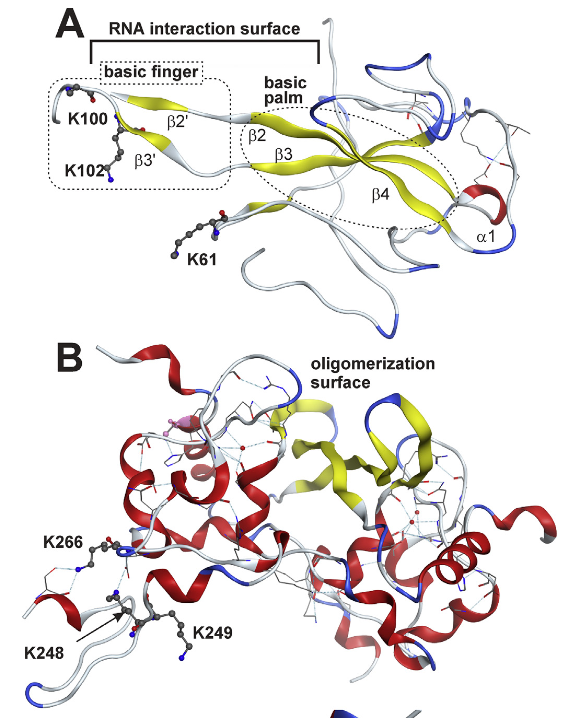
(pmid: 33894414) N proteins are strongly acetylated by human histone acetyltransferases, P300/CBP-associated factor (PCAF), and general control nonderepressible 5 (GCN5), but not by CREB-binding protein (CBP) in vitro. 12 acetyl-lysine residues. potential effect on RNA binding
Glycosylation
(pmid: 33997890) - native N Protein model had O-phosphorylation at Ser176 and no glycosylation