NP - Comparative Protein Structure
Structure intro
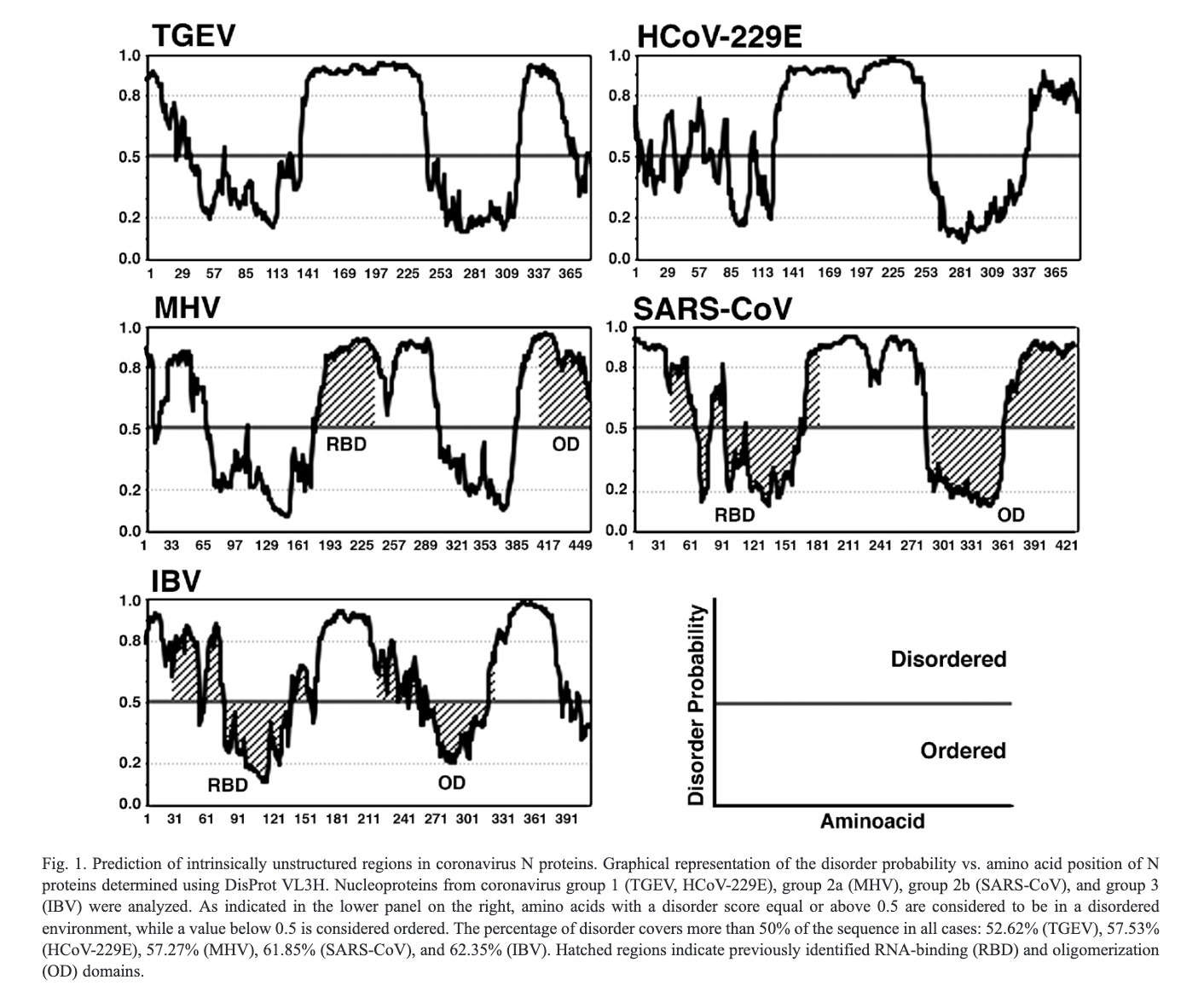
(pmid: 25810552) A combination of protein sequence alignment, secondary structure and intrinsic disorder predictions suggests that all CoV N proteins share the same modular organization [44].
-- Coronavirus N proteins contain three intrinsically disordered regions (IDRs): N-arm, central linker region (LKR) and C-tail, and two structural domains: Nterminal domain (NTD) and C-terminal domain (CTD), where the NTD and CTD are sandwiched between three IDRs.
-- NTDs involved in RNA binding,
-- CTDs are involved in RNA binding and oligomerization [45–50].
-- All three IDRs modulate the RNA-binding and oligomerization properties of NTD and CTD, respectively [51]. For example, Nterminal IDR has been implicated in the RNA binding of the N protein. It has also been reported that the LKR and the C-terminal IDR are involved in the oligomerization of the N protein [47]. In addition, the LKR of the N protein with Ser–Arg-rich sequences has also been shown to contain an RNA-binding region and putative phosphorylation sites that might regulate N protein functions [52– 54] and N–M interaction. The RNA-binding activity of the LKR also contributes toward RNA chaperone activity, and is involved in template switching under in vitro conditions [33].
Protein details
see geneious
see uniprot: P0DTC9 · NCAP_SARS2 see uniprot-cov19
(.data/md-images/3009cb0c-2730-4380-b8e9-f5de0fee39d1.webp)
Overall structure of the full length NP
2022 PMID: 35696898 - Conformational ensemble of the full-length SARS-CoV-2 nucleocapsid (N) protein based on molecular simulations and SAXS data
the dimer of N: exhibits large conformational fluctuations with its radius of gyration ranging from about 4 to 8 nm.
The RNA-binding domains do not make direct contacts.
The disordered region that links these two domains comprises a hydrophobic α-helix which makes frequent and nonspecific contacts with the RNA-binding domains.
Each of the intrinsically disordered regions adopts conformations that are locally compact, yet on average, much more extended than Gaussian chains of equivalent lengths.
Structure determination
(pmid: 25810552) The fold and the distribution of the secondary structures of the N-terminal domain are essentially conserved across the various CoVs [41,55].
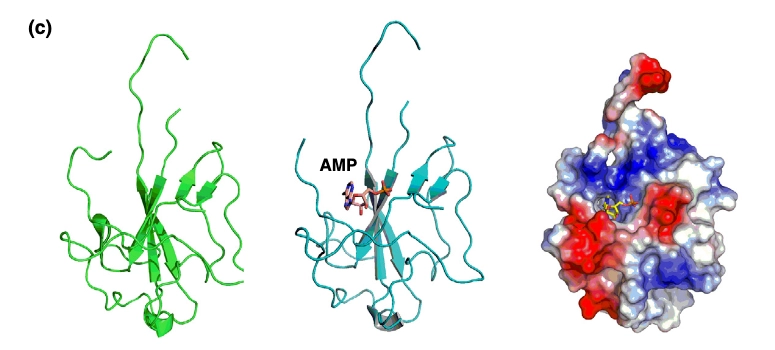
The crystal structures of the C-terminal domains of SARS-CoV, MHV and IBV N proteins show a similar stable fold in which the fourstranded b-sheet forms one face and the a-helices form the opposite face, suggesting that the dimerized N protein is the building block for all groups of coronaviruses [45,46,49,50,60].
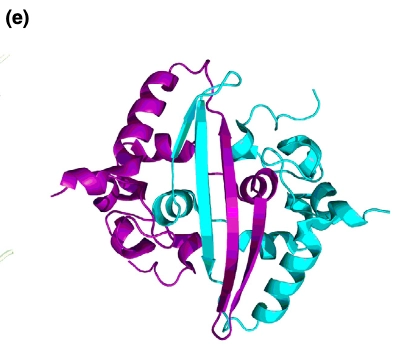
The C-tail region has an important role in oligomerization [58]. However, owing to its highly disordered sequence, no NMR or crystal structures have been solved to date.
unstructured regions
(pmid: 16979208)