NP - CTD biochemical analysis
CTD is a dimer and the isolated domain tends to oligomerize
analytical UZ of dimer
(Peng 2020 Embo pmid: 32914439) - see for purification protocol
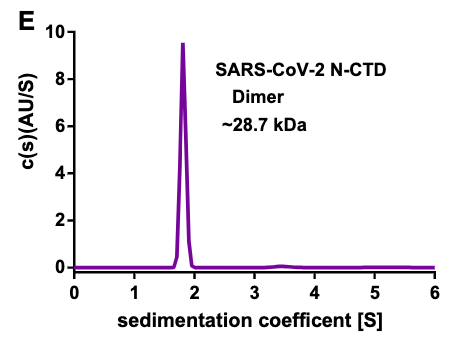
CTD dimer formation and stability
(Zinzula Baumeister BBRC 2020 PMID: 33039147) CTD from CoV - avian infectious bronchitis virus (IBV), the mouse hepatitis virus A59 (MHV-A59), the human CoV NL63 (hCoV-NL63), the SARS-CoV and the MERS-CoV, reported the selfassociation of this domain into a stable dimer [21,32-37].
isolated CTD domains tend to form oligomers
(Zinzula Baumeister BBRC 2020 PMID: 33039147) crystal packing analysis suggested that SARS-CoV N CTD dimers are able to form octameric superhelical complexes, and transient interactions between CTD dimers leading to the formation of higher-order oligomers were reported to occur in solution, depending on protein concentration [21,38]. Furthermore, a work published during the preparation of this manuscript described fulllength SARS-CoV-2 N in either dimeric and oligomeric state, as detected by static light scattering and chemical cross-linking [39].
SARS-CoV - CTD octamers
(PMID: 16254320) held together through hydrophobic interactions and hydrophilic contacts among the four dimers. Although the interactions between dimers seem weak when examined individually, the multitude of interactions compensate for the weakness and provide the basis for octamer formation in the crystal.
Our previous NMR study at millimolar concentrations also showed that the CTD exists predominantly in the dimeric form.11,13
It is interesting to note that the dimer–dimer and tetramer–tetramer interfaces are relatively small, ∼1000 Å2, indicating that the octamer is not a stable form of the CTD, even in the crystal.
CTD stability
SARS-CoV-2 N CTD
(Zinzula Baumeister BBRC 2020 PMID: 33039147) full-length N protein of SARS-CoV - thermally unstable, starting to unfold at 37°C and denaturing at 55°C, whereas for the protein from hCoV-OC43 a melting temperature (Tm) valueof 55°C was reported [40,41].
nanoDSF two transitions, corresponding to Tm values of49.3±0.1°C and 54.9±0.1°C. - the SARS-CoV-2 N CTD exists in a stable dimeric state in solution and suggest that the overall stability of the protein depends on the self-association of this domain.
The nanoDSF twin transitions and relatively low Tm values - suggests dynamics in solution - prone to undergo conformational changes with respect to the compactness shown by the crystal structures. Conformational dynamism in aqueous environment has been suggested by NMR data for the same domain from SARS-CoV, which showed disordered and protruding N-termini from each CTD monomer and a more relaxed dimer interface due to significant perturbations at the b-sheet interlace [21].
our nanoDSF data: see CTD - nanoDSF Results
SARS-CoV CTD
(Chen 2007 PMID: 17379242) a core stabilized by multiple hydrophobic interactions.14
Residues required for dimerisation
PMID: 16214138
SARS-CoV
(PMID: 16254320) stabilized by hydrophobic interactions. The combination of hydrogen bonds and hydrophobic interactions results in a very stable dimer with a buried surface area of ∼5280 Å2. Thus, the dimer structure seems to be the most stable structure in solution, in agreement with previous results.11,13,21