STONY LAKE EAST GOLD PROJECT
Located within the Cape Ray/ Valentine Lake structural trend in Central Newfoundland
Project covers 13,025 ha and 27 kilometers of favorable trend between Sokoman’s Moosehead discovery to the northeast and Marathon's Valentine Lake deposit to the southwest.
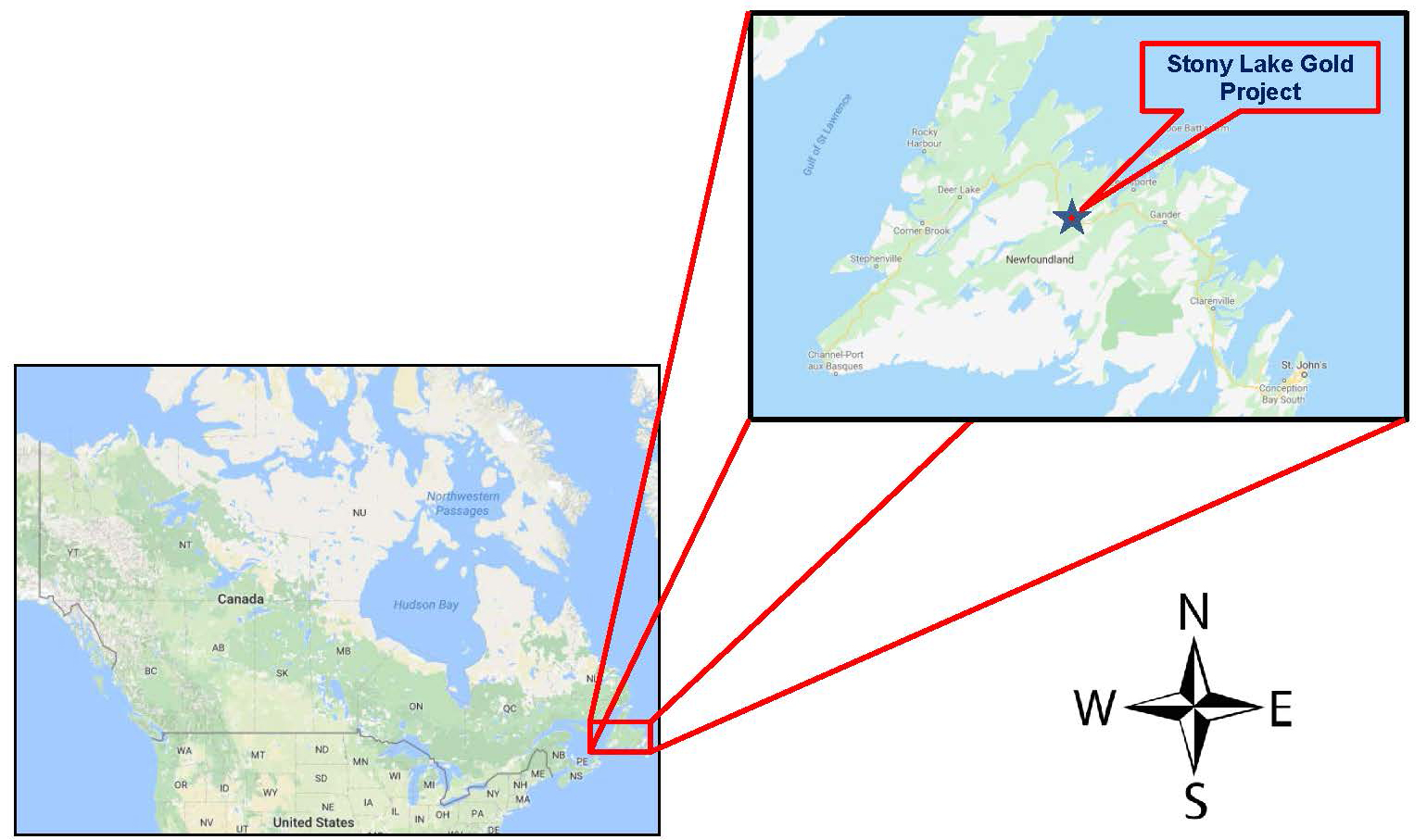
REGIONAL SETTING
Deposit Models: Widespread low grade (0.5 to 4.0 g/t Au) mineralized pyritic sandstone, quartz veins and quartz stockwork as seen exposed in the Silurian-age Botwood Group sediments; and</li><li style="box-sizing: inherit;">A high-grade gold environment (similar to Sokoman’s Moosehead and New Found Gold’s Queensway<br style="box-sizing: inherit;">projects) in the basement rocks below the Botwood sediments.</li></ul> Geology: Located on the interpreted Cape Ray – Valentine Lake (“CRVL”) structural trend.CRVL covered by Oxidized Silurian Sedimentary rocks. Significant post-sediment felsic intrusives | 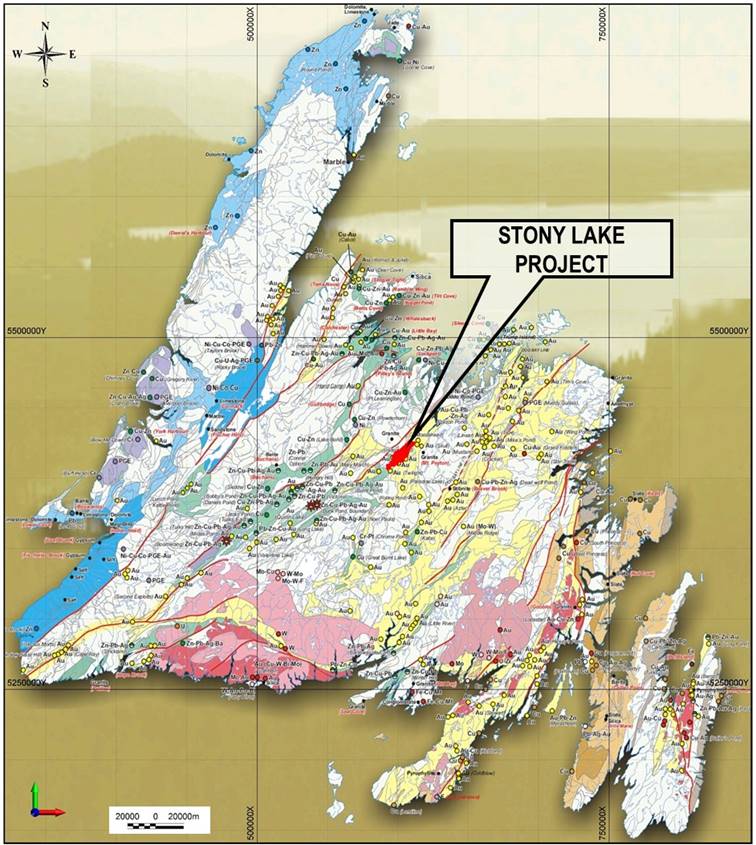 |
METALLOGENIC SETTING
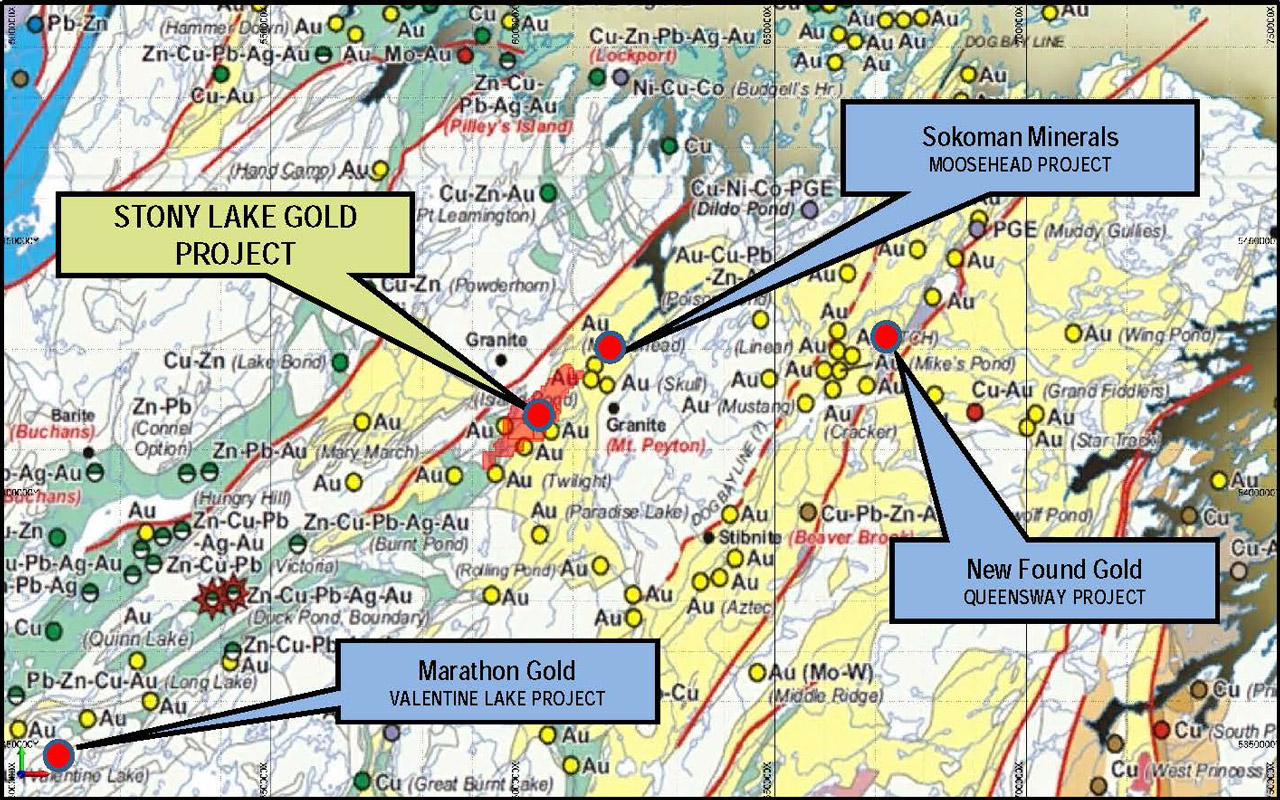
EXPLORATION DETAILS
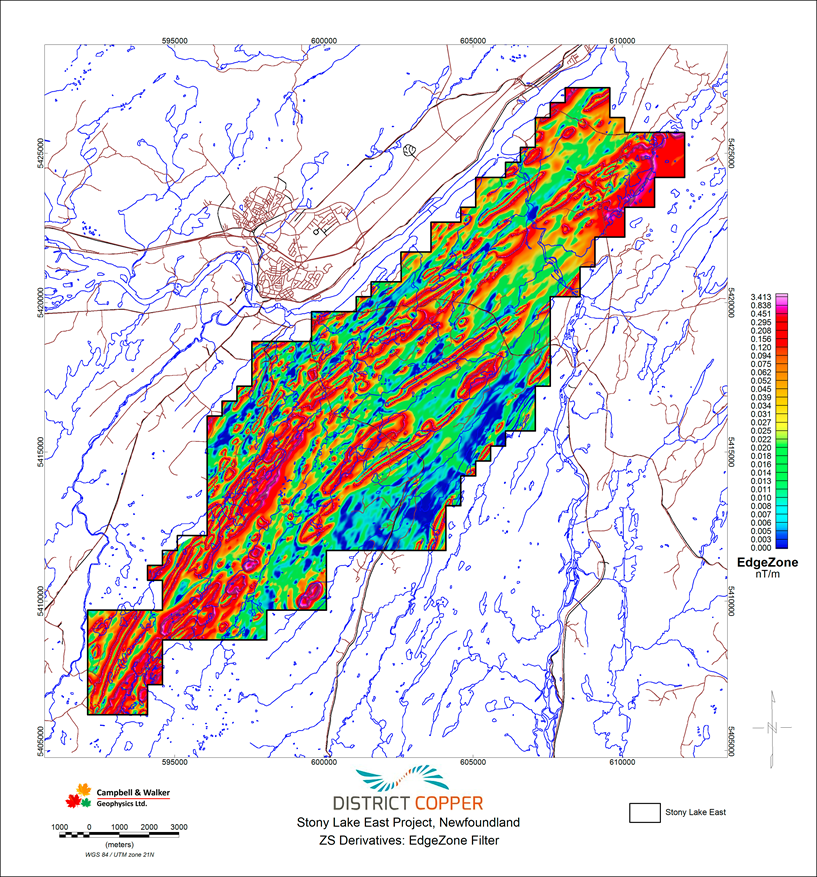
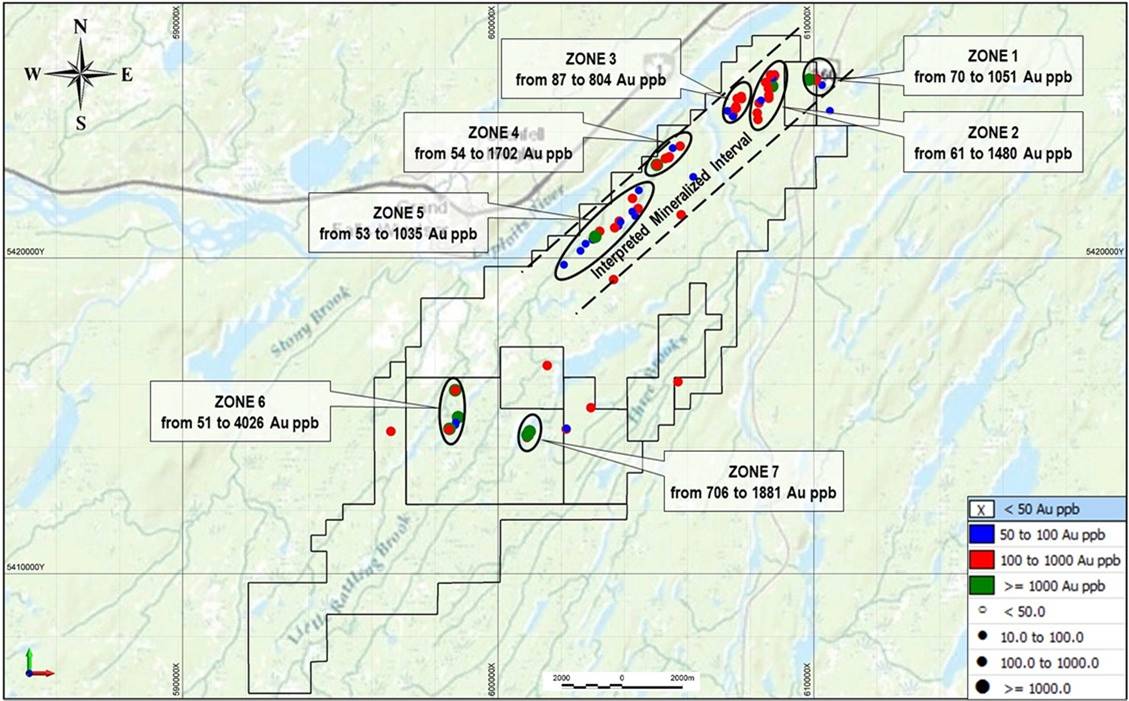
Exploration:Exploration An extensive field program in 2019, focused on prospecting, mapping and sampling along with a property wide airborne magnetometer and radiometric survey to map bedrock lithologies, structural features and areas of structurally controlled potassic alteration identified numerous target areas.</li></ul> Results: Eight areas of highly anomalous to high grade gold(15.05 g/t) mineralization have been identified. The gold mineralization is hosted in quartz feldspar porphyry, pyrite and arsenopyrite bearing reduced sandstone, quartz stockworks and quartz veins.Mineralization exhibits arsenic-antimony-molybdenum geochemical associations with high gold to silver ratios. Gold mineralization is characterized by sericite, silica, ankerite, carbonate and chlorite alteration typically as pervasive alteration and envelopes around quartz stockwork and quartz veins. Pyrite and arsenopyrite (1-3% total sulfide) are common to the gold mineralization in all samples greater than 50 ppb gold. | [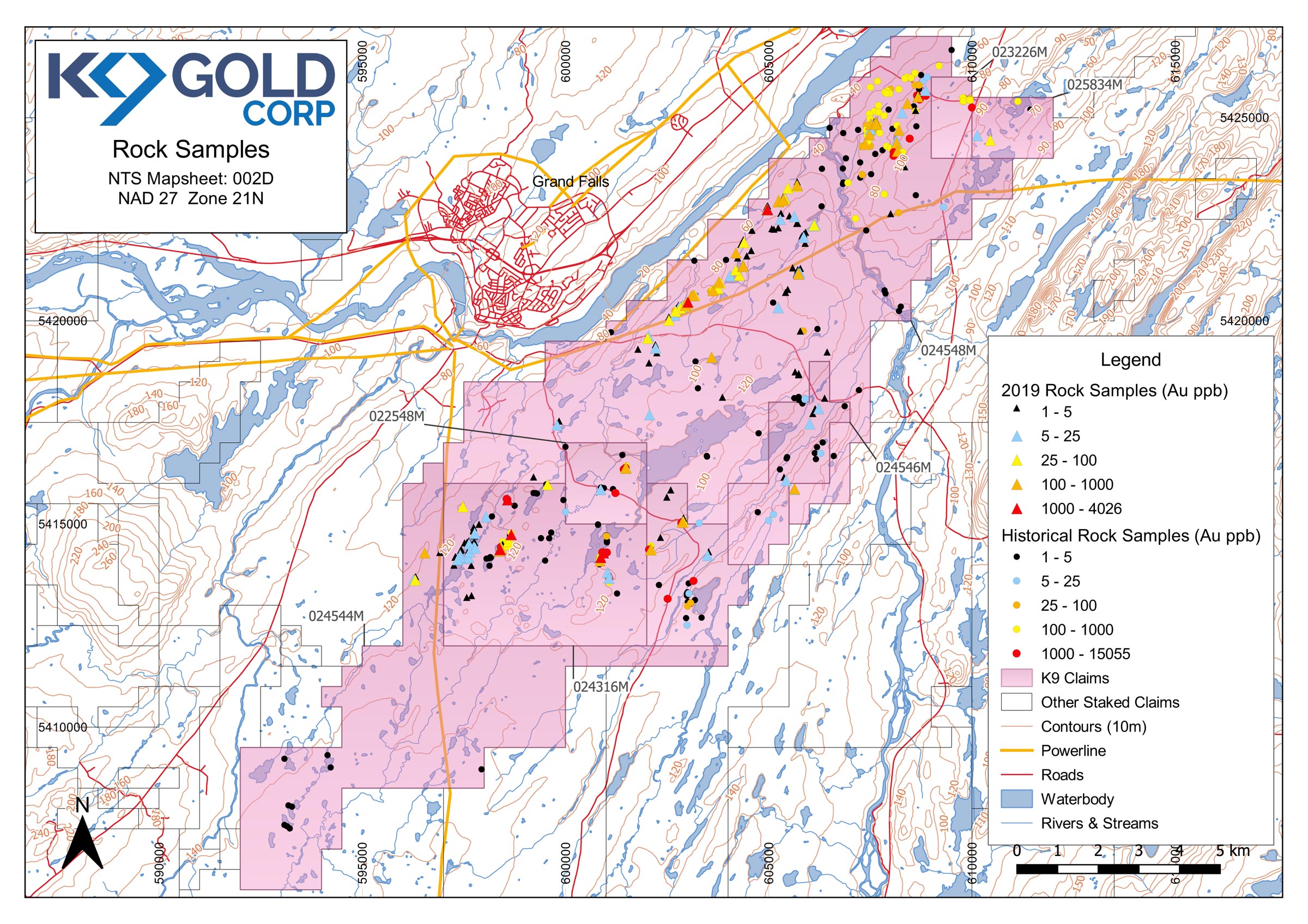 |
2019 GEOPHYSICAL SURVEY
|  |
2019 MINERALIZED ZONES
REGIONAL DISCOVERIES
The Stony Lake Project is contiguous to and covers the southwest extension of Sokoman Mineral’s Moosehead high-grade gold discovery. It also lies North East of Marathon’s Valentine Lake Deposit and West of New Found Gold’s Queensway discovery.
Regional Significance
- indicates gold potential in this portion of Newfoundland
- classified as orogenic style gold setting
- intersections of high-grade gold mineralization
Selected Drilling Results
- Sokoman; MH-18-01 returned 11.9 m of 44.96 g/t Au (news release July 24, 2017), MH-20-86 returned 4.70 m of 18.60 g/t Au (news release July 15, 2020) MH-18-08 returned 1.05 m of 207.1 g/t Au from 8.50 m to 9.55 m and 2.28 m of 42.36 g/t Au from 33.07 to 35.35 m (Sokoman news release Aug. 28, 2018)
- New Found Gold NFGC-19-01 returned 92.9 g/t Au over 19 m incl. 285.29 g/t Au over 6 m (corp. presentation 2020)
- Marathon Gold; VL-20-823 returned 3.33 g/t Au over 120.0 m incld. 11.83 g/t Au over 10 m (news release July 2020)REGIONAL DISCOVERIES9
~*~ ~The ~gold ~mineralization ~on ~the ~Moosehead ~property ~may ~not ~be ~indicative ~of ~the ~gold ~mineralization ~on ~the ~Stony ~Lake ~property
GALLERY
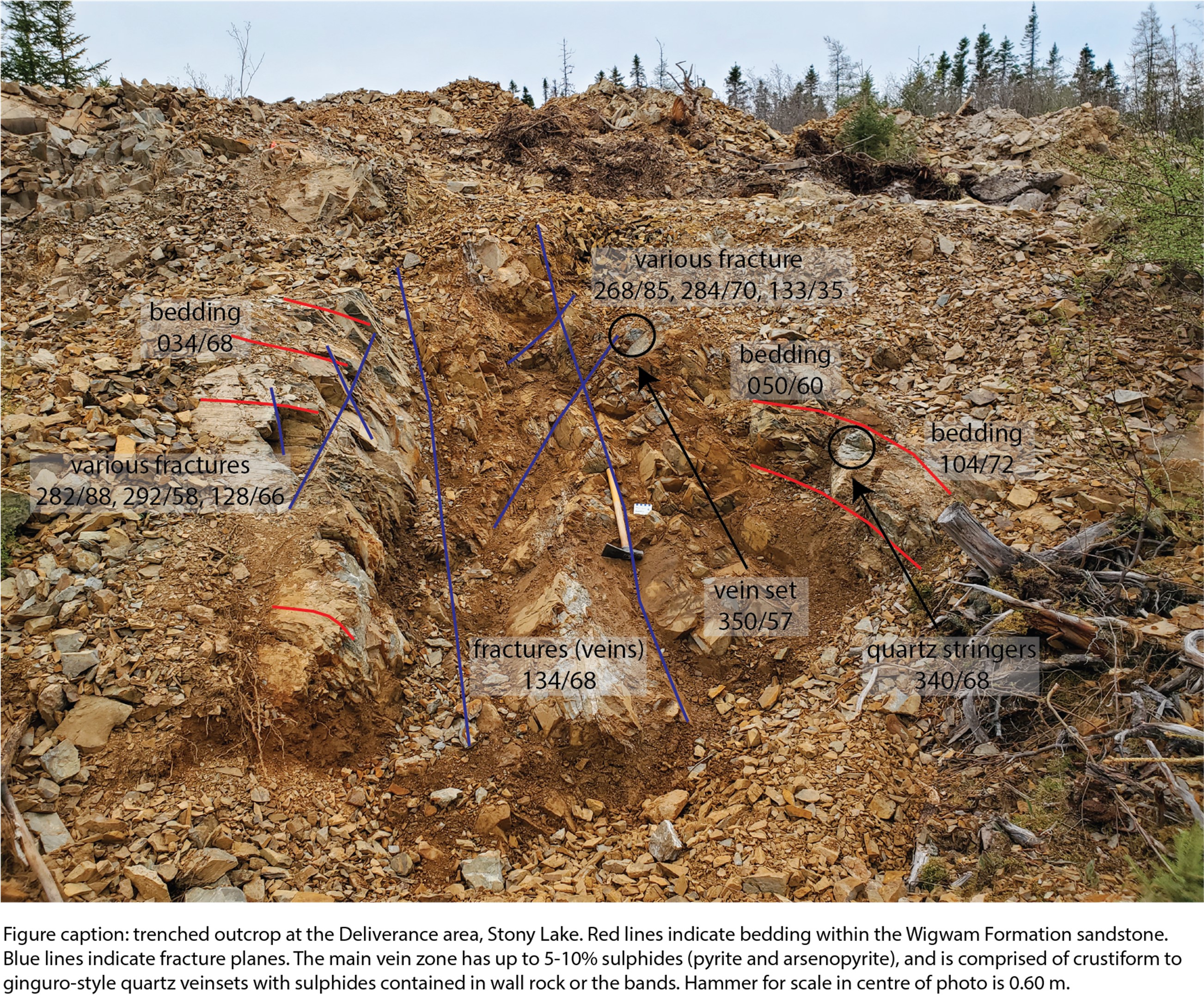
About Stony Lake Project The Stony Lake project lies within the Cape Ray/Valentine Lake structural trend in Central Newfoundland, lying parallel to that of New Found Gold's Queensway project, along the prolific Dog Bay Line. The project covers 13,625 ha and 27 kilometers of favorable trend between Sokoman's Moosehead discovery to the northeast and Marathon's Valentine Lake deposit to the southwest. At Stony Lake, large areas of significant gold mineralization occur primarily in altered Botwood sediments and quartz-feldspar porphyry intrusives associated with intense silicification, sericite-chloritecarbonate alteration and a strong pyrite-arsenopyrite mineralogical association. These features indicate epizonal/mesozonal temperatures for the hydrothermal fluids and support the exploration model of hydrothermal fluids leaking upwards into the Botwood sediments from a deeper igneous intrusive source. This area is now referred to as the Exploits Subzone gold district which essentially covers the Silurian-age clastic sediments surrounding the Mount Peyton intrusive. Prior to the 2020 field season, airborne geophysical coverage, with follow-up ground prospecting and sampling, has led to the identification of eight area of highly anomalous to high grade gold mineralization. The gold mineralization is hosted in a variety of environments, including quartz-feldspar porphyries, reduced sandstones, quartz stockworks and quartz veins. The property hosts both widespread low grade mineralization (up to 4.0 g/t Au) within the Botwood Formation and high grade veins (>4.0 g/t Au) in the basement rocks below the Botwood, similar to the nearby New Found Gold Queensway project, and the immediately adjacent Sokoman Minerals Moosehead discovery. On-going interpretive work on the Stony Lake property has yielded several direct comparisons with the Sokoman Minerals Corp Moosehead discovery, immediately to the northeast of Stony Lake's Jumper's Pond area (note - this area was previously named "Flyers Grid," and since significant portions of the historic Flyers Grid lie off K9's property, K9 has renamed the area to avoid confusion). Published information on the Moosehead discovery indicates that the mineralization is spatially related to reworking of a major basement structure which is likely the main pathway for the mineralizing fluids. The spatial association of the faulting with mafic intrusives appears to be highly significant. The Moosehead mineralization is hosted by N to NW trending and east dipping faults, which appear to be related to meso-scale anticlinal folding. These types of mineralizing systems typically have great lateral and depth extents (measured in kilometers). Recent (2019) and historic (2001) geophysical work on the Jumper's Pond area strongly suggests the presence of a large fold structure that plunges to the NE towards Moosehead, as well as several NWtrending structural features. The presence of mafic rocks is also indicated for this area. The major fault structure related to the Mooseheads discovery can clearly be traced by regional magnetics for 5 - 6 km onto the Stony Lake property. These similarities increase K9's confidence in the prospectivity of the Jumper's Pond area.