BJORKDAL GOLD MINE
PROPERTY AT A GLANCE
Location
Skellefteå, Sweden
Land Package
12,949 hectares
Mining Method
Long-hole stoping
Product
Gold (gravity and flotation)
2020 Production
45,296 Gold oz
Life of Mine
10+ years
Processing Capacity
1.3 million tonnes per annum
The Björkdal operation is located within the Boliden mining district, approximately 28 km northwest of the municipality of Skellefteå and approximately 750 km north of Stockholm. Acquired in 2014, the mine produced gold from both an open pit and underground mine. In 2019, Mandalay Resources completed the transition and suspended the open pit operation and now solely operates the underground mine. The target was to eliminate the associated open pit costs and take advantage of processing higher margin underground Aurora zone and stockpiled ore. Mandalay Resources expects to increase the underground production rate to 1 million tonnes of ore in 2020 from 850,000 tonnes mined in 2019.
The Björkdal operation has been operational since 1983. Currently, the Björkdal mine produces ore from the Aurora zone underground mine, as well as from a stockpile of low-grade material accumulated over the course of its life of mine. Approximately 75% of the mill feed is attributed to the underground operation and the remining 25% from the stockpiled material.
Underground mining is accomplished by long-hole stoping using a combination of contractors and owner-operated mobile fleet. Access is via dual ramps from the open pit. The processing plant includes: multiple crushers, a ball mill and rod mill, a gravity circuit, and a flotation circuit. Four separate gravity and flotation gold concentrates are produced and sold to smelters in Sweden and Germany.
2021 OUTLOOK
Production
Gold (oz)
52,000 – 57,000
Antimony (t)
-
Gold Equivalent (oz)(1)
52,000 – 57,000
Cash Costs ($USD/oz)(2)
$900 – $1,050
All-in sustaining Costs ($USD/oz)(2,3)
$1,200 – $1,350
Capital Expenditures ($USDM)(4)
$32M – $36M
2020 PERFORMANCE
PRODUCTION
Gold (oz)
45,296
Cash Costs ($USD/oz)
-
All-in sustaining cost ($USD/oz)
-
Capital Expenditures ($USDM)
-
GEOLOGY AND MINERALIZATION
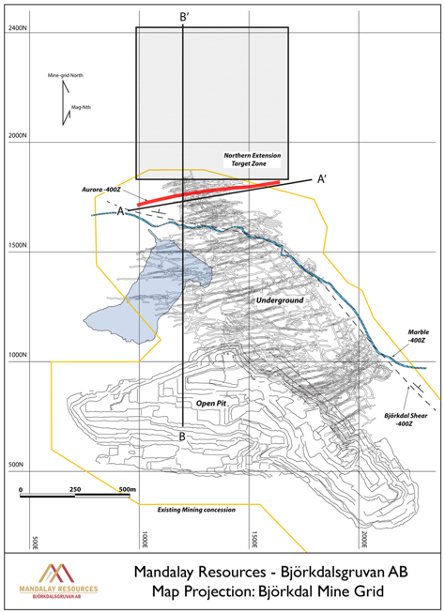 The Skellefteå region consists of Paleoproterozoic-aged rocks that host several world-class volcanogenic massive sulphide copper, zinc, and lead deposits that have been worked on for nearly a century. The Skellefteå district lies within a large and ancient cratonic block named the Fennoscandian shield. The Fennoscandian shield spans much of Finland and northwestern Russia, extending further westward throughout Sweden and Norway.
Mineralization in the Skellefteå region is focused within and around a regionally extensive, west- to northwest-trending structural feature named the Skellefteå belt. The Skellefteå belt is 120 km long and 30 km wide and consists of deformed and metamorphosed volcanic, sedimentary, and igneous rocks that are all Paleoproterozoic in age. Deformation and metamorphism is attributed to the Paleoproterozoic-aged Svecokarelian orogeny that occurred around 1.88-1.8 Ga. Metamorphism associated with the Svecokarelian orogeny and ranges in intensity from greenschist to amphibolite facies.
The rocks of the Skellefteå belt are observed to have undergone two major shortening events and metamorphism during the Svecokarelian orogeny. The first of the major shortening events resulted in folding and shearing: folding consisting of vertical to upright isoclinal folds with east- to northeast-striking axial planes, while shear zones are oriented sub-parallel to the axial planes of the folds. The later shortening event produced structures mainly dominated by shearing, with only minor folding coaxially overprinting the earlier generation of folding. These late-stage shears appear to play a crucial role in the formation of the deposit.
The Björkdal gold deposit is a lode-style, sheeted vein deposit that is hosted within the upper-portions of the Skellefteå Group lithologies as they are found at Björkdal (as described above). Gold is found within quartz-veins that range in thickness from less than a few centimetres in width, to over several decimetres in width. These veins are usually observed as vertical to sub-vertical dipping veins that strike between 000° and 090°, with the majority of veins occurring with a strike between 030° and 060°. The veining is locally structurally complex, with many cross-cutting features as well as thin quartz veinlets which introduce mineralization into the wall rocks proximal to the main quartz veins.
Gold-rich quartz veins are most often associated with the presence of minor quantities of sulphide minerals such as pyrite, pyrrhotite, marcasite, and chalcopyrite alongside more common non-sulphide minerals such as actinolite, tourmaline and biotite. Scheelite and bismuth-telluride compounds (i.e., tellurobismuthite and tsumoite) are also commonly found within the gold-rich quartz veins and are both excellent indicators of gold mineralization.
Gold occurs dominantly as free gold, however, gold mineralization is also associated with Bi-telluride, electrum and pyroxenes. Silver is seen as a minor by-product of the Björkdal processing plant, however, very little is known about its deportment within the deposit, although it is assumed to be associated with electrum.
EXPLORATION
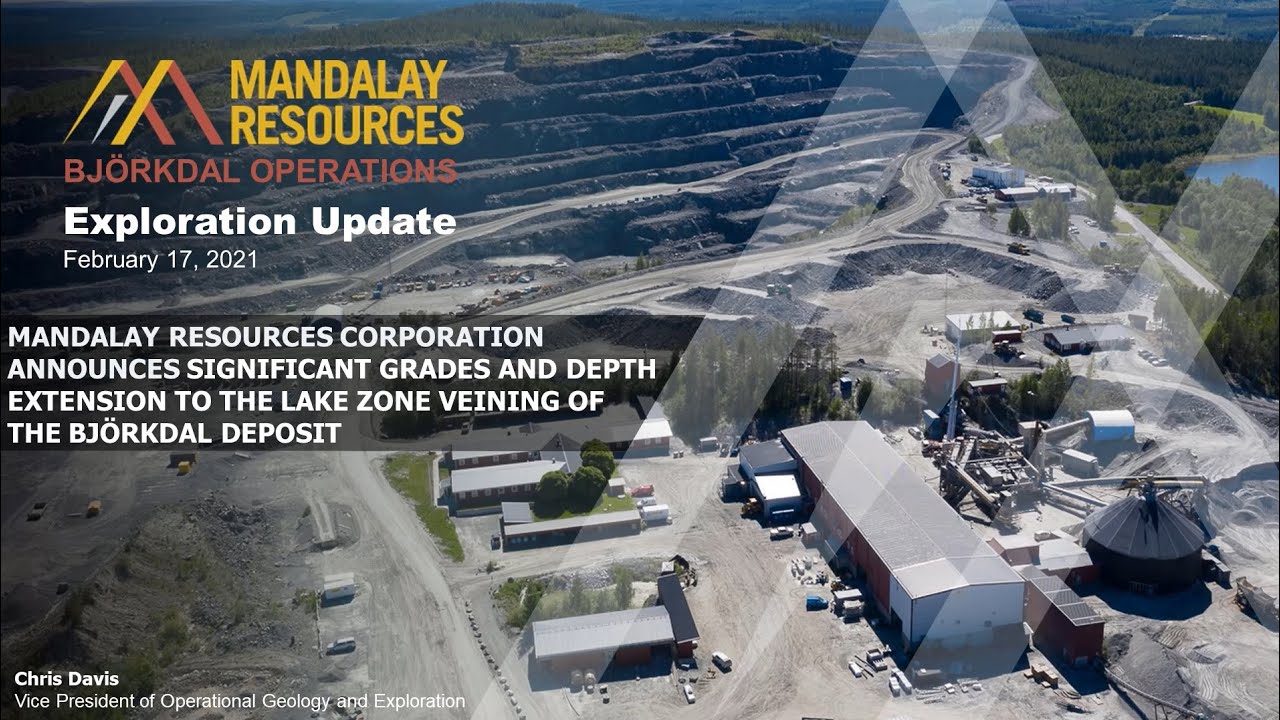
 At Björkdal in Q4 2020, drilling continued on the Björkdal Deeps program which tested the depth and eastern extension of the Lake Zone veining. This program was completed in January 2021 with an infill drilling program commenced in Q1 2021 and expected to be complete in Q2 2021. Alongside this program, drilling commenced on the Lake Zone Skarn program with the intent to test for the presence of elevated grades though skarnified marble within the Lake Zone. This program is continuing and is expected to be complete in Q1 2021. A discrete drilling program investigating the western extension of the Central Zone was also carried out during Q4 2020. In Q1 2021, drilling commences on the eastern extension potential of the Main Zone as well as the upper extension and infill drilling on Aurora.
As at December 31, 2020, Mandalay’s total Proven and Probable Mineral Reserves totalled 799,000 ounces of gold and 21,900 tonnes of antimony, compared to 752,000 ounces of gold and 17,800 tonnes of antimony at yearend 2019, a 6% and 12% increase, respectively year-on-year. These Mineral Reserves were added at an exploration cost of $23.24 per gold equivalent ounce.
RESERVES AND RESOURCES
Bjorkdal Mineral Reserves as of 2020
| Category | Tonnage (kt) | Au Grade (g/t) | Contained Au (koz) |
|---|---|---|---|
| Probable | Probable | Probable | Probable |
| Underground | 5,623 | 2.05 | 371 |
| Open Pit | 3,157 | 1.05 | 106 |
| Norrberget Open Pit | 162 | 2.80 | 15 |
| Stockpile | 2,551 | 0.64 | 53 |
| Total Probable | 11,493 | 1.47 | 544 |
Bjorkdal Mineral Resources Inclusive of Mineral Reserves 2020
| Category | Tonnage (kt) | Au Grade (g/t) | Contained Au (koz) |
|---|---|---|---|
| Indicated Resources | Indicated Resources | Indicated Resources | Indicated Resources |
| Underground | 11,482 | 2.32 | 858 |
| Open Pit | 2,383 | 2.10 | 161 |
| Norrberget Open Pit | 144 | 3.29 | 15 |
| Stockpile | 2,551 | 0.64 | 53 |
| Total Indicated | 16,560 | 2.04 | 1,087 |
| Inferred Resources | Inferred Resources | Inferred Resources | Inferred Resources |
| Underground | 2,322 | 2.06 | 154 |
| Open Pit | 3,515 | 1.44 | 163 |
| Norrberget Open Pit | 3 | 4.03 | 0.5 |
| Stockpile | - | - | - |
| Total Inferred | 5,840 | 1.69 | 318 |
-