GOLDEN ZONE PROPERTY
General
- The Golden Zone gold-silver-copper property lies within the Upper Chulitna District of the Valdez Creek Mining District, and is a Intrusion-Related Gold System (IRGS) located in the Kuskokwim Mineral Belt on the south side of the Denali Fault in south-central Alaska.
- Possible IRGS geological and exploration analogues for the Golden Zone Project include the Donlin Creek deposit, Alaska (+ 39 Moz), and the Dublin Gulch system (+ 6 Moz) in the Yukon.
- The property is located midway between Anchorage and Fairbanks, approximately 16 km west of the main transportation corridor, George Parks Highway (Alaska Route 3), the Alaska Railroad and the 345Kv Alaska Intertie, between Alaska’s two largest cities.
- The project is entirely on land patented to the State of Alaska, with the core of the project situated on a 2,920-acre (1200 hectare) Uplands Mining Lease that was issued by the State in 1995 (55 year term). The core is surrounded on three sides by newly staked State of Alaska mining claims and to the North and Northwest by the Denali National Park and Preserve.
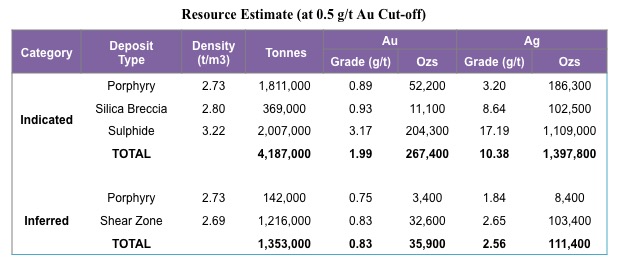
- The property contains numerous igneous affiliated mineral occurrences of Late Cretaceous-early Tertiary age in three NNE aligned fault blocks (the Golden Zone, Long Creek and the Silver Dikes Corridors) which appear to be young in age to the SE. The most northwesterly and probably oldest block, the Golden Zone Corridor, contains the GZ Breccia Pipe Deposit that hosts a 2016 NI 43-101 Indicated resource of 267,400 ounces Au and 1,397,800 oz Ag (4,187,000 tonnes at 1.99 g/t Au & 10.38 g/t Ag).
 This corridor can be traced for +4 km and hosts a number of other mineral occurrences, exposed in trenches and/or drill holes, containing high grade gold mineralization (> 5 g/t Au to + 25 g/t Au with Ag and Cu). The central corridor, Long Creek Corridor is +2 km long and hosts 3 known occurrences of high grade Au-Cu veins, i.e. 13.72 m @ 7.01 g/t Au, 94.1 g/t Ag & 4.0 % Cu, that may relate to an underlying porphyry system. The easterly block, the Silver Dikes Corridor contains a mineralized rhyolitic dike swarm.
Target Type
- The Golden Zone Project comprises magmatic-hydrothermal mineralization that is fully compatible with models for Intrusion-related Gold Systems (IRGS).

Land Status
- 125.3 sq km or 30,960 acres (2,960 acre Uplands Mining Lease, a 40 acre Millsite Lease, 28,000 acres of State of Alaska Claims).
- Avidian owns 29.4% of the property with a purchase agreement to acquire the balance of the 70.6% interest for US $875,000 in cash & US $1,125,000 of stock over a 7 year period (to 2023), plus a work commitment of US $2,000,000 over 5 years (US $200,000 minimum expenditures per year).
- 4% NSR of which 1.4% can be bought out for US $1,400,000 at Avidian’s option and an additional 1.6% for US $1,600,000 at vendors option.
- Holding Cost of approx. US$ 35,000 per year (lease and claims rentals costs & general overhead costs).
Geology
The Golden Zone property is in the “Chulitna Block” at the western end of the Wrangellia Terrane that extends from western Canada through the Wrangell Mountains and eastern Alaska Range into the Upper Chulitna area. The Chulitna Block is mainly composed of argillite, volcanic and volcaniclastic rock, red-bed volcanic conglomerate and limestone of Permian to Jurassic age that have been intruded by isolated plugs and dikes of monzodiorite and granite of late Cretaceous and Early Tertiary age. To the west the Chulitna Block rocks are faulted against a flysch complex of the Cretaceous Kahiltna terrane. To the east the Chulitna rocks are separated from weakly metamorphosed Wrangellia volcanic and sedimentary rocks of Upper Paleozoic age by a graben filled with Jurassic sandstone and argillite. The Chulitna rocks are tightly folded around northeast axes and are offset by high-angle faults of NNE strike and tear faults of NW strike. Metallic mineral resources are contained in three NE trending fault-bounded belts or corridors, named from northwest to southeast, the ” Golden Zone”, “Long Creek” and “Silver Dikes” corridors.
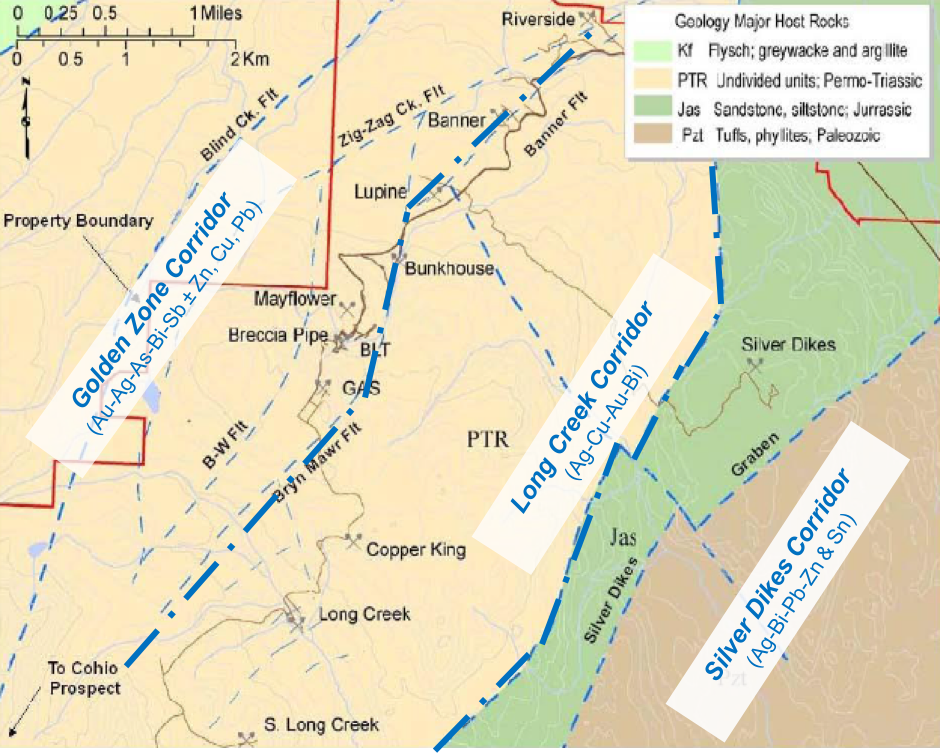
Gold-bearing occurrences within the Golden Zone Corridor include quartz-arsenopyrite-sulfide veins at the Riverside prospect; similar veins and skarn mineralization at the Banner prospect, veins and shears at the Lupine, Bunkhouse, Mayflower and BLT prospects, the highly mineralized breccia and mineralized porphyry at the Golden Zone Breccia Pipe deposit, and veins and shears at the GAS prospect. In general, the Golden Zone Corridor is typified by characteristic elements of Au-Ag-As-Bi-Sb± Zn, Pb and Cu.
Gold-bearing occurrences in the Long Creek Corridor include skarn, carbonate replacement deposits, and porphyry mineralization associated with a quartz-eye porphyry granite. Favored hosts are carbonate rich volcaniclastic sediments. From north to south, named prospects are Copper King, Long Creek and South Long Creek. The Long Creek Corridor is generally typified by the characteristic elements of Ag-Cu-Au-Bi. Mineral occurrences in the Silver Dikes Corridor are mainly veins and shear zones associated with granitic dikes. This corridor is poorly known and is not completely defined. Characteristic elements are Ag-Bi-Pb-Zn and possibly Sn.
The prospects in the Golden Zone and Long Creek corridors typify mineralization types common to Intrusion-Related Gold Systems and are apparently all related to late-Cretaceous (65-70 Ma) monzodiorites. Mineralization in the Silver Dikes corridor may be more typical of tin-silver systems, and may well be related to younger (±57 Ma) McKinley sequence granitic rocks which are associated with other tin-silver prospects in the area.
Mineralization
- The Golden Zone Project comprises magmatic-hydrothermal mineralization that is fully compatible with models for Intrusion-related Gold Systems (IRGS).
- Mineralization likely formed at a relatively shallow paleo depth, which will influence the patterns of geochemical, geophysical and mineralogical properties useful to exploration.
- Possible IRGS geological and exploration analogues for the Golden Zone Project include the Donlin Creek deposit, Alaska (+ 39 Moz), and the Dublin Gulch system (+ 6 Moz) in the Yukon.
- The distribution of mineralization styles in these analogues can be compared favorably to the Golden Zone Project. The high-grade Au-As quartz veins in the Golden Zone Corridor and the Cu-Au veins in the Long Creek Corridor are a ‘proximal style’ of mineralization which may be laterally proximal to and/or vertically above intrusion-hosted sheeted vein deposits similar to Fort Knox (+8 Moz) or Dublin Gulch.

- The Golden Zone Corridor is +4 km in length and also hosts several other mineralized occurrences with gold mineralization of > 5 g/t Au to + 25 g/t Au with Ag and Cu. The Long Creek Corridor (+2 km in length) contains high grade gold and copper mineralization (i.e. 13.72 m @ 7.01 g/t Au, 94.1 g/t Ag & 4.0 % Cu) as well as elevated Mo and Zn, possibly implying that the mineralization is near the roof of a mineralized intrusive body and possibly a Cu-Au-Ag-Mo system.
- The Golden Zone Corridor hosts the Breccia Pipe Deposit that is comprised of an arsenopyrite, chalcopyrite and pyrite mineralized breccia pipe that forms the core of a small porphyry stock of Cretaceous age. The breccia pipe is approximately 150 m x 80 m in size near surface, plunging to the northeast and not fully tested below a depth of approximately 200 m. High grade mineralization (1.5 m @ 15.43 g/t Au, 250 g/t Ag 2.65% Pb, 4.65% Zn, 0.25% Cu has previously been intersected at a depth of approximately 260 m below surface. This multi-element deposit presently hosts a 2016 NI 43-101 Indicated resource of 267,400 ounces Au and 1,397,800 oz Ag (4,187,000 tonnes at 1.99 g/t Au & 10.38 g/t Ag) and an Inferred Resource of 35,900 oz Au & 111,400 oz Ag (1,353,000 tonnes at 0.83 g/t Au & 2.56 g/t Ag), amenable to open-pit mining. The deposit remains open at depth and potentially along strike.
- The most prospective settings for bulk tonnage deposit styles on the property are where NNE trending faults are intersected by NW-trending cross faults. There is evidence that this relationship may have influenced formation of the Golden Zone Breccia Pipe Deposit.
Results from the 2017 exploration program can be found below in the Golden Zone presentation, December 2017.