EGINA
Novo Discovers Broad Gold-Bearing Swale at Egina Mining Lease and Discusses Terrace Concept
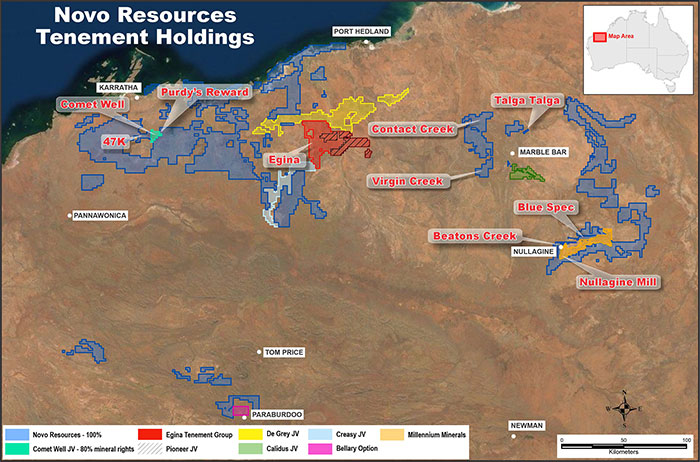
Novo’s Egina project lies in the heart of the Pilbara conglomerate gold province approximately 120 km east of Novo’s Karratha gold project. Upon recognizing its conglomerate gold potential, Novo began applying for multiple exploration licenses covering much of the core area beginning in 2017. In September 2018, Novo announced two transactions; the acquisition of private company Farno-McMahon Pty Ltd (“FM”), and a joint venture with ASX-listed Pioneer Resources Limited, increasing Novo’s Egina project to 948 square km. Importantly, purchase of FM included granted mining leases M47/560 and M47/561 covering approximately 11.8 square km of key target areas. The farm-in and joint venture with Pioneer was finalized in September 2018 and the acquisition of FM was finalized in October 2018.
[ ](https://www.novoresources.com/_resources/images/Novo-Resources-Tenement-Slide-Egina.jpg)
Like Novo's Karratha gold project, Egina is an important part of the Pilbara conglomerate gold province. Not only does Egina have potential to host significant deposits of gold-bearing conglomerates, weathering and erosion appear to have liberated considerable gold from these rocks and redeposited it into extensive surficial lag gravel deposits blanketing much of the area. Gold-bearing gravels can easily be explored as described in Novo's aggressive exploration program described below.
Egina Exploration Model Highlights:
- Three styles of gold mineralization are recognized at Egina: 1) basal Fortescue gold-bearing conglomerates like those at Novo’s Karratha gold project, 2) gold-bearing, deflationary and/or marine lag gravels blanketing an erosional terrace covering most of the Egina area, and 3) lode gold mineralization hosted by the underlying Mallina Basin assemblage.
- Given the large size of the target, Novo considers the gold-bearing terrace lag gravels to be the most important immediate target at Egina. Gravel deposits form a continuous sheet across much of the terrace. Where they have been trenched, they are up to 1.5 meters thick and weakly consolidated. Lag gravels rest on weathered Mallina Group sedimentary rocks, and up to 1 meter of soil and sand overlie them.
- Novo has discovered considerable cobbles and boulders of weathered Fortescue-type conglomerate within the lag gravels. Particulate gold has been observed in the matrix of some conglomerate boulders. A few gold nuggets that have been recovered from trenches at Egina remain partially encased in ferruginous rock matrix, some of which display a distinctive melon seed shape similar to nuggets observed at Karratha. Remarkably, halos of fine-grained gold are evident in the residual rock matrix surrounding these nuggets, again strikingly similar to that observed around in situ nuggets at Karratha. Novo firmly believes much of the gold in lag gravels is derived from geologically recent weathering and erosion of Fortescue-type conglomerates that once blanketed this area.
- Most gold found at Egina is coarse and water-worn. During the 2018 exploration season, FM focused entirely on metal detecting nuggets within a series of trenches covering an area roughly 500 x 200 meters. Detected nuggets range in size from approximately 0.5-104 grams. As a test for the presence of fine-grained gold, Novo recently assessed gravel from these trenches. Significant numbers of small nuggets up to 4 mm across were recovered along with appreciable very fine gold particles down to approximately 10 microns in size. Novo finds the presence of fine gold particularly encouraging and believes it may be derived, in part, from weathering of halo gold associated with Fortescue-type nuggets.
2018/2019 Exploration Plans
- Systematic sampling of
- largely unworked areas of lag gravel within M47/560
- gravels already excavated but not processed by FM that have shown appreciable fine gold in preliminary testing
- Geophysical testwork including ground penetrating radar and ground magnetics to define terrace and channel geometries
- Trench mapping and survey pickup to delineate gravel horizons for input into a 3D model
- Conduct broader-spaced program of alluvial sampling for fine gold and develop coarse gold assessment strategy
- Assess Novo’s IGR3000 alluvial processing plant for suitability and engineering modifications ahead of bulk sampling of the terrace gravels in 2019
- Regional 1:2,500 scale mapping to define areas of conglomerate gold and basement gold potential
Novo plans to engage the Kariyarra and Mugarinya Traditional Owner Groups to seek permission to explore on Novo-controlled exploration licenses surrounding M47/560. Environmental regulators will also be engaged regarding permitting requirements for the project, laying the groundwork for Novo to conduct test mining of lag gravels on mining lease M47/560 at Egina beginning after the rainy season, approximately second quarter of calendar 2019.
Sampling Update (January 2019)
A total of 107.88 grams of raw gold were recovered from 95 cubic meters of gravel. Gold was found to be dominantly coarse suggesting simple processing techniques can likely be employed during potential future large-scale gold recovery at Egina. Novo thinks lag gravels mantling the vast erosional terrace at Egina could host a significant gold deposit, the shallow nature of which makes it a particularly attractive target.
Work at Egina is on hold during the rainy season lasting until late March, 2019. Plans are currently being made to resume aggressive bulk sampling and processing on the Egina mining lease to evaluate the geologic potential of the terrace gravels as well the best means of processing. Current permitting allows for up to 50,000 tonnes of gravel to be excavated and processed at Egina, subject to appropriate heritage clearances.
Tuesday, May 26, 2020, 8:26 AM ET
Novo Discovers Broad Gold-Bearing Swale at Egina Mining Lease and Discusses Terrace Concept
VANCOUVER, British Columbia, May 26, 2020 (GLOBE NEWSWIRE) -- Novo Resources Corp. ("Novo" or the "Company") (TSX-V: NVO; OTCQX: NSRPF) is pleased to announce it has discovered a broad gold bearing swale in the northwestern part of its Egina mining lease. This new discovery ties in well with the Company's overall interpretation regarding gold distribution across the greater Egina terrace.
Summary:
Discovery of new gold-bearing swale at Egina mining lease
-- Novo has identified a broad gold bearing swale in the northwestern
quadrant of its Egina mining lease (Figure 1). This discovery is situated
a few hundred metres west of the swale that was the subject of extensive
test work by the Company in 2019. Identification of gold-bearing gravels
comes from processing approximately 1 tonne bulk samples using Novo's
mobile alluvial Knudson ("MAK") test plant. MAK sampling indicates the
presence of a northwest trending swale up to 350 m wide that appears to
extend off the mining lease onto Novo's adjoining exploration licenses.
Point counts of gold from these MAK samples are similar to those from the
test swale to the east. Gravel thickness are also similar, 0.5-2 m thick.
-- This discovery is located immediately north of a series of low hills that
are capped in places by Fortescue Group gold-bearing conglomerates. Novo
believes these conglomerates were once far more extensive in this area
and that as they eroded away, gold was reworked into the modern gravel
terrace.
-- It is envisaged that the next phase of exploration will be to conduct
bulk sampling in this area to confirm grade. Being situated on the Egina
mining lease, this discovery may prove to be a suitable location for
trial bulk extraction and processing of gravels.
Current interpretation of the greater Egina gold bearing terrace
-- Through recent MAK sampling and ground penetrating radar data at Egina,
the newly discovered Paradise area where multiple broad gold bearing
swales have recently been discovered (please refer to the Company's news
release dated May 15, 2020), Novo is beginning to assimilate an
interpretive model of gold distribution across the terrace in areas north
of the mining lease. Although this represents a small fraction of Novo's
overall land holdings in the region, this interpretation speaks to the
potential size of the system.
-- Figure 1 illustrates an area approximately 10 km wide extending
approximately 17 km northward from a series of low rolling hills that
marks the southern limit of the terrace. Novo believes this area
potentially hosts an extensive system of swales that have a general trend
from south to north. Multiple areas thought to be potential gold sources
lie at the head of this swale system. This includes the recently
discovered swale discussed above.
-- This model helps present a picture that ties together the newly
discovered gold bearing swales at Paradise with areas further south. Gold
at Paradise may be originating from weathered and eroded Fortescue
conglomerates as well as basement lode deposits in the region. If correct,
this model implies that the gold-bearing swales discovered at Paradise
extend for at least 10 km to the north and south.
"We are pleased to see a model coming together of gravel gold mineralization across the greater Egina terrace," commented Quinton Hennigh, President and Chairman of Novo Resources. "We are starting to see a pattern of gravel gold distribution that appears robust around Egina. Recently discovered broad gold bearing swales discovered at Paradise likely tie back to areas further south. This implies we have a network of swales nearly 10 km wide and 17 km from south to north to further explore around Egina, a small part of our large land holdings across the expansive terrace. We have many other target areas to test across our terrace holdings this year. We are just getting started."
Description of MAK sampling process:
MAK samples are collected from pits spaced approximately 50 metres apart across target areas. Pits are dug by track hoe and range up to 3 metres depth. Targeted sample size is approximately one tonne. Samples are placed in wooden crates lined with bulka bags and transported to Novo's Station Peak camp where they are processed through a mobile alluvial Knudsen centrifugal concentrator. Concentrates are panned down to reveal gold for point counting and further study.
Dr. Quinton Hennigh, P. Geo., the Company's President, Chairman, and a Director, and a qualified person as defined by National Instrument 43-101, has approved the technical contents of this news release.
About Novo Resources Corp.
Novo's focus is primarily to explore and develop gold projects in the Pilbara region of Western Australia, and Novo has built up a significant land package covering approximately 13,000 square kilometres with varying ownership interests. In addition to the Company's primary focus, Novo seeks to leverage its internal geological expertise to deliver value-accretive opportunities to its shareholders. For more information, please contact Leo Karabelas at (416) 543-3120 or e-mail leo@novoresources.com
On Behalf of the Board of Directors,
Novo Resources Corp.
"Quinton Hennigh"
Quinton Hennigh
President and Chairman
Neither TSX Venture Exchange nor its Regulation Services Provider (as that term is defined in the policies of the TSX Venture Exchange) accepts responsibility for the adequacy or accuracy of this news release.
Forward-looking information
Some statements in this news release contain forward-looking information (within the meaning of Canadian securities legislation) including, without limitation, statements as to planned exploration activities. These statements address future events and conditions and, as such, involve known and unknown risks, uncertainties and other factors which may cause the actual results, performance or achievements to be materially different from any future results, performance or achievements expressed or implied by the statements. Such factors include, without limitation, customary risks of the mineral resource industry as well as the performance of services by third parties.
(END) Dow Jones Newswires
May 26, 2020 08:26 ET (12:26 GMT)