ASANKO GOLD MINE JV
Located in Ghana, West Africa, the Asanko Gold Mine is a joint venture with Gold Fields Ltd (JSE, NYSE: GFI). Galiano and Gold Fields both have a 45% economic interest in the mine, with the Government of Ghana holding the remaining 10%. Galiano is the manager and operator.
The Asanko Gold Mine is a multi-deposit complex, with two main deposits, Nkran and Esaase, and multiple satellite deposits, situated on the Asankrangwa Gold Belt, and a 5Mtpa carbon-in-leach (CIL) processing plant. Gold production commenced in January 2016 and commercial production was declared on April 1, 2016.
In 2019, the mine exceeded the upper-end of guidance with record gold production of 251,044 gold ounces. In 2020 the mine is targeting approximately 245,000 ounces of gold production at all-in sustaining costs of approximately $1,150/oz (100% basis).
Approximately 2,600 people are employed at the mine. 99% of the total workforce are Ghanaians, of which around 53% are from our local communities.
The Asanko Gold Mine has a downstream tailing storage facility, further details are available here: Asanko TSF Disclosure
GEOLOGY
The Nkran deposit is located within the Kumasi Basin on the "Asankrangwa gold belt". The basin is bound to the south by the Ashanti Fault/Shear and the Bibiani shear to the north. The Asankrangwa gold belt expresses itself as a complex of northeast trending shear zones situated along the central axis of the Kumasi Basin. The Nkran deposit is located on a jog along the regional Nkran Shear, which is a zone of about 15 km in width and may be traced on a northeast to southwest trend for a distance of some 150 km. This is one of several major northeast trending shears/structures that bisect the Kumasi Basin/Asankrangwa Gold Belt.
EXPLORATION
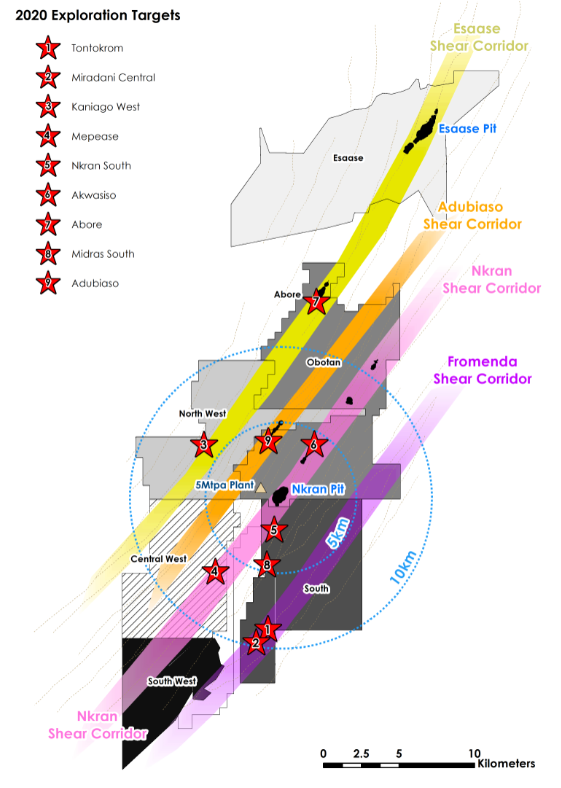
Ghana is currently the largest gold producer on the African continent and as such plays host to a number of globally important gold belts and their associated deposits. The Asankrangwa gold belt is located within the Kumasi basin which is dominated by Palaeoproterozoic metasedimentary and metavolcanic rocks. The belt itself is approximately 200km long and 20km wide and contains numerous significant gold deposits and occurrences. The Asanko Gold Mine holds the largest land package within the belt, with approximately 21,000 hectares of tenure (see figure 2) on this highly prospective and under-explored portion of central Ghana.

REGIONAL GEOLOGY
The geology of the Asankrangwa Belt comprises strongly deformed Birimian meta-sediments, with minor granitic intrusions and mafic igneous rocks. The lithological units are cut by steeply north-west dipping primary and secondary structures. It is this combination of structural architecture and permissive lithologies that have been important in the localization of gold mineralization, and provides the capacity for enhanced fluid flow forming major alteration systems associated with the gold bearing systems. The gold mineralization is linked to at least two separate deformation events and fluid emplacement, with many similarities to the gold deposits on the adjacent Sefwi and Ashanti Greenstone Belts.
Much of the Asankrangwa belt geological understanding and prospectivity mapping comes from a combination of airborne geophysical surveys such as VTEM and magnetics, and the wealth of accumulated geochemical and geological data. These datasets have allowed the company to develop our current pipeline of exploration targets.
2021 EXPLORATION PROGRAM
The company’s 2021 exploration program is focused on evolving our project pipeline. Priority is given to (i) Upgrading and expanding our existing resources, (ii) Advancing strategic projects to MRE (Mineral Resource Estimate) stage, (iii) Testing early stage targets associated with existing resources, and (iv) Developing geochemical anomalies and concepts into discernible ‘Advance to Drill’ targets for testing.
Following a successful drill season in 2020 and into Q1 2021, Miradani North continues to be a priority, with work now focusing on completion of infill drilling to support a maiden MRE for the deposit by mid-2021.
STRATEGY
UPGRADE AND ADVANCE
Drilling at the Abore deposit in 2020 yielded encouraging results beneath the existing resource. A program of step out drilling is planned for 2021 to build on this new data and will be used to revise the Abore MRE. As mentioned, work at Miradani North is focused on supporting a maiden MRE by mid-2021. These targets are all within a strategic haul distance of the Obotan plant and have the potential to add to the Asanko operations LOM plan.
EARLY STAGE TARGETS
In order to enhance the Company’s medium term business plan, exploration will focus on several projects that have the potential to add to existing Mineral Resources for nearby deposits in 2021 – 2022. These targets include Miradani Central and Abore West, both of which are well located adjacent to or along strike from existing resources yet have received little or no exploration attention to date. These will require additional work such as ground or drone based geophysics prior to drilling in order to better refine targets.
ADVANCE TO DRILL
The company’s land position hosts a wealth of targets that require additional work before consideration for advancement to drill targeting can commence. This work will include soil sampling, ground and drone based geophysics, trenching and mapping.
Figure 1