LARDER LAKE PROPERTY
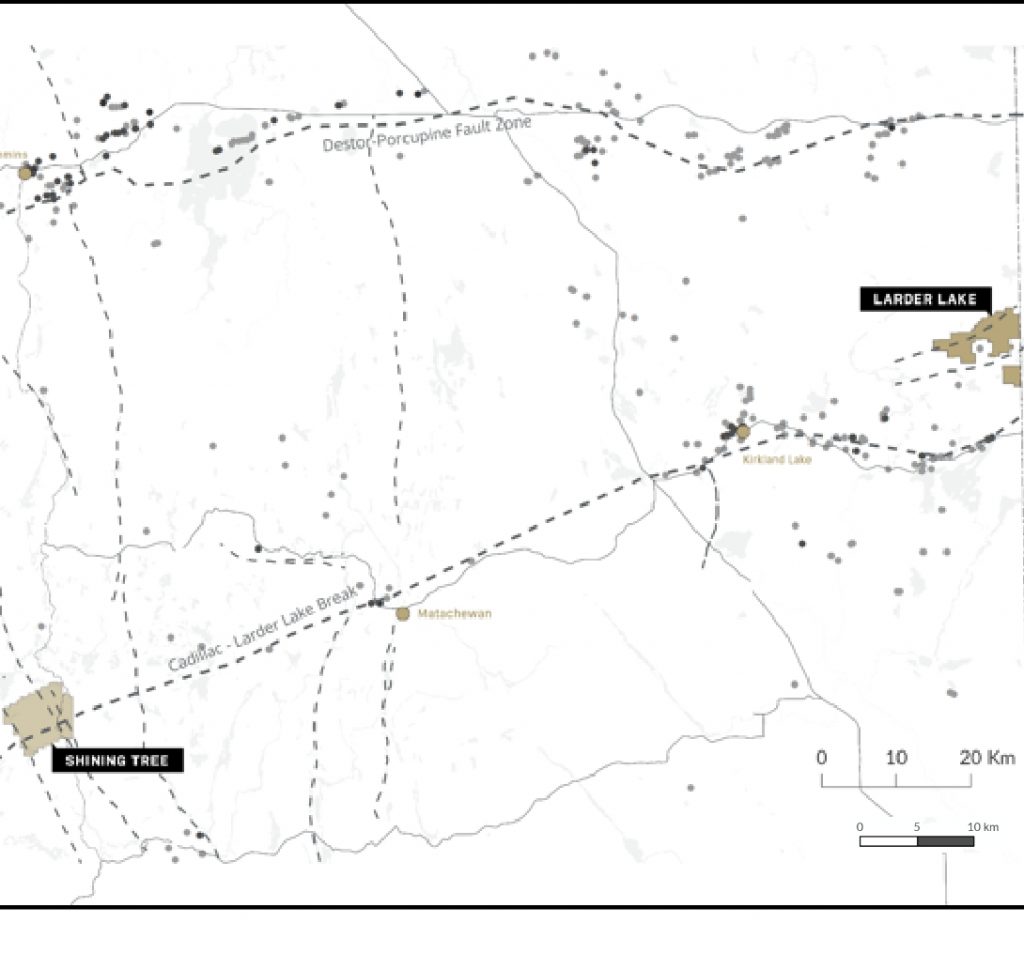
The Larder Lake Property (14 claims covering 4,630 hectares in 2 separate blocks) covers favourable fault structures within the Larder Lake gold camp, including a 12 km strike length along the easterly trending Misema-Mist Lake Fault, an eastern extension of the highly mineralized Kirkland Lake Fault, plus two N-NW trending cross structures, totalling an additional 4 km in length. The property’s eastern boundary is also the Ontario-Quebec provincial boundary.
The southern property boundary encompasses the easterly and westerly extensions of the Ossian Prospect. Historical work between 1924 to 1938 includes trenching, diamond drilling and sinking of a two-compartment exploration shaft to 64m (210 ft) depth and 240m (800 ft) of development on 2 levels. The prospect was described as an east-trending quartz vein containing sericite, calcite and pyrite traced over 120m in a felsic porphyry host rock. This vein returned assays up to 21.5 g/t Au over 1.23m (0.63 opt over 4 feet) from channel sampling.
Deposit Potential
Most of the previous exploration work on the Larder Lake property focussed on tracing the Ossian Prospect mineralization to the east. A 1996 reverse circulation drill program completed by Silver Century Explorations Ltd., indicated slightly elevated pristine and modified gold grain counts from 2 holes in the southeast portion of the property, suggesting a proximal to intermediate source of gold. Follow up work in 1997 included ground geophysical surveys, geological mapping/sampling and diamond drilling. One diamond drill hole testing an IP anomaly was completed on Trillium Gold’s current property. Gold mineralization was not encountered in this drill hole.

Exploration Results
The Walsh Mine prospect (Newfound Gold) is located 3 km south of the property. The primary mineralized zone is described as NE-striking quartz-ankerite veins traced 400m along strike and up to 1.5m width, containing pyrite, chalcopyrite, specularite, and galena. In 1924, a two-compartment shaft was sunk to a depth of 157m with lateral development on 4 levels. Two bulk samples collected in 1933 assayed 3.77 g/t Au (0.11 opt) and 64.1 g/t Au (1.87 opt), respectively. One of the better results of diamond drilling by Canper Resources Inc. in 1986 was 47.29 g/t Au over 2.5 feet.