SAN JOSE MINE
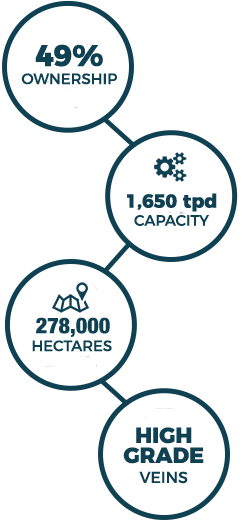
The San José Mine is owned and operated in partnership between McEwen Mining (49% interest) and Hochschild Mining (51% interest).
Located approximately 20 km north of Newmont’s Cerro Negro project, in the northwest corner of the Deseado Massif region of the Santa Cruz Province in Argentina, the mine is a high grade underground gold and silver operation in production since 2007.
- SAN
JOSÉ
(100%)
- MCEWEN
MINING
(49%)
2020 Production

64.9K
Au Oz

4.1M
Ag Oz
SAN JOSÉ
KEY
OPERATIONAL
FACTS
LocationSanta Cruz Province, Argentina
Workforce1,400
Mining TypeUnderground
Processing MethodGrinding and flotation
Crushing/Processing Capacity1,650 tonnes per day
2020 Production (100%) 64.9 thousand ounces gold + 4.1 million ounces silver
PRODUCTION
Mineralized material at San José is processed at a mill site, with half of the concentrate material produced being processed into doré, and the balance filtered and shipped as concentrate. The mine has been in commercial production for over 12 years and is estimated to continue producing gold and silver into 2024, according to the December 2018 assessment. The life of the mine continues to be updated as exploration advances and reserve estimates are renewed.
McEwen Mining's attributable production for 2020 at San José was of 31,800 gold ounces and 2,013,000 silver ounces. In 2020 the mine operated under capacity as a result of lockdowns and travel restrictions imposed by the government in relation to COVID-19. For the nine months ending September 30, 2020, cash costs and all-in-sustaining costs per ounce of gold equivalent were $1,232 and $1,536, respectively.
- SAN
JOSE
(100%)
- MCEWEN
MINING
(49%)

RESOURCES
& RESERVES
SILVER
MEASURED & INDICATED
38,600,000OZ
INFERRED
20,300,000OZ
PROVEN & PROBABLE
15,200,000OZ

GOLD
MEASURED & INDICATED
624,000OZ
INFERRED
321,000OZ
PROVEN & PROBABLE
241,000OZ
EXPLORATION
- NEW HIGH GRADE RESULTS
The San Jose Property Has Not Been Fully Explored
The Property Encompasses
687,000 ACRES
The San José Property is located in the northwest corner of the Deseado Massif in the Santa Cruz Province in Argentina, where Jurassic bimodal volcanics host numerous quartz veins bearing gold and silver. Low sulphidation silver-gold and polymetallic mineralization accompanied Jurassic magmatism and deformation in the Deseado Massif.
The mine is part of a larger property which covers a total area of approximately 1,074 square miles (2,781 square kilometers) and consists of 135 mining concessions. The sizable land package provides good potential for additional resource and reserve expansion.
The Jurassic Bajo Pobre Formation is the main host for gold and silver mineralization, where veins are typically developed in competent andesite flows at the Huevos Verdes, Frea and Kospi deposits on the San José property and to a lesser extent in volcaniclastic units.
Mineralization in the San José area occurs as low sulfidation epithermal quartz veins, breccias and stockwork systems accompanying normal-sinistral faults. The main structural trend of fault and vein systems on the property is northwest to north-northwest, together with less prominent east striking and north to northeast striking faults and veins.
The San Jose property is still under-explored. We are continuing to identify structures/ extensions with current operations. Long hole drilling started close to the mine at the end of 2019 has recognized new potential to the west side of the Huevos Verdes vein. Geophysics for the Titan area was also started in 2020.
The evaluation of the Aguas Vivas polymetallic deposit to the north west of our existing operations was continued in 2019 and will be completed in 2020.
The Telken zone, which we believe that it could form the extension to veins from Newmont’s Cerro Negro mine in the south, was prepared for drilling in 2019 and will have a 5 kilometers drilling program in the first half of 2020.
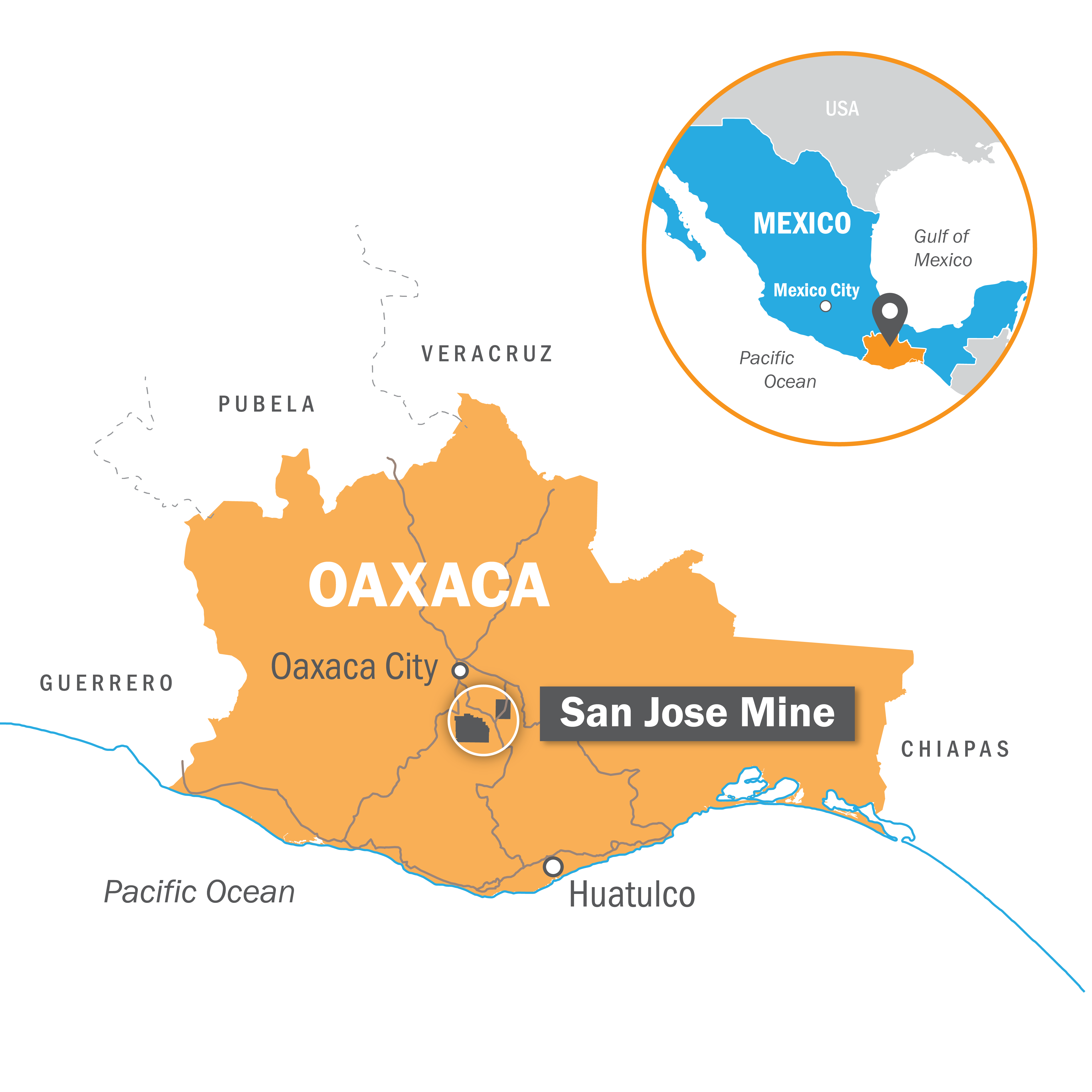
Our San Jose Mine in the Taviche Mining District, Oaxaca, Mexico, produces silver and gold. The underground mine is operated by Compañia Minera Cuzcatlan S.A. de C.V., a Mexican subsidiary 100% owned by Fortuna. It is a low sulfidation epithermal vein deposit and based on reserves reported as of December 31 2020, the operation has a three year mine life.
The San Jose Mine was commissioned in July 2011 and began commercial production in September 2011 at 1,000 tonnes per day. With strategic investment over many years, we increased the mill’s capacity to 3,000 tonnes per day by mid-2016. In 2020, the mine produced 6.2 million ounces of silver and 37,805 ounces of gold.
We recognize the role our San Jose Mine plays to support sustainable development in our areas of influence around the mine. As the largest employer in the area, we employed 214 community members from San Jose del Progreso and 349 from Oaxaca in 2020.
OPERATING HIGHLIGHTS
| 20201 | 2021E1 | |
|---|---|---|
| Tonnes milled (000) | 934 | 1,130 |
| Average milled (tpd) | 2,647 | 3,200 |
| Silver production (Moz) | 6.2 | 5.8 - 6.5 |
| Gold production (koz) | 38 | 38 - 42 |
| Silver equivalent (Moz) | 9.0 | 8.7 - 9.7 |
| Cash cost (US$/t) | $69.4 | $68.0 - $75.0 |
| AISC2 (US$/oz Au) | $12.2 | $12.2 - $14.5 |
Notes
- Refer to Fortuna news releases dated January 19, 2021, “Fortuna reports 2020 full year production of 11.3 million silver equivalent ounces and issues 2021 guidance” and March 10, 2021, “Fortuna reports consolidated financial results for full year 2020”
- Silver equivalent production is calculated using silver to gold ratio of 76 to 1