MEDICINE SPRINGS PROJECT JV
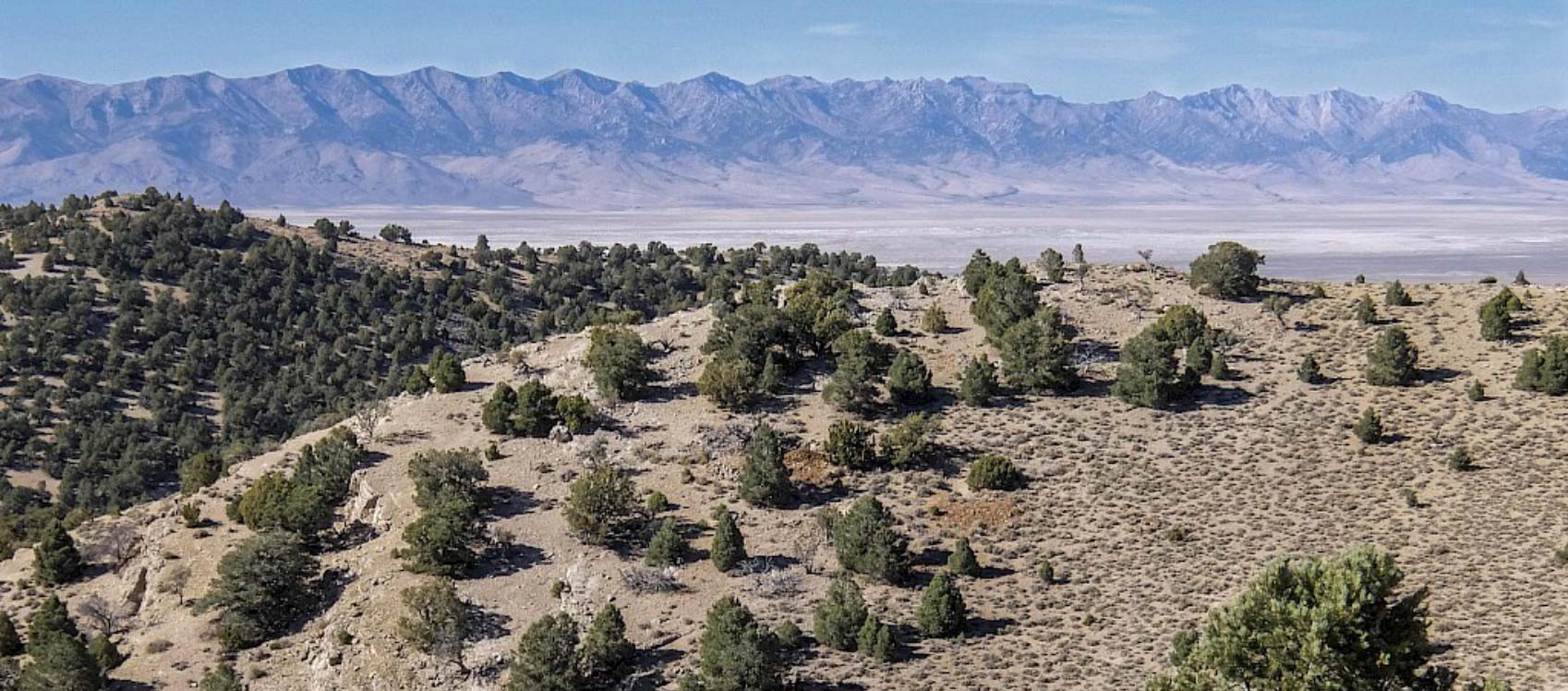 Silver Butte Area
NLR's second key project is the Medicine Springs Project located on the eastern edge of the Carlin Trend in southeastern Elko County, Nevada. Medicine Springs is a high grade silver-zinc-lead project with strong potential to host a large scale high-grade carbonate replacement.
Since acquiring the Medicine Springs Project in 2017, Northern Lights has completed exploration work including detailed geological mapping, rock sampling, analysis of historic geophysical survey data (CSAMT and IP), review of historic exploration drilling, an aeromagnetic survey and an Ionic Leach soil geochemistry survey.
The results of the exploration work completed by Northern Lights at the Medicine Springs Project highlight the potential for significant silver-zinc-lead mineralization including the potential for high-grade CRD style mineralization.
On October 5, 2020 Northern Lights announced a Option and Joint Venture Agreement with Reyna Silver Corp. (TSXV:RSLV). Under the terms of the Agreement, Reyna Silver can earn up to 80% equity in the Medicine Springs Project by completing minimum exploration expenditures of US$2.4 million plus other commitments and paying a cash payment of US$1 million to Northern Lights by no later than December 31, 2023. Northern Lights has a free carry (with no future repayment) until Reyna Silver as spent US$4 million on exploration on the project### Excellent Location.
Located in the Ruby Mountain Valley, south east of Elko, Nevada, with an area of 4,831 hectares. Accessible to Elko City, which serves as a major support base for numerous large gold mines currently operated by Newmont Mining & Barrick Gold.
Historical Producer.
Produced around 160 tonnes Pb, 800 kg of Zn and 500 kg of Ag from numerous surface and underground mine workings between 1910 to 1956.
High Exploration Potential.
Current exploration aims to define high-grade carbonate replacement deposit (CRD) sulfide mineralization at depth. Previous exploration already identified a strong NE-trending Pb-Zn-Ag soil anomaly with >2000 meters length and width ranging 350-500 meters.
Geological Setting.
Geological setting analogous to Taylor-Hermosa Zn-Pb-Ag deposit in Arizona (acquired by South32 for $CAD 1.9 billion in 2018).
MINERALIZATION
Two styles of oxide mineralization are observed at the Medicine Springs Property, high grade silver-lead-zinc-barite veins and breccias controlled by steep northeast structures and shallow west dipping bedding replacement mineralization hosted by permissive Gerster Formation carbonate units. The mineralization exhibits a close spatial relationship with Tertiary dykes identified from the magnetic data. It is important to emphasize that the older stratigraphic calcareous units underlying the Gerster Fm. offer excellent potential for replacement-style silver-base metal mineralization when adequate structural preparation exists. Historical exploration defines a silver-lead-zinc mineralized footprint that is traced along northeast trend for 3,400 meters and is up to 1,400 meters in width.
The Medicine Springs silver-zinc-lead-barite oxide mineralization is localized along 2 subparallel north-northeast trending fault systems that encompass the Golden Pipe and Silver Butte prospects. The mineralization is dominated by breccias, jasperoids and zones of decalcification hosted by carbonates of the Gerster Formation. Intensive oxidization has been observed to depth of approximately 150 meters. It is postulated that oxide silver-zinc-lead-barite mineralization overlies sulfide-rich carbonate replacement mineralization which was not tested by the previous shallow drilling programs.
Alteration observed in outcrop and in drill cuttings is dominated by jasperoidal silicification and argillization observed in the calcareous clastic units. A geological analogue for Medicine Springs silver-lead-zinc mineralization hosted by Permian carbonates is documented at the Lone Mountain property located 150 kilometers to the southwest. Carbonate hosted silver-rich base metal skarns are also observed at Bald Mt, Spruce Mtn and Eureka deposits.
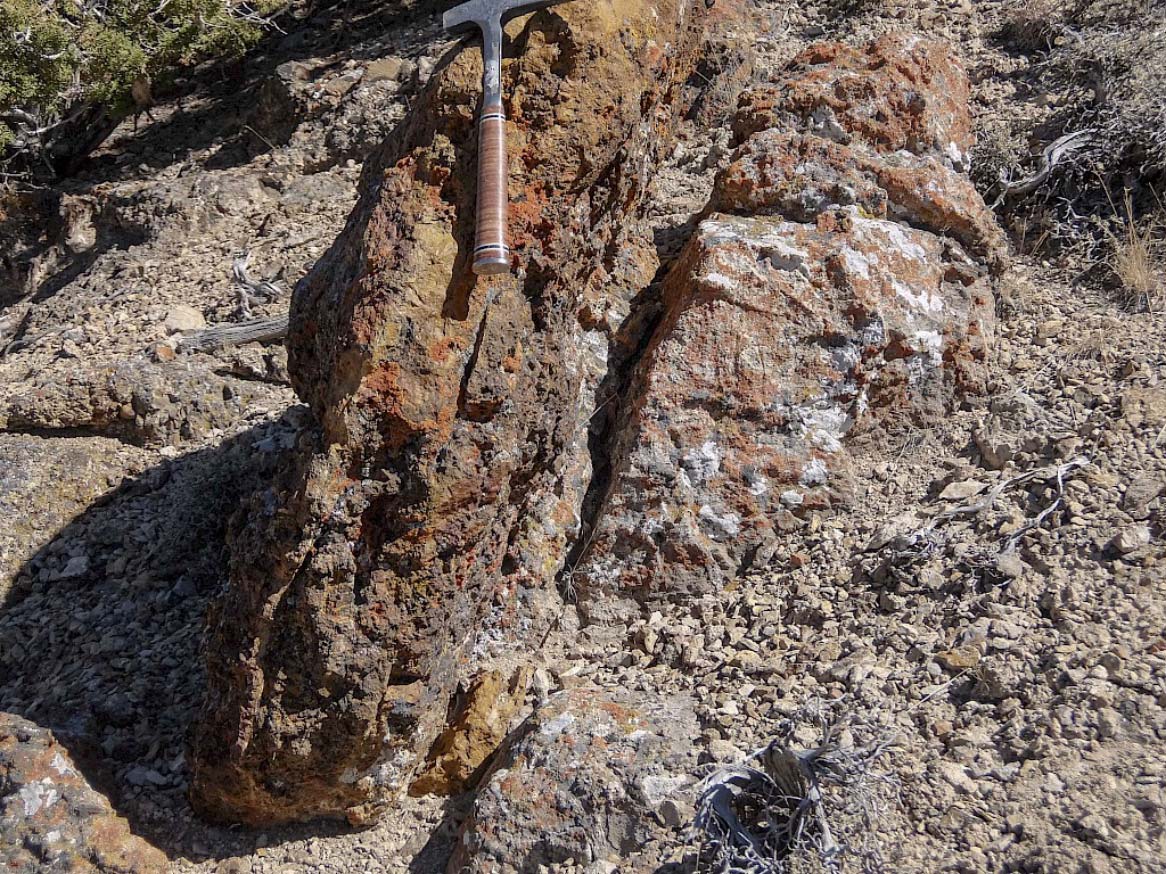 Surface Jasperoid-Barite Vein
Geological analogues for Medicine Springs oxidized silver-lead-zinc mineralization are observed at the Maverick Springs, Gunman, Lone Mtn, Bald Mtn and Spruce Mtn deposits located within the same northeast trending metallogenic zone hosted by Cambrian to Permian age carbonates with a relationship with Jurassic to Tertiary age intrusives.
- Spruce Mountain (American CuMo Mining)
PFS, 1.2 Bt, Eocene age porphyry deposit averaging 0.05% Mo, 0.05% Cu, credits in Ag and W. Distal Pb-Zn-Ag, and Cu mantos replace late Pennsylvanian and lower Permian carbonates/dolostones
- Maverick Springs (Silver Standard)
With Indicated Resource 63 Mt @ 34 g/t Ag and 0.31 g/t Au plus Inferred Resources of 77.6 Mt @ 34 g/t Ag and 0.31 g/t Au, open-pittable, hosted by Permian carbonates and strongly oxidized.
- Bald Mountain (Kinross)
With Reserves/resources 275 Mt @ 0.6 g/t Au, open pit, heap leach producing 283,000 oz Au; gold hosted by Jurassic intrusives and gold-silver-base metals developed in Devonian Devils Gate carbonates.
- Gunman (Pasinex)
Exploration, upper oxidized zinc-silver, low lead mineralization hosted by Permian carbonates and a lower sulfide zone hosted by Pennsylvanian age (?) black shale; targets CRD and SEDEX mineralization
- Lone Mountain (Nevada Zinc)
Nevada Zinc; exploration, shallow dipping oxidized zinc-lead low silver mineralization hosted by Devonian Devils Gate carbonates cut by with late barite/calcite veining.