DESERT EAGLE VANADIUM PROJECT
The Desert Eagle Project is located in Garfield County, Utah, United States. It is comprised of 97 Lode claims for a total of 2,004 Acres.
The Desert Eagle Project is host to historic Vanadium and Uranium production beginning in the early 1900’s and continued erratically and intermittently to date. The project is located in the Trachyte district situated to the east of the Henry Mountains, 95 miles south of Green River, Utah. Until recently practically all production from the Henry Mountains area came from the Trachyte district. The district is considered favorable for development of ore reserves.
The Desert Eagle Project can be reached from Green River, Utah via State Highways 24 and 95, and then by secondary country roads approximately 5km from the highway, or from Blanding, Utah via State Highway 95.
Vanadium and Uranium Ore on the Desert Eagle Project is confined to the Salt Wash member of the Jurassic Morrison formation. Historic development occurs across the entire project area with 31 historic mine adits and 21 prospect and prospect pits.
Primary vanadium mineralization occurs as carontite-vanoxite type, with V:U ratios in excess of 5:1. Secondary copper mineralization occurs in some occurrences as bornite. Generally the ore is concentrated in carbonaceous material in sedimentary layers; however the ore also extends beyond this material and mineralizes the surrounding sandstones. Depth to the ore zones varies from surface exposure to a maximum estimated depth of 180 ft. Overburden at a few of the surface operations consisits of thin layers of windblown sand.
Weighted averages of seven channel samples (approx 1.5 meters each) mainly from underground workings were 1.307% V2O5, and 0.245 U3O8.
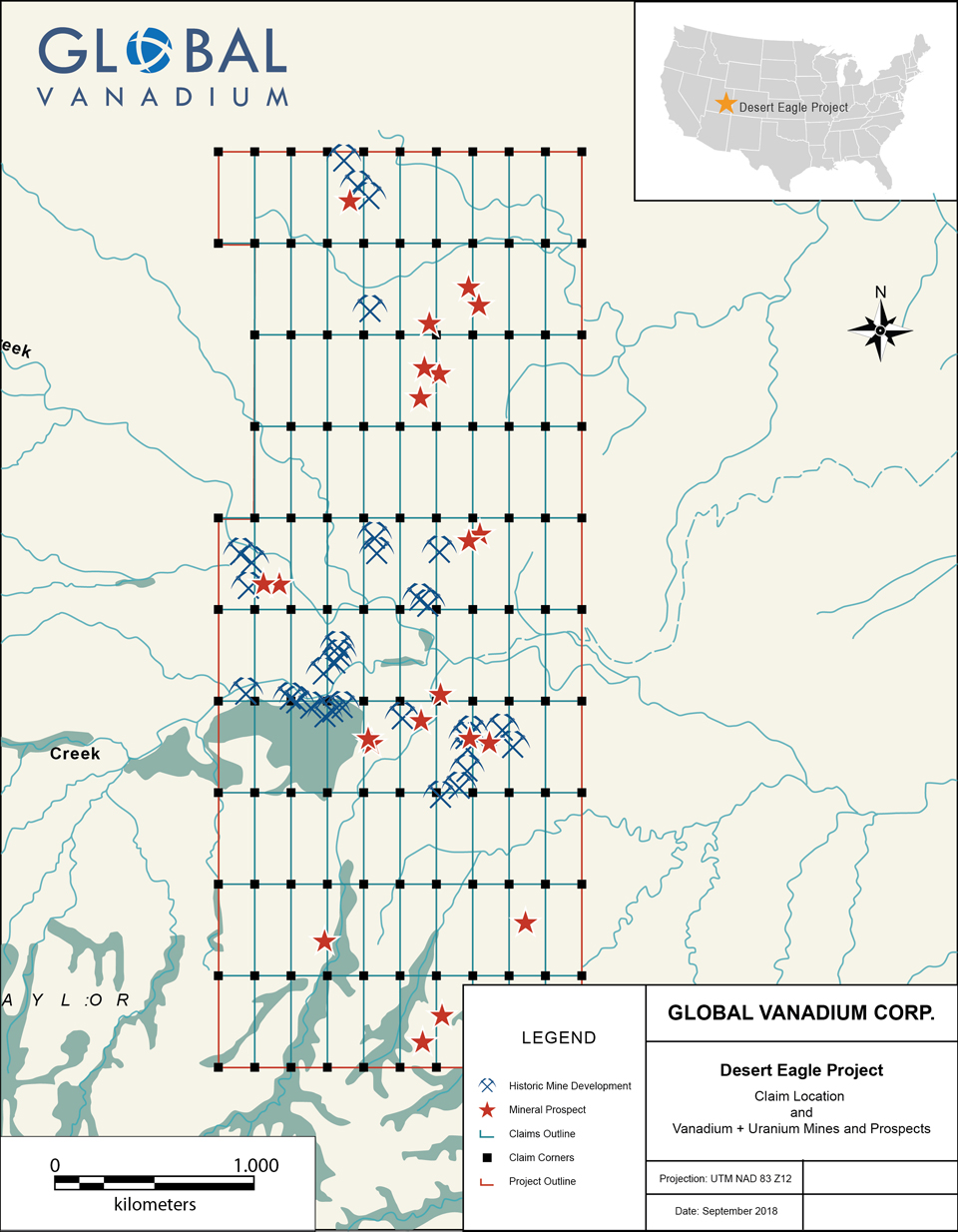
The Desert Eagle Project is comprised of a total of 2,004 acres located in the Trachyte district situated to the east of the Henry Mountains, 95 miles south of Green River, Utah. The project is considered prospective for the development of vanadium due to high historic grades and high ratios of vanadium over uranium present on the claims. Mineralization occurs within sandstone of the Salt Wash member of the Jurassic Morrison formation, a rock unit synonymous with vanadium and uranium production across the Colorado Plateau. A 1967 publication by the Utah Geological and Mineralogical Survey (Special Studies #22) reported results from 24 samples collected in historic audits on the property. These samples ranged from 0.11% to 28.20% V2O5, and averaged 5.17% V2O5. That same report indicates that historic production from this area yielded a 5:1 vanadium to uranium ratio. Sampling on behalf of the company in 2018 resulted in 57 samples being analyzed. Of those, 33 returned values greater than 0.5% V2O5, and 22 were greater than 1.0% V2O5. Twenty of those samples collected from accessible areas of the old audits ranged from 0.01% to 4.32% V2O5, and averaged 1.40% V2O5. In January 2019, the Company completed an NI 43-101 technical report on the project.