HOPPER COPPER GOLD PROPERTY
Highlights
- Skarn mineralization over 1200 x 800 x 400m extent
- High grade copper and gold in several skarn horizons
- Late Cretaceous poprhyry target, undrilled
- Undrilled skarn mineralization present in outcrop
- Permitted for advanced exploration including drilling and road building
The Hopper property hosts copper-gold skarn and porphyry mineralization in southwestern Yukon Territory. This 74 sq km road accessible property is located 22 km north of the Otter Falls hydroelectric generator within the Traditional Territory of the Champagne & Aishihik First Nation.
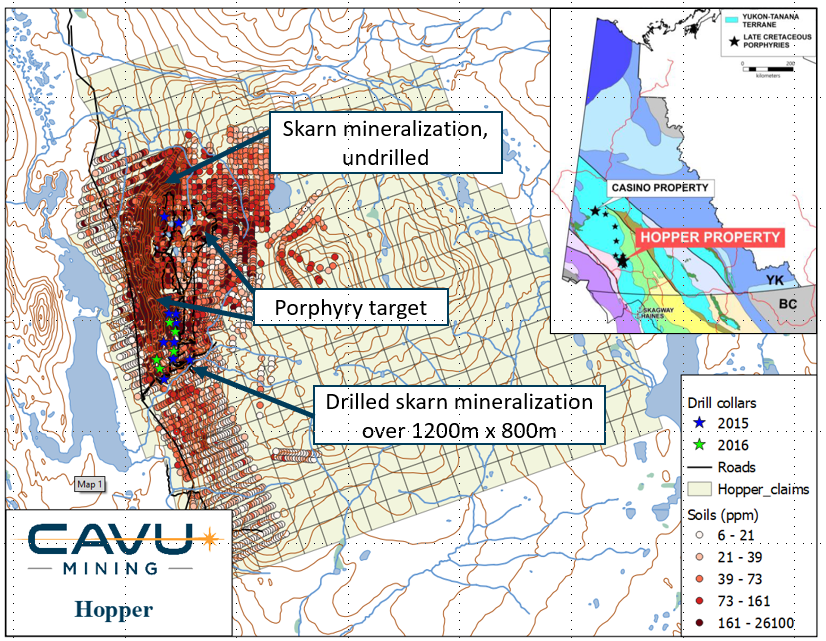
Overview
The property lies within the Yukon-Tanana Terrane. The oldest rocks in the area comprise Devonian to Mississippian quartz-biotite±muscovite schists, which are intercalated with lesser biotite-bearing quartzite and banded marble. This package is intruded by a Late Cretaceous (76.0±1.1 and 83.7±1.9 Ma) granodiorite pluton, which is informally called the Hopper Pluton. The age of the Hopper Pluton places it in the same metallogenic episode as the Patton Porphyry, which is the mineralizing pluton at Western Copper and Gold Corporation’s Casino porphyry copper-gold-silver-molybdenum deposit located 190 km to the north-northwest. The Casino deposit* contains 8.9 million ounces and 4.5 billion pounds in proven and probable ore reserves (mill reserves of 965.2 million tonnes grading 0.204% Cu, 0.240 g/t Au and 0.0227% Mo and heap leach reserves of 157.4 million tonnes grading 0.036% Cu and 0.292 g/t Au).
The mineralized hydrothermal system is centered on a porphyry-style copper zone that is flanked by stacked skarn horizons and distal veins. Historical work within the porphyry zone consisted of mechanized trenching and a number of widely spaced, very short percussion drill holes. The best results from this work were 0.52% copper over 45.72 m (trench) and 0.24% copper over 39.62 m (entire length of percussion drill hole). In 2015, a diamond drill hole was intended to intersect a chargeability anomaly that straddles the northern contact of the Hopper pluton. yielded an interval that averaged 0.17% copper over 162.85 m. However, the drill hole could not be collared far enough to the west due to ground conditions and the drillhole did not intersect the chargeability anomaly. Despite the unfavorable collar location the drill hole yielded an interval that averaged .17% Cu over 162.85m. There are many other untested chargeability anomalies within and adjacent to the Hopper Pluton.
Skarn Mineralization
Skarn mineralization in the south zone occurs over an area of 1200 x 800m and over a 400m vertical extent. The zone is open to the east, west and south. To the north it is cut by the Hopper Pluton. Skarn horizons continue further north past the pluton but have not been drilled. Road access to the northern skarn zones was built in 2016.
Skarn intersects in the southern zone include:
- 15m of 0.5% Cu, 0.5 g/t Ag and 1.64 g/t Ag in HOP15-02 from 113.1m
- 2.65m of 0.95% Cu, 12.15 g/t Au and 5.45 g/t Ag in HOP15-01 from 284.3m
- 8.50m of 1.62% Cu, 0.54 g/t Au and 9.30 g/t Ag in HOP11-03 from 58.3m
- 7.79m of 1.98% Cu, 0.67 g/t Au and 14.4 g/t Ag in HA89-2 from 23.09*
- 12.74m of 1.05% Cu in TH77-6 (silver and gold not assayed) from 57.4m*
- 18.59m of 1.94% Cu, .087 g/t Au and 14.6 g/t Ag in TH77-2 from 23.5m*
CAVU Focus: infill and step out drilling of southern skarn mineralization as well as drilling the northern skarn mineralization.
Hopper Porphyry Target
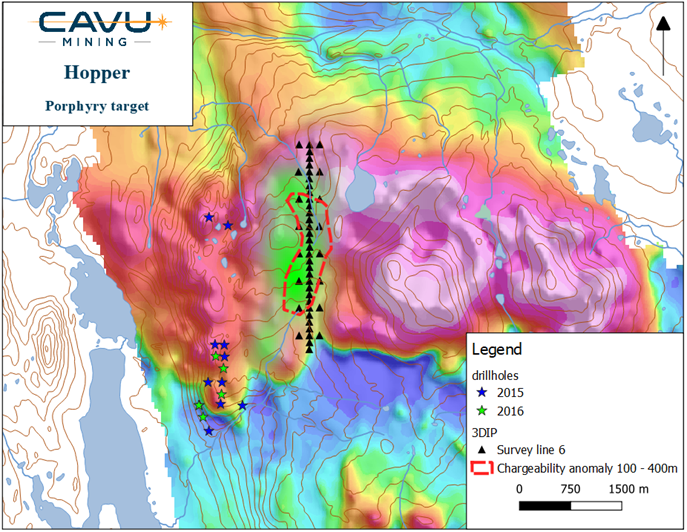 The Hopper Porphyry target consists of a large soil geochemical (green heatmap) anomaly underlying a chargeability anomaly. This target has never been drilled. The below figure highlights the depth profile of a 2014 3DIP survey.
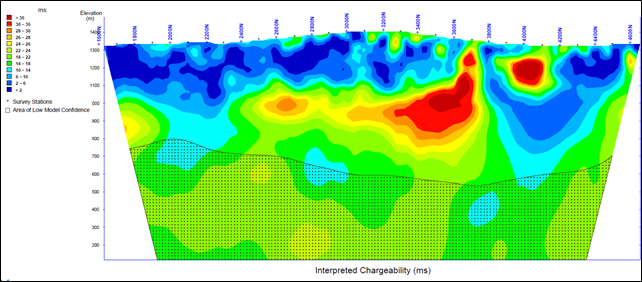 A large chargeability anomaly underlies the geochemical anomaly within the magnetic high of the Hopper Pluton, which may represent disseminated sulphides and is a priority drill target.
The Hopper porphyry target consists of 1) a mag high with 2) coincident copper and molybdenum in soil anomalies underlain by 3) IP anomalies. Despite the favourable geochemistry and geophysics the target has never been properly drill-tested and the area is only mapped to limited extent. A grid of percussion holes drilled in 2011 were too short to intersect the targets and were placed outside the main soil anomaly that defines the target. A drill hole collared in 2015 was too far to the west to test a chargeability high.
_CAVU Focus:_ ground truthing of target through geological mapping and prospecting with a possible preliminary drill-test, followed by a more significant drill test consisting of 3,000m of drilling.
The Hopper Project is under option from Strategic Metals. CAVU may earn 70% by making total payments of $700,000 and 250,000 shares over 4 years. Payments after year 2 may be half cash and half shares by the election of CAVU. CAVU must further incur $5,000,000 in expenditures over the option period.
*Drill holes and assay data are historic in nature. A deposit on tenure other than CAVU’s tenure is not indicative that a deposit may ever be defined on the Hopper Project. The Hopper Project is exploration stage.