STILLWATER WEST PROJECT
HIGHLIGHTS:
- 100%-owned, large, brownfields project in Montana’s Stillwater District; one of the world’s largest and highest-grade PGE-Ni-Cu regions
- Adjacent to high-grade Sibanye-Stillwater’s PGE Mines¹ with over 14Moz past Pd+Pt production2
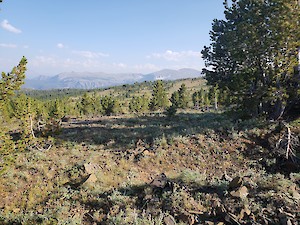
- The Stillwater District has a rich mining history for PGEs, Ni, Cu, Cr, and other commodities
- The project features an extensive database –– including almost 12,000 m of core –– to which Group Ten is applying modern geological models developed in South Africa at Ivanhoe’s Platreef and Anglo American’s Mogalakwena mines
- Compilation and analysis by Group Ten shows the potential for much larger mineralized systems than have been previously recognized
- Existing road access and power infrastructure with three operating mines
- Inaugural mineral resource estimate planned for 2021
OVERVIEW
The Stillwater West PGE-Ni-Cu Project consists of 14 multi-kilometer-scale exploration target areas along a 25 km strike length adjoining and adjacent to Sibanye-Stillwater’s high-grade Stillwater (Stillwater, East Boulder, and Blitz) mines in the Stillwater Igneous Complex of Montana, USA. Located in one of the top regions in the world for PGE-Ni-Cu mineralization, the producing J-M Reef deposits operated by Sibanye-Stillwater is the highest-grade major PGE project in the world and the largest outside South Africa and Russia. In June 2017, one month after South African producer Sibanye announced the completed takeover of Stillwater Mining company for USD 2.2 billion, Group Ten Metals announced the closure of the Stillwater West project acquisition deal, which positions the Company as the second largest landholder in the district. In addition to the land package, the Stillwater West acquisition included an extensive historic database of soil and rock geochemistry, geophysical surveys, geologic mapping, and historic drilling with nearly 12,000 metres of preserved core.
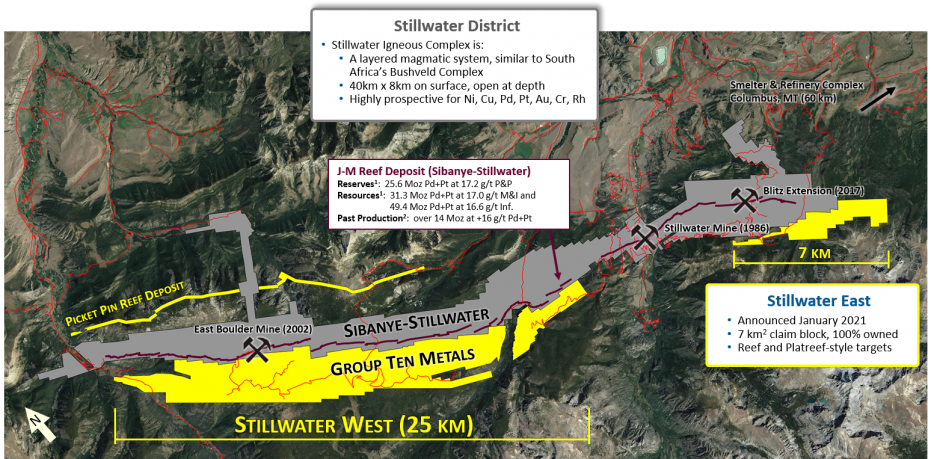
The Stillwater Complex is a 2.7 billion-year-old layered intrusive mafic-ultramafic complex with geology similar to South Africa’s Bushveld Complex. Mining in the Stillwater District currently occurs along the J-M Reef, a PGE-enriched sulphide horizon that shares many similarities with the highly-prolific Merensky and UG2 Reefs in the Bushveld Complex, particularly very high PGE grades along narrow seams. In addition to these narrower “reef-type” deposits, the Bushveld also hosts much larger-scale disseminated and high-sulphide PGE-nickel-copper-type deposits, including Anglo American’s world-leading Mogalakwena Mine and Ivanhoe’s developing Platreef Mine. Similarly, the lower part of the Stillwater Complex, which hosts the majority of Group Ten’s 54 km² holdings, also shows the potential for these broadly-disseminated deposits that can range well beyond 100 metres in thickness.
A total of 14 exploration target areas ranging from 3 to 8 km in length and defined by major high-level electro-magnetic conductors with broad coincident soil geochemical anomalies have been identified on the Stillwater West property. Each of these are further divided into eight ‘Platreef-style’ bulk tonnage PGE-Ni-Cu sulphide exploration target areas and six ‘Reef-type’ higher-grade PGE areas. While Group Ten’s Stillwater West property hosts both styles (the “reef-type” Picket Pin in the upper portion of the Complex and the larger “Platreef-type” deposit located in the lower portion), the Company has prioritized exploration of the lower Stillwater Complex where work to date demonstrates strong potential for very large, world-class mineralized systems. Each of the major conductor targets on the main claim is as large as Ivanhoe’s Platreef deposit and drilling data from the 1960s, 1970s, and 2000s confirms the presence of significant intervals of platinum group elements (PGE) and cobalt with nickel and copper sulphides associated with at least six (6) of the 15 identified geophysical exploration target areas.
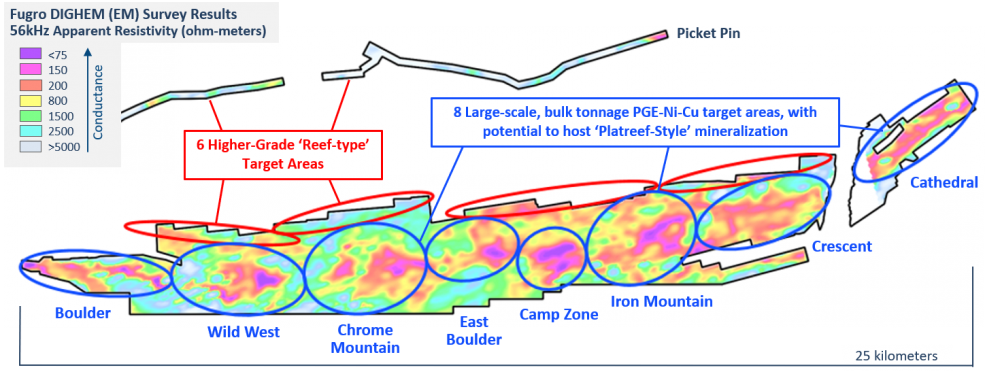
The eight ‘Platreef-style’ PGE-Ni-Cu exploration target areas occur within the ultramafic and basal part of the Stillwater Complex and are highlighted by strong electro-magnetic conductive signatures that are characteristic of large bodies of massive to extensively disseminated sulphides. These geophysical exploration targets have overlapping highly elevated palladium, platinum, gold, nickel, copper, and chromium values in soils and rock sampling. Individual target areas have from a few drill holes to as many as 30 wide-spaced holes that have intercepted significant levels of platinum, palladium, and gold along with nickel, copper, cobalt, rhodium, vanadium, and chromium.
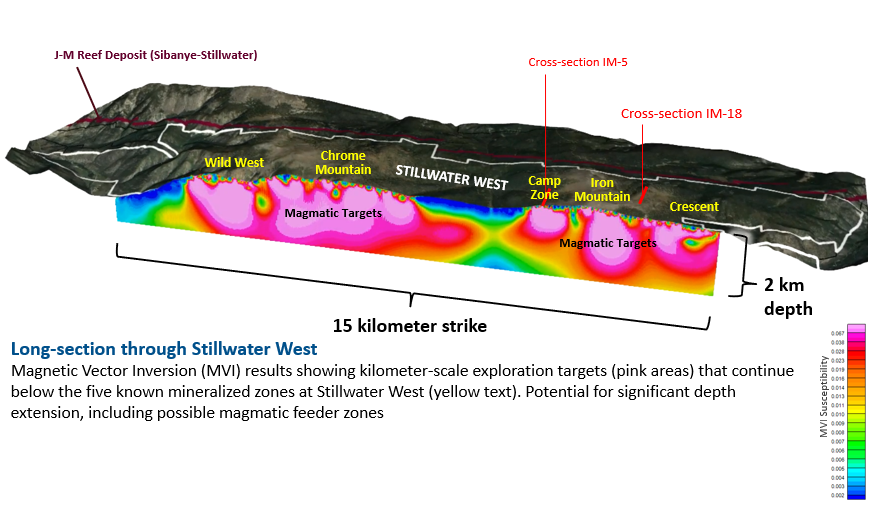
PRIORITIES FOR 2021:
- Convert mineralized zones to formal resources
- Expand known mineralization into untested areas
- Identify and prioritize new targets
UPCOMING NEWS:
- IP survey results
- Updated block models in most advanced areas
- 2021 exploration program plans and launch
- Potential additional agreements on secondary projects