HEMLO WEST PROPERTY
KEY HIGHLIGHTS:
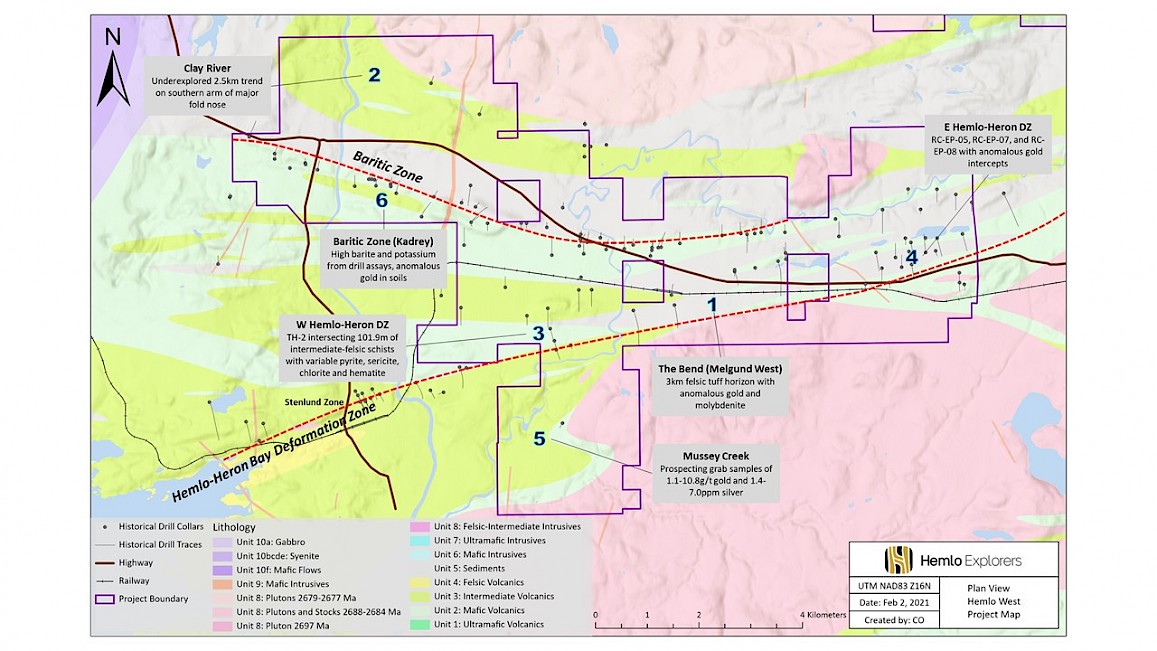
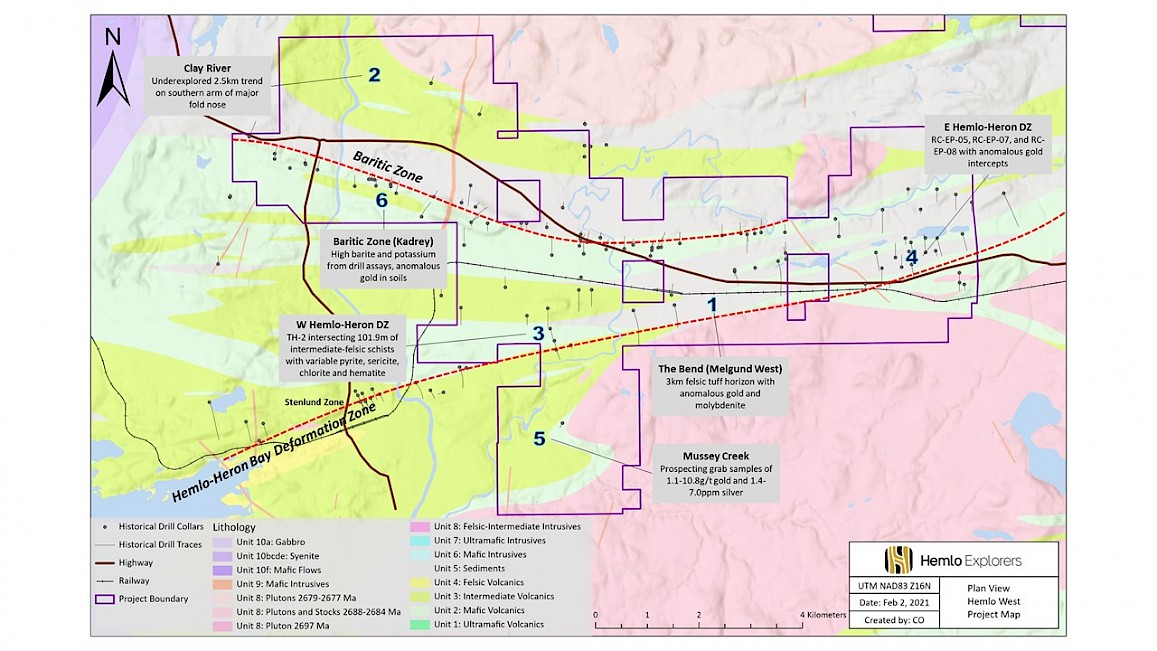
- Hemlo-Heron Bay Deformation Zone - Hemlo West contains 7.5 kilometres of this deformation zone that hosts the Hemlo Deposit located 13 kilometres to the east. Three zones, with appreciable intermediate to felsic volcanic units with variable alteration and mineralization have been identified by wide-spaced drilling. Regional scale magnetic signatures may serve as a vectoring tool for future testing.
- Clay River Area - a 2.5 kilometre area on the southern arm of a regional fold or arcuate bend with reported felsic tuffs and meta-sediment sequences. The area has seen very limited exploration.
- Mussey Creek - Represents an area with anomalous prospecting grab samples that returned 1.1 to 10.8 g/t gold, 1.4 to 7.0 g/t silver from a felsic intrusive within a mafic unit. The extent and control of gold mineralization is not clear and needs further evaluation.
- Baritic Zone (Kadrey) - Barite is a unique and major component of the Hemlo deposit as either a stratigraphic unit that has reacted with hydrothermal fluids or an entirely introduced hydrothermal mineral. A baritic unit has been mapped on surface and tested by diamond drilling, at the Hemlo West Project, over an approximate 4.5 km roughly west to easterly trend. Kadrey represents a 1.7 km section of the baritic trend that has been poorly tested.
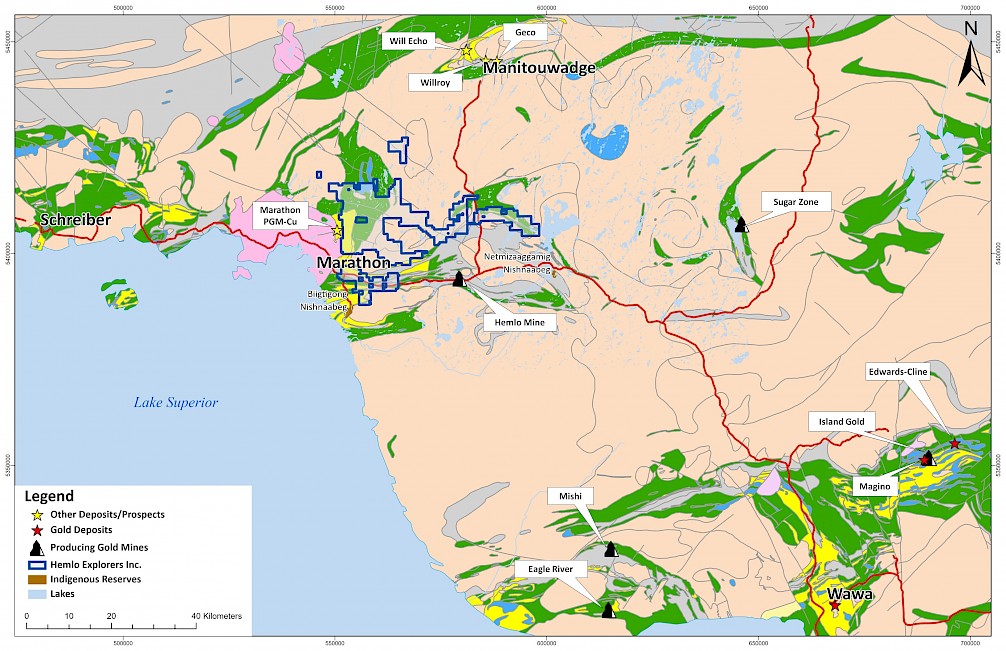
Through acquisitions and staking programs, Hemlo Explorers has assembled a large land package totaling 380 square kilometres of prospective mineral rights in the Hemlo-Schreiber Greenstone Belt. The Hemlo Camp is famous for hosting the Hemlo Deposit, with historical production of more than 22 million ounces of gold since 1985, and remains in operation at the Williams Mine operated by Barrick Gold Corporation.
HEMLO GOLD CAMP SUMMARY: AN EXPLORATION OPPORTUNITY
Hemlo is an Archean deposit located in the Hemlo-Schreiber Greenstone Belt of the Superior Province (Wawa Sub-province) in northwestern Ontario, Canada.
The deposit is located at a felsic rock interface (Moose Lake Volcanic Complex) with sulphides in a sheared-fractured-folded structural regime. Intrusions of variable age and composition and pluton emplacements may have played a role in metal deposition or reworking. Prior to its discovery, several ground surveys and shallow drill programs between 1946 and early 1981 failed to find the Main Hemlo Deposit whose surface expression did not reflect it’s metal enrichment that would be found at greater depths (>500 metres) below surface.
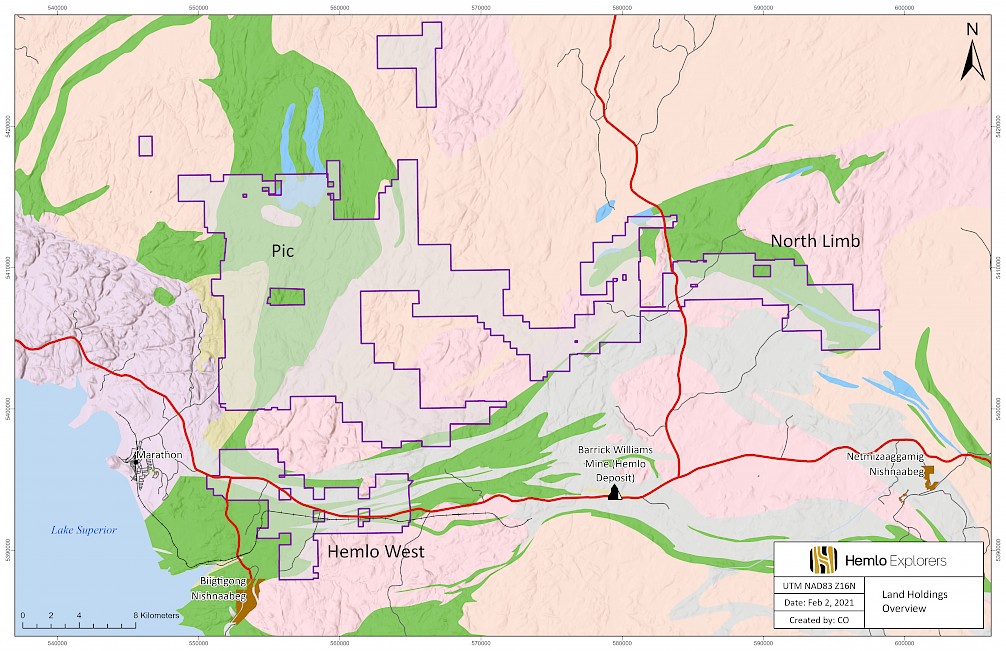
With this understanding, in 2016 Hemlo Explorers (formerly Canadian Orebodies) embarked on mining claim consolidation in the Hemlo Camp acquiring favourable felsic volcanic assemblages, areas of sulphide occurrences and intrusive related gold systems. Through compilation of historical data and current exploration initiatives, Hemlo Explorers has generated targets/trends for drill testing and further exploration.
KEY HIGHLIGHTS:
- Hemlo-Heron Bay Deformation Zone - Hemlo West contains 7.5 kilometres of this deformation zone that hosts the Hemlo Deposit located 13 kilometres to the east. Three zones, with appreciable intermediate to felsic volcanic units with variable alteration and mineralization have been identified by wide-spaced drilling. Regional scale magnetic signatures may serve as a vectoring tool for future testing.
- Clay River Area - a 2.5 kilometre area on the southern arm of a regional fold or arcuate bend with reported felsic tuffs and meta-sediment sequences. The area has seen very limited exploration.
- Mussey Creek - Represents an area with anomalous prospecting grab samples that returned 1.1 to 10.8 g/t gold, 1.4 to 7.0 g/t silver from a felsic intrusive within a mafic unit. The extent and control of gold mineralization is not clear and needs further evaluation.
- Baritic Zone (Kadrey) - Barite is a unique and major component of the Hemlo deposit as either a stratigraphic unit that has reacted with hydrothermal fluids or an entirely introduced hydrothermal mineral. A baritic unit has been mapped on surface and tested by diamond drilling, at the Hemlo West Project, over an approximate 4.5 km roughly west to easterly trend. Kadrey represents a 1.7 km section of the baritic trend that has been poorly tested.
Through acquisitions and staking programs, Hemlo Explorers has assembled a large land package totaling 380 square kilometres of prospective mineral rights in the Hemlo-Schreiber Greenstone Belt. The Hemlo Camp is famous for hosting the Hemlo Deposit, with historical production of more than 22 million ounces of gold since 1985, and remains in operation at the Williams Mine operated by Barrick Gold Corporation.