DOROPO PROJECT
HIGHLIGHTS
3.5 MOZ M&I&I RESOURCE
1850 SQ KM LICENSE HOLDING
PFS UNDERWAY
OVERVIEW
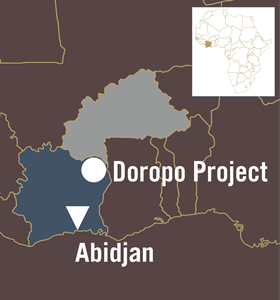 The Doropo Project (“Doropo”) consists of seven exploration permits, covering an area of approximately 1,850km2. Doropo is in the northeast of Côte d’Ivoire, between the Comoè National Park and the international border with Burkina Faso, and approximately 650km north of Abidjan.
Geologically, Doropo lies entirely within the Tonalite-Trondhjemite-Granodiorite domain, bounded on the eastern side by the Boromo-Batie greenstone belt, in Burkina Faso, and by the Tehini-Hounde greenstone belt on the west.
The Company began extensive exploration at Doropo in late 2015, leading to a maiden resource declared in 2017. The Company’s experienced exploration team has achieved year-on-year resource growth. The team applies a systematic approach to prioritise resource-focussed target generation and ranking to fast-track the most prospective target.
The Main Resource Cluster contains 67% of the defined mineral resource deposits within a 10km radius.
2019 Doropo NI43-101 Technical Report
GEOLOGY
The Doropo landholding lies entirely within the granitic domain, bounded on the eastern side by the Boromo-Batie greenstones belt, in Burkina Faso, and on the western side by the Tehini-Hounde greenstones belt.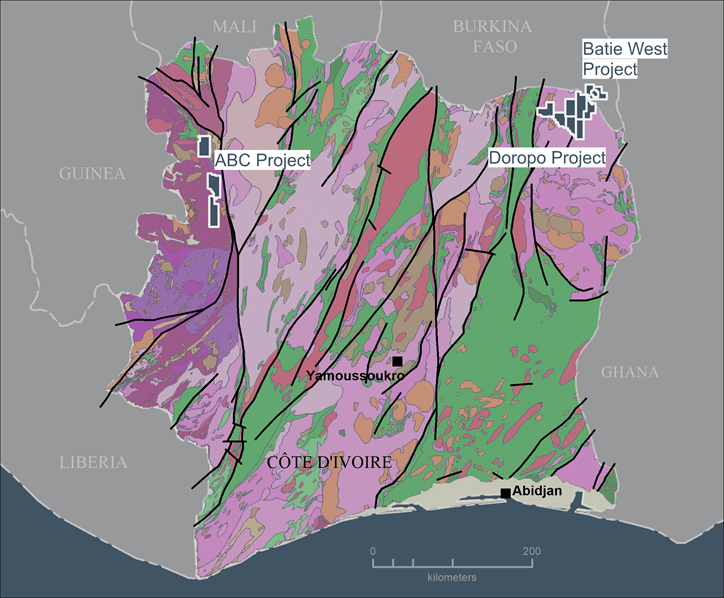
At the project scale, the geology consists of a granite-gneiss terrain, the granite being mostly of coarse granodioritic composition, bound by major bimodal greenstone belts, which express progressive assimilation and strain gradients at the margins, evidenced by the presence of pyroxenites and amphibolites in the volcanic suites and migmatites in the granitoids (mostly on the western side).
Gold mineralisation occurs late in the regionally-extensive, reactivating compressional shear networks, framed by intense silica-sericite-carbonate alteration haloes. The main structural hosts are cross-cutting quartz veins with diffuse overprinting with fine to medium grained pyrite sulphide selvages. Gold grade correlates with the density of pyrite and high grades are correlated with native gold within the structural laminations and contacts of the quartz veining. The veins range up to several metres. Late regional, post-gold, doleritic dykes intrude along a number of the gold-bearing shear structures.