CANGREJOS GOLD COPPER PROJECT
Summary
- Ownership 100%, 6,374 hectares
- Located 40 km to commercial port of Puerto Bolivar
- Power to camp from national grid
- Sparsely populated area, constructive ongoing relations with local community
- Mineral Resource Estimate updated in June 2020
- Indicated mineral resource of 571 million tonnes of 0.73 g/t AuEq, with 10.4 Moz and 1.4 Blbs Cu
- Inferred mineral resource of 500 million tonnes of 0.52 g/t AuEq, with 6.3 Moz Au and 0.8 Blbs Cu
- Gran Bestia remains open to the north, west and at depth. Cangrejos remains open to the west and at depth
- PEA completed in June 2020 and will be filed by July 2020
Location & Access
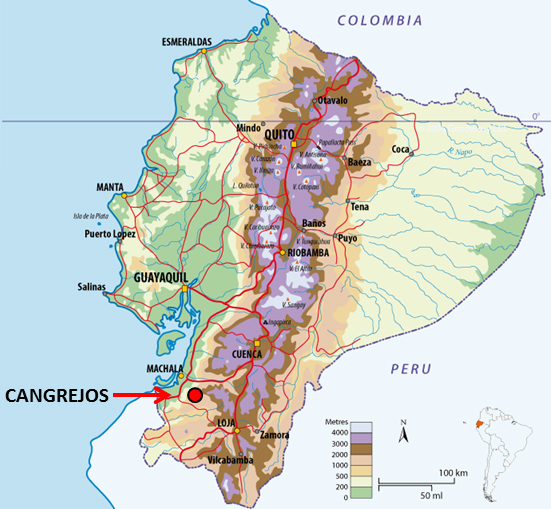
The Cangrejos project is located in El Oro province, SW Ecuador, 30 km SE of the provincial capital of Machala and the Pan American Highway and 40 km from the deep water commercial port of Puerto Bolivar. Access to the property is via paved and 8 km of gravel roads. The company has a field camp and core facility located on the property.
Location Map
[
Location Map](https://luminagold.com/assets/img/projects/cangrejos-gen-loc-map.jpg)
Region
Lumina's Cangrejos project is located in the Andean foothills of El Oro province, in southwestern Ecuador. El Oro province has a long established history of mining, which is a way of life in many areas.
In 1994 Lumina (formerly Odin Mining) identified the Cangrejos area as the source of the Biron alluvial gold deposit which yielded 69,000 ounces of gold. A joint venture was formed with Newmont and during the period 1994 to 2001 geophysical and geochemical surveys were completed and anomalies were tested by diamond drilling. The Cangrejos zone was discovered by hole CC-99-14 which intersected 1.57 g/t Au over 192m.

Mineralization
Gold +/- copper mineralization in southern Ecuador is associated with:
- granitic intrusions of various ages
- Deposits are low grade, bulk tonnage Cu-Au porphyries or higher grade epithermal Au veins
At Cangrejos, porphyry style Au-Cu mineralization is associated with a sequence of intercalated porphyritic dioritic intrusions and hydrothermal breccias. Better Au grades correlate with potassic alteration and chalcopyrite-bornite occurring as fine disseminations and in quartz veins. This northeast trending zone was discovered by Newmont in 1999 and tested by 3 Odin drill holes in 2011.
Qualified Person
Leo Hathaway, P.Geo, a "qualified person" within the definition of that term in NI 43-101, has reviewed and approved the scientific and technical information contained on this page.
Lumina Gold: new PEA shows increased mine life of 25 years

Allen Sykora Tuesday June 09, 2020 09:12
Kitco News
Share this article:
 (Kitco News) - Lumina Gold Corp. (TSXV: LUM) is upbeat about results from a new preliminary economic assessment for its 100%-owned Cangrejos gold-copper project in Ecuador, reporting an increased amount of metal and a longer mine life of 25 years.
The study, initiated in late 2019 by an independent team of consultants, demonstrates what the company called “substantial improvements” from a preliminary economic assessment that was conducted in 2018, with the addition of Gran Bestia, increased mineral resource definition and improved process flow sheet, Lumina said.
Marshall Koval, president and chief executive officer, said the after-tax net present value of Cangrejos increased by over $600 million to $1.6 billion. Also, the report shows average annual gold production of 366,000 ounces per year over a mine life of 25 years. The 2018 study showed annual output of 373,000 gold ounces for a shorter mine life of 16 years. The company projected payable by-product copper production of 46 million pounds annually, up from 43 million in the earlier study.
The amount of “contained gold” for the life of mine rose to 11.4 million ounces from 7.5 million, while the amount of “contained copper” increased to 1.5 billion pounds from 0.9 billion.
“Cangrejos is an exceptional global gold deposit and one of the few of this scale that is 100% controlled by an independent developer,” Koval said. “Ecuador has made substantial progress in its mining sector with the successful commissioning of Fruta del Norte and Mirador. Now the country will turn their focus to the next generation of development projects.”
Lumina said that base-case economics were calculated using a gold price of $1,400 per ounce, copper price of $2.75 per pound, molybdenum price of $9 per pound and a silver price of $16 per ounce.
The study listed average cash operating costs of $545 per gold ounce and all-in sustaining costs of $604, after by-product credits. The PEA looked at large-scale open-pit mining using an owner-operated equipment fleet, the company said.
The report listed life-of-mine processed grades of 0.56 grams of gold per metric ton and 0.10% copper. The life-of-mine revenue mix was put at 78.9% gold, 19.4% copper and 1.7% molybdenum, plus silver output.
Initial capital costs, including working capital and refundable value-added taxes, were estimated at $1 billion