USICAYOS GOLD PROJECT
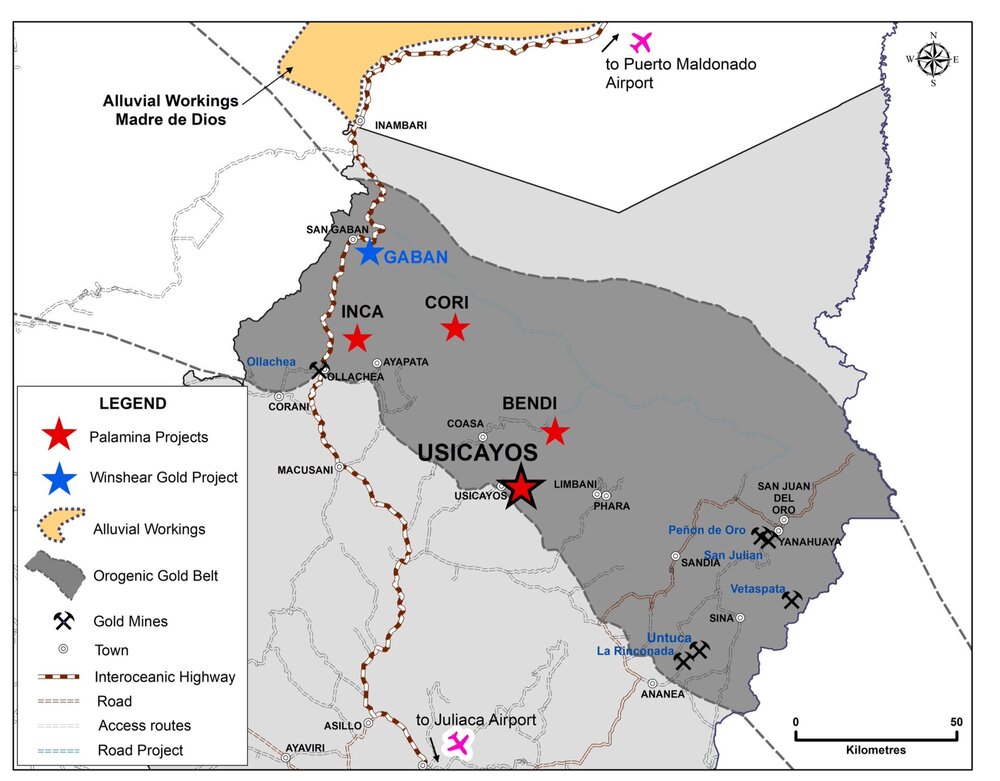
Palamina has participation in 5 projects in the Puno Orogenic Gold Belt
100% INTEREST
14,600 HECTARES
DEPARTMENT OF PUNO, SOUTH-EASTERN PERU
**CLICK HERE FOR USICAYOS* NI 43-101 TECHNICAL REPORT*** Completed prior to renaming of project on July 9, 2021
Overview
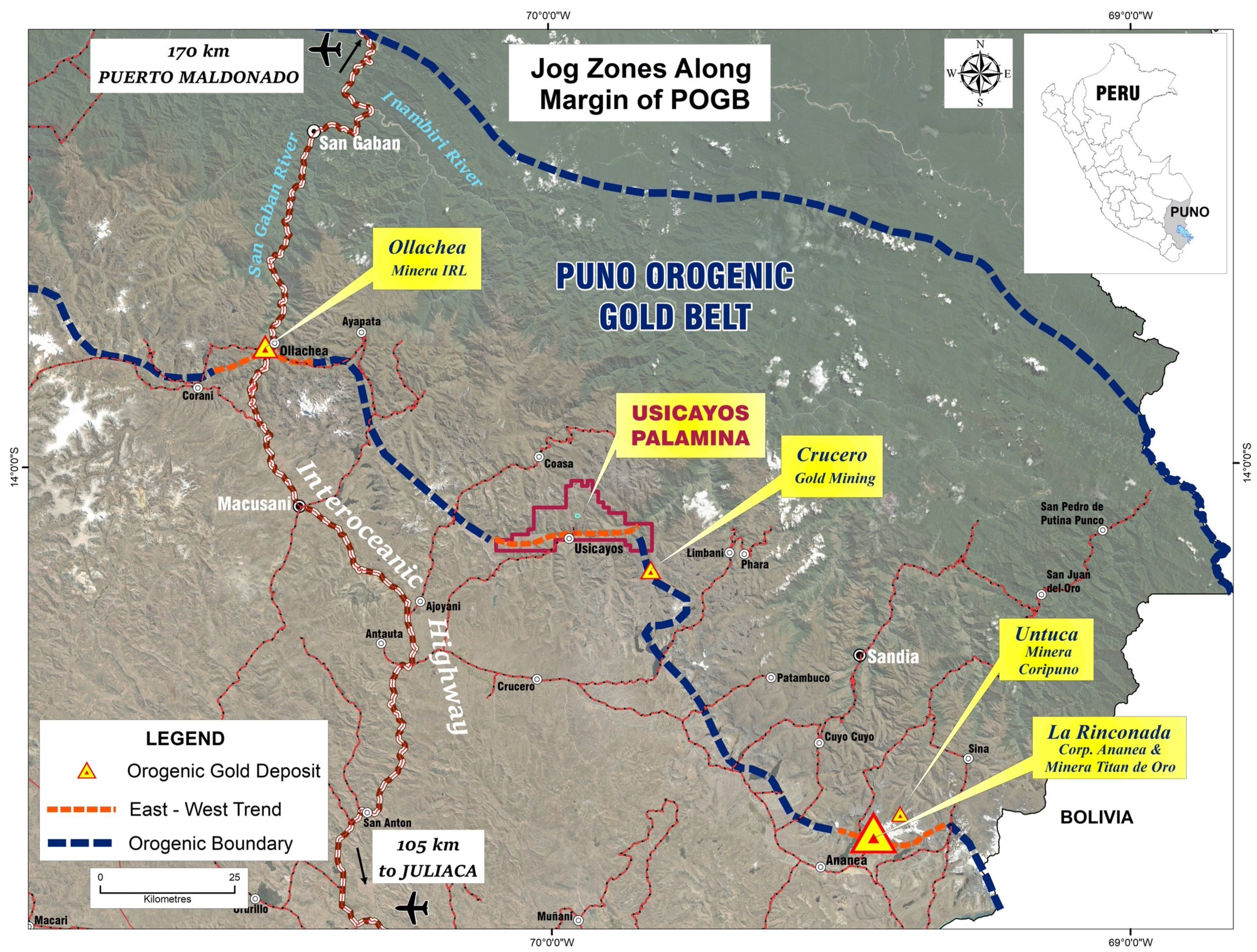
The Usicayos Gold Project was acquired primarily through staking to explore a geologic environment interpreted to be similar to that of the Ollachea, La Rinconada and Crucero orogenic gold deposits. Usicayos is not subject to any NSR or onerous future payments to any vendors or optionors. Usicayos is located along the southern edge of the Puno Orogenic Gold Belt (“POGB”) with a structural environment similar to those associated with the Ollachea and La Rinconada gold deposits to the northeast and southwest.
All of these gold deposits are focused along structurally deformed east-west trending ‘jog’ zones along an otherwise NW-SE structural trend of POGB structural boundary. The mineralized surface footprint at Usicayos is second only to La Rinconada. Mineralizing controls common to orogenic gold deposits are identified throughout the POGB. Members of Palamina’s geological team were part of the exploration discovery team at Ollachea and have extensive experience in the POGB.
Infrastructure
The Usicayos Gold Project is located in the area near the town of Usicayos which is a 4 hour drive and 150 km north of the city of Juliaca via paved and gravel roads. Juliaca is a local economic hub which hosts a domestic airport as well as many services which can support exploration at Usicayos. Palamina has a field office located in Juliaca.
Elevations at Usicayos range from 2,800 to 4,700 metres. Access to the project is along dirt roads from the towns of Usicayos and Coasa to several points within the claim block. From these points, exploration is undertaken on foot or by horse along river valleys or footpaths to access mineralized targets. Due to the elevation, rock exposure is generally excellent as the property sits above the tree line with sharp rocky ridges at the highest elevations, which give way to high alluvial terraces and narrow canyons at lower elevations.
Geology
The Usicayos property captures a 22 km long section of deformation corridor hosting numerous discrete shear zones. These are believed to be intimately associated with the extension of regional shear structures controlling gold mineralization at the Crucero gold project located 4.5 km south of the Usicayos Project’s south-eastern boundary. At Usicayos, Palamina has identified 10 geochemical anomalies. The Veta, Cayos & Veta NE zones are the highest priority targets to date and have been selected for drill testing.
Lithology, structure, sulphide mineralization and intrusive bodies similar to those identified at Ollachea have been identified at Usicayos Shear zones are concentrated along relatively weak horizons, especially along organic-rich black shales principally of the Late-Silurian/Early Devonian Ananea Formation.
Veta, Cayos & Veta NE Gold Discovery Zones:
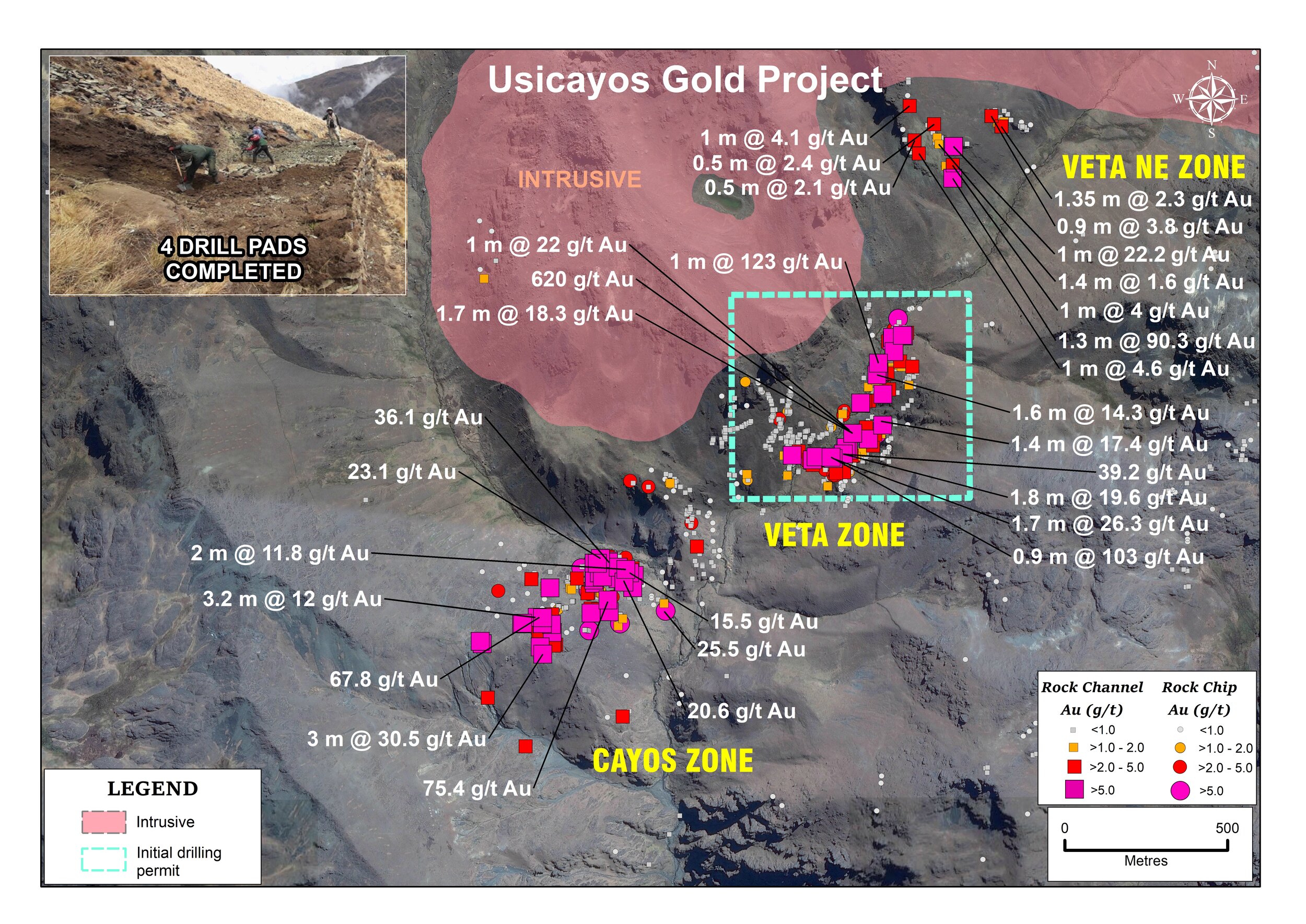
Geological mapping, surface and channel sampling has resulted in the discovery of a 2.4 km by 500 m anomalous gold trend made up of the Veta, Cayos & Veta NE Zones. These zones are located on the southwest flank later intrusion into the Ananea formation. Four sites hosting visible native-gold hosted in shale horizons have now been discovered by prospecting where no historic mining has taken place. Selective sampling has returned up to 620 g/t Au (19.9 oz/t Au) gold in the Veta Zone from an outcropping quartz vein; continuous channel sampling has returned up to 30.5 g/t Au over 3 m in the Cayos Zone; and continuous channel sampling has returned up to 90.3 g/t Au over 1.3 m in the Veta NE Zone.These results, along with heliborne geophysical survey work and a comprehensive structural study completed have played an important role in defining the Veta, Cayos & Veta NE Zones as priority drill target areas.
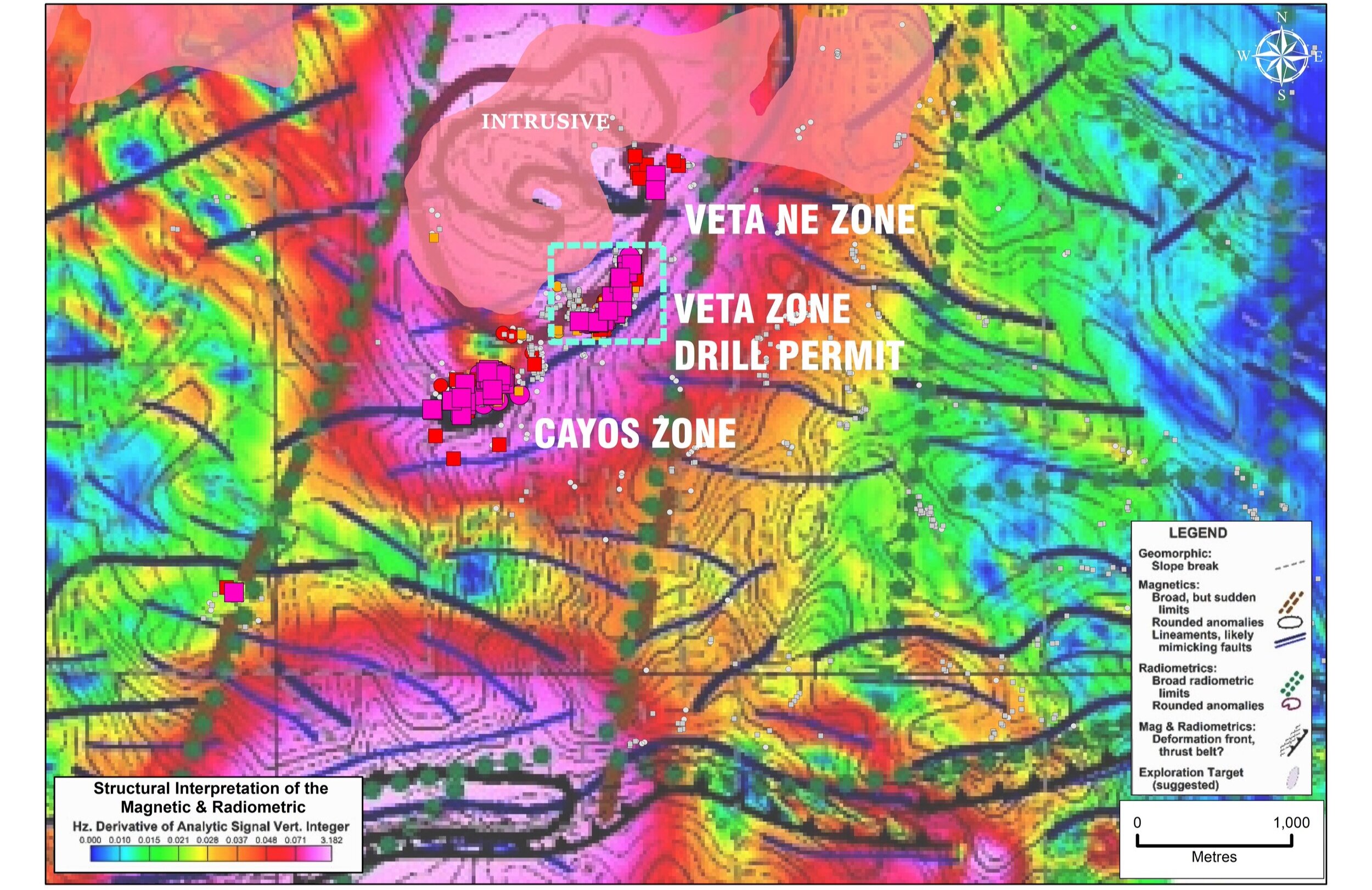
The Veta, Cayos & Veta NE Zones are associated to regional NNE-SSW broad radiometric and magnetic trends along the margin of an intrusive. Both are located within magnetic highs at the intersection of interpreted regional scale shear zones and SE to NE fault structures. Palamina continues to investigate the potential that Usicayos may host an intrusive related gold deposit as the gold mineralization identified to date is centered around an intrusive.
A Declaración de Impacto Ambiental (“DIA”) was approved for the Veta zone and provides for the construction of up to 40 drill pads. An initial 2,600 m drill program focused on testing below high-grade gold surface mineralization in the Veta Zone is planned to start in July of 2021. Palamina plans to drill an initial 12 drill holes in the Veta Zone and is in the process of modifying its DIA to carry out drilling in the Cayos and Veta NE Zones. Palamina has first mover advantage on gold projects in the Puno Orogenic Gold Belt and remains focused on completing an initial drill discovery program in the Veta Zone at the Usicayos Gold Project.