HAIB COPPER PROJECT
The renewal of the Exclusive Prospecting Licence 3140 covering the
Haib Copper project has been refused by the Minister of Mines and Energy of Namibia. The Company intends to vigorously contest this decision by all means necessary and available, including under the Minerals (Prospecting and Mining) Act and other applicable laws of Namibia, and will provide regular updates in this regard. For more information,}: please see the press release here.
 The Haib deposit has a distinct surface expression with abundant copper staining on fractures and joint planes, particularly in and around the dry river bed of the Volstruis River. This led to German prospectors identifying the deposit around the late 1800s or early 1900s. Small tonnages of high grade copper carbonate ore were mined at this time.
After World War II, the prospect was pegged as claims by prospector Mr. George Swanson who carried out small scale mining and tank leaching operations. Over 6,000 tons of hand sorted high-grade copper ore were sold to the O’okiep Copper Mines, across the border at Nababeep in South Africa, reportedly at grades of up to 18% Copper.
In 1963 - 1964 Falconbridge completed a moredetailed exploration programme looking at the higher grade zones within the Haibdeposit. They drilled some eleven diamond drillholes totalling 1,012 metres of drilling. The average grade of the drillhole intersections was given as 0.33% Cu.
During 1968 - 1969 King Resources of South Africa Pty Ltd conducted a diamond drilling programme of 21 holes totalling 3,485 metres. They examined both lower and higher grade sulphide zones, as well as the higher gradeoxide shear zones.
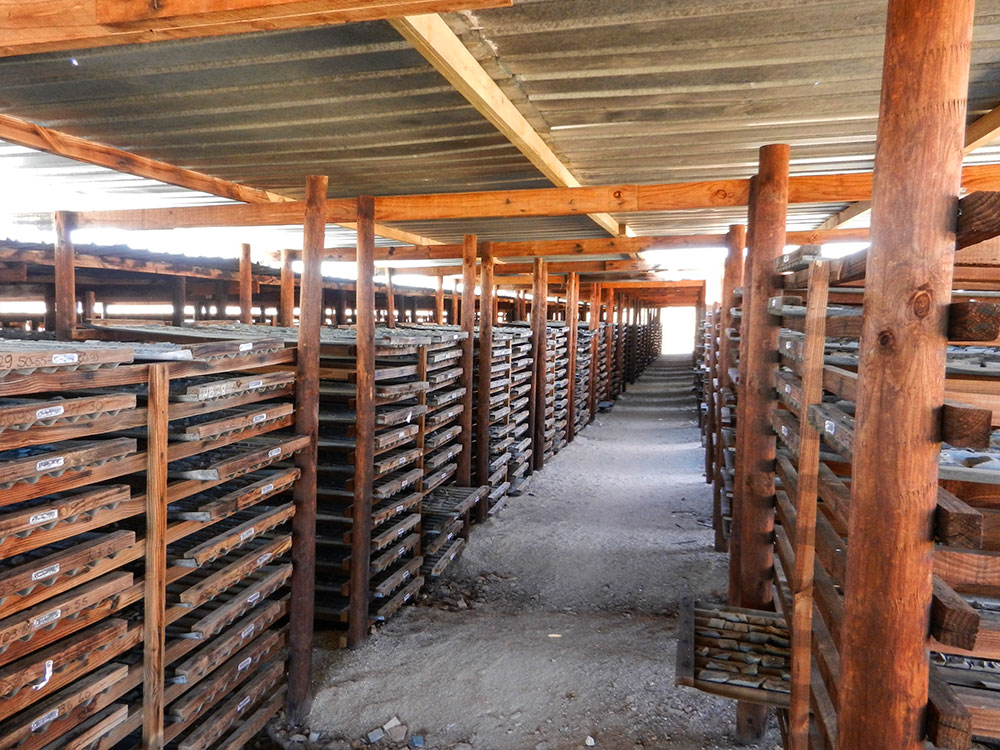
During 1972 – 1975 Rio Tinto Zinc (“RTZ”) conducted the first extensive and systematic investigation of the Haib deposit. Geochemical and chip sampling surveys were conducted along with IP and Resistivity surveys. They drilled one 120 diamond drillholes totalling 45,903 metres. The cores from this programme are still intact and stored in a core shed on site. RTZ sampled by compositing half cores over 2 metre intervals and submitted these for determination of total copper and where appropriate, oxide copper (acid soluble copper). Composite samples from each drillhole were also tested metallurgically to determine recoverable copper and were assayed for molybdenum, silver and gold indicating average contents of 25 g/t Mo, 0.01 g/t Au, and 0.9 g/t Ag. Tonnage and grade estimates at various cut-offs were made and a conceptual pit design was proposed.
In November, 1993 Rand Merchant Bank Ltd of South Africa acquired an option over the Haib property. Venmyn Rand Pty Ltd., produced a study of the project including compilation ofall the available drillhole and assay records from previous investigations and set up a computerised drillhole database. It was concluded that the increase in the copper price since the 1970’s, development of low cost / high tonnage mining systems and new and refined technologies such as bacterial leaching, solvent extraction and electro-winning combined to create a situation where development of the Haib deposit could represent an economic project; however, no further exploration work was done and work terminated in 1995.
In March 1995, Great Fitzroy Mines NL (“GFM”) and RMB Mr. George Swanson signed a joint venture called Namibian Copper Joint Venture (“NCJV”). From 1995 to 1999, NCJV drilled a 12 infill holes, drilled 5 geotechnical investigation holes, completed 126 metres of excavation in an adit and two crosscuts for bulk sampling and metallurgical testing and carried out various test works including mining cost audits, bio-leaching studies, and milling and grinding studies. NCJV ran into financial difficulties and work was stopped at the Haib deposit in early 1999.
In 2004, Deep-South Mining Company (Pty) Ltd (Deep-South) was granted the Exclusive Prospecting licence 3140 (EPL) was granted over an area of 74,563.0 ha covering the deposit and a very large surrounding area. This was subsequently renewed in April 2007, 2009, 2011, 2013 and 2015 with the area reduced to 37,000ha after the 2007 renewal.
From 2008, Teck under the option Agreement with DSM has completed a comprehensive exploration programme at the Haib and immediate surroundings. (results discussed in the other sections below).
Preliminary Economic Assessment
A Preliminary Economic Assessment ("PEA") has recently been completed by Mineral Engineering and Technical Services of Australia (“METS”) on the Haib Copper project in Namibia.
Highlights of PEA
The recent leaching test-work was carried out by Mintek of South Africa. Mintek is a world leader in Bio-leaching technologies.
Amenability test work confirmed copper recoveries of up to 95% in bacterially assisted heap leaching of the Haib mineral. Recoveries of 80% and 82% were showed to be very achievable and sustainable for the project by the test-work to date.
Further work is required in order to refine and optimize process conditions to improve recoveries and operating costs.
Run-of-Mine mineral Bio heap leaching was determined to be the most viable process route for the Haib mineral. Six processing scenarios were established with the key variables being recoveries, final products (copper cathode and copper sulfate) and metal price. The base case chosen by Deep-South is the scenario (1) below, which is based on the production of copper cathodes and copper sulfate. All financial metrics are based on the recent 43-101 indicated resource estimation of 456.9 MT @ 0.31% Cu:
Table 1: Scenario 1 - project metrics
| 20 Mtpa @ 80% Cu Recovery + CuSO4 | 20 Mtpa @ 80% Cu Recovery + CuSO4 | 20 Mtpa @ 80% Cu Recovery + CuSO4 | 20 Mtpa @ 80% Cu Recovery + CuSO4 | 20 Mtpa @ 80% Cu Recovery + CuSO4 | 20 Mtpa @ 80% Cu Recovery + CuSO4 |
|---|---|---|---|---|---|
| LME Cu, tpa | 35,332.3 | 35,332.3 | 35,332.3 | 35,332.3 | 35,332.3 |
| CuSO4.5H2O, tpa | 51,080.9 | 51,080.9 | 51,080.9 | 51,080.9 | 51,080.9 |
| CAPEX, (US$M) | $341 | $341 | $341 | $341 | $341 |
| OPEX, (US$M / year) | $91 | $91 | $91 | $91 | $91 |
| Avg Annual RevenueLME Cu (US$M) | $195 | $195 | $195 | $195 | $195 |
| Avg Annual RevenueCuSO4 (US$M) | $90 | $90 | $90 | $90 | $90 |
| Total Cost, US$/t ROM | $7.64 | $7.64 | $7.64 | $7.64 | $7.64 |
| Total Cost, US$/lb CuEq | $1.34 | $1.34 | $1.34 | $1.34 | $1.34 |
| Copper Price, US$/lb | $2.00 | $2.25 | $2.50 | $2.85 | $3.00 |
| NPV7.5%, pre-tax (US$ M) | $424 | $701 | $977 | $1,364 | $1,530 |
| IRRpre-tax | 18.6% | 24.6% | 30.1% | 37.3% | 40.2% |
| Payback Period pre-tax | 6.91 | 5.21 | 4.22 | 3.38 | 3.13 |
| NPV7.5%, after-tax (US$ M) | $119 | $439 | $611 | $853 | $957 |
| IRR after-tax | 14.9% | 18.9% | 22.7% | 27.6% | 29.7% |
| Payback Period after-tax | 8.87 | 6.94 | 5.71 | 4.59 | 4.23 |
| Strip Ratio | 1.41:1 | 1.41:1 | 1.41:1 | 1.41:1 | 1.41:1 |
| LOM, years | 24 | 24 | 24 | 24 | 24 |
Note: The PEA is based only on the estimated indicated resource and the inferred resource are not part of this economic assessment
With further metallurgical work and testing, the company's goal is to attain higher recovery rates. The below scenario (2) illustrate the potential economic upside of higher recoveries:
Table 2: Scenario 2 - project metrics
| 20 Mtpa @ 85% Cu Recovery + CuSO4 | 20 Mtpa @ 85% Cu Recovery + CuSO4 | 20 Mtpa @ 85% Cu Recovery + CuSO4 | 20 Mtpa @ 85% Cu Recovery + CuSO4 | 20 Mtpa @ 85% Cu Recovery + CuSO4 | 20 Mtpa @ 85% Cu Recovery + CuSO4 |
|---|---|---|---|---|---|
| LME Cu, tpa | 38,336.8 | 38,336.8 | 38,336.8 | 38,336.8 | 38,336.8 |
| CuSO4.5H2O, tpa | 51,080.9 | 51,080.9 | 51,080.9 | 51,080.9 | 51,080.9 |
| CAPEX, (US$M) | $341 | $341 | $341 | $341 | $341 |
| OPEX, US$/year | $96 | $96 | $96 | $96 | $96 |
| Avg Annual RevenueLME Cu (US$M) | $211 | $211 | $211 | $211 | $211 |
| Avg Annual RevenueCuSO4 (US$M) | $90 | $90 | $90 | $90 | $90 |
| Total Cost US$/t ROM | $7.91 | $7.91 | $7.91 | $7.91 | $7.91 |
| Total Cost, US$/lb CuEq | $1.32 | $1.32 | $1.32 | $1.32 | $1.32 |
| Copper Price, US$/lb | $2.00 | $2.25 | $2.50 | $2.85 | $3.00 |
| NPV7.5%, pre-tax (US$ M) | $503 | $796 | $1,088 | $1,498 | $1,673 |
| IRR pre-tax | 20.4% | 26.5% | 32.2% | 39.6% | 42.6% |
| Payback Periodpre-tax | 6.32 | 4.83 | 3.94 | 3.18 | 2.94 |
| NPV7.5% after-tax (US$ M) | $119 | $497 | $681 | $937 | $1,04 |
| IRR after-tax | 16.0% | 20.2% | 24.1% | 29.2% | 31.3% |
| Payback Period after-tax | 8.22 | 6.47 | 5.34 | 4.30 | 3.98 |
| Strip Ratio | 1.41:1 | 1.41:1 | 1.41:1 | 1.41:1 | 1.41:1 |
| LOM, years | 24 | 24 | 24 | 24 | 24 |
Note: The PEA is based only on the estimated indicated resource and the inferred resource are not part of this economic assessment
Please note that: Mineral Resources that are not mineral reserves do not have demonstrated economic viability. Mineral resource estimates do not account for mineability, selectivity, mining loss and dilution. These mineral resource estimates ar based on Indicated Mineral Resources that are considered too speculative geologically to have the economic considerations applied to them that would enable them to be categorized as mineral reserves. However, there is no certainty that these indicated mineral resources will be converted to measured categories through further drilling, or into mineral reserves, once economic considerations are applied. There is no certainty that the preliminary economic assessment will be realized.
Other scenarios
The other scenarios can be found in the NI 43-101 technical report for the Haib Copper project filed on SEDAR under Deep-South's profile and on the web site of the company.
Mineralogy
The Haib Copper Deposit is a large sulfide mineral deposit. Copper is mainly present as a sulfide in the form of chalcopyrite. Copper is also present as oxides (chrysocolla, plancheite, malachite and azurite), occurring as intrusions in shear zones.
Initial testwork results showed that the Haib mineralisation is a competent quartz feldspar porphyry rock.
It can be seen that the main mineral is copper with only an accessory amount of molybdenum present. The chalcopyrite also occurs as occasional coarse irregular grains from 0.1 mm to 0.35 mm.
Mining Methods
Considering the Haib copper deposit characteristics, the suitable mine design is based on an open pit method. As the deposit is basically composed of hard rock material, the mining operations will involve drill and blast of all excavated material, which will be segregated by cut-off grade.
The mining fleet considered for the Haib project would consist of appropriately sized hydraulic excavators and off highway dump trucks, depending, supported by standard open-cut drilling and auxiliary equipment.
Initial open pit mine design work undertaken indicates a strip ratio of 1.41:1 for 20 Mtpa. The low strip ratio has a significant effect on the low operating cost indication of the project.
Recovery Method
For the recovery of copper from the Haib deposit, heap leaching was considered for all options. The primary reasons for the selection of heap leaching are the low-grade nature of the deposit and the vast scale of the mineral body. Previous work conducted on the Haib Project suggested that a conventional crush-grind-float and sale of copper concentrate is not economically feasible under the current copper market conditions. The low costs associated with heap leaching compared to a whole mineral flotation circuit is believed to improve the viability of the project. Heap leaching is traditionally performed on oxide material, although there has been increasing development in the application to acid-insoluble sulfides.
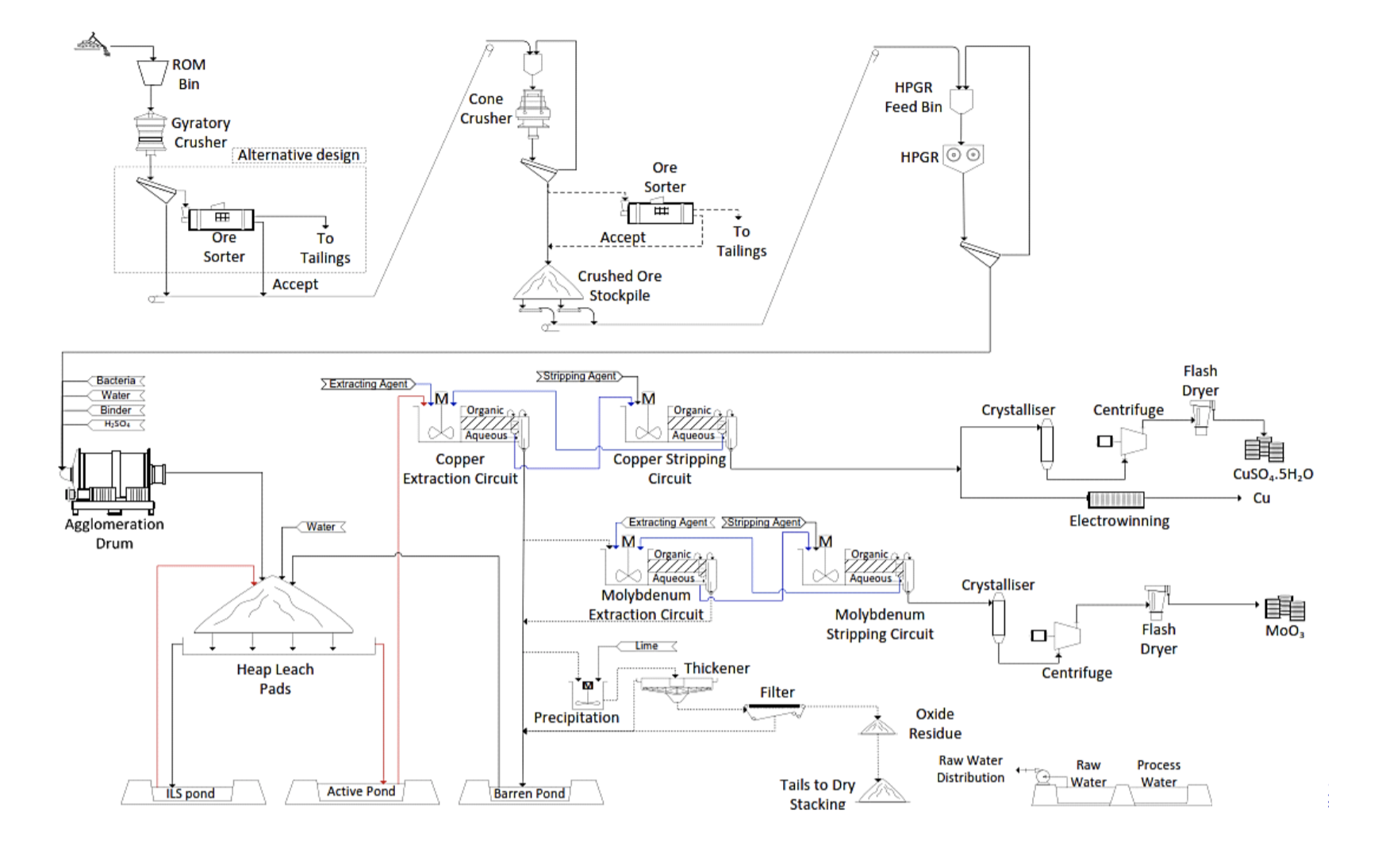
Previous sighter amenability test-work, carried out by Mintek, METS and SGS South Africa, suggests that high amounts of copper can be extracted from the Haib material, up to 95.2% via a bacterial assisted leaching. However, additional test-work is required to determine the optimal operating parameters. The system design proposed will use 3 stage crushing and a mineral sorting system (either on the primary crushed product or the secondary crushed product depending on the technology selected) that will provide higher grade mineral to the heaps. The primary crusher will reduce the rock to 127 mm (gyratory crusher),the secondary crusher to 32 mm (cone crusher) and the tertiary crusher to 5 mm (HPGR).
Haib Copper flow sheet diagram
(on the following page)
Capital Cost
Table 6:
Capital cost breakdown @ 80% Cu recovery at a price of US $ 2.50 per lb of copper
| Direct Cost (US$M) | 20 Mtpa |
|---|---|
| Crushing & HPGR | 100.1 |
| Agglomeration & Heap Leaching | 43.2 |
| Copper Solvent Extraction | 72.9 |
| Iron Removal | 6.3 |
| Process and Raw Water | 4.1 |
| Reagents | 5.0 |
| Services | 2.9 |
| Supporting Infrastructure | 3.0 |
| First Fill | 8.3 |
| Indirect Cost (US$M) | |
| Working Capital | 24.7 |
| Insurance | 7.4 |
| EPCM | 24.7 |
| Contingency | 24.7 |
| Commissioning | 5.0 |
| Accommodation & Temp Services | 5.0 |
| Spares & Tools | 3.0 |
| Total (US$M) | 340.3 |
Operating Costs
Total operating costs, including capital leases as an operating expense, are estimated in the PEA and are broken down as follows:
Table 7:
Total operating cost breakdown – Scenario 1
| 20 Mtpa @ 80% Cu Recovery + CuSO4 @ US 2.50 per lb / Cu | 20 Mtpa @ 80% Cu Recovery + CuSO4 @ US 2.50 per lb / Cu | 20 Mtpa @ 80% Cu Recovery + CuSO4 @ US 2.50 per lb / Cu | 20 Mtpa @ 80% Cu Recovery + CuSO4 @ US 2.50 per lb / Cu | 20 Mtpa @ 80% Cu Recovery + CuSO4 @ US 2.50 per lb / Cu |
|---|---|---|---|---|
| Area | Annual Cost | Unit Cost | Unit Cost | Unit Cost |
| (‘000 USD) | (USD/t ROM) | (USD/lb CuEq) | (USD/lb CuEq) | |
| Mining | 45,200 | 2.26 | 0.40 | 0.40 |
| Processing | 90,799 | 4.54 | 0.80 | 0.80 |
| Product Freight | 3,889 | 0.19 | 0.03 | 0.03 |
| Wharfage & Shiploading | 432 | 0.022 | 0.004 | 0.004 |
| Administration | 4,000 | $0.20 | 0.04 | 0.04 |
| Royalty | $2.00 | 6,824 | 0.34 | 0.06 |
| $2.25 | 7,677 | 0.38 | 0.07 | |
| $2.50 | 8,530 | 0.43 | 0.08 | |
| $2.85 | 9,724 | 0.49 | 0.09 | |
| $3.00 | 10,236 | 0.51 | 0.09 | |
| Total | $2.00 | 151,144 | 7.56 | 1.33 |
| $2.25 | 151,997 | 7.60 | 1.34 | |
| $2.50 | 152,850 | 7.64 | 1.34 | |
| $2.85 | 154,044 | 7.70 | 1.35 | |
| $3.00 | 154,556 | 7.73 | 1.36 | |
Note: Mineral Resources that are not mineral reserves do not have demonstrated economic viability. Mineral resource estimates do not account for mineability, selectivity, mining loss and dilution. These mineral resource estimates are based onIndicated Mineral Resources that are considered too speculative geologically to have the economic considerations applied to them that would enable them to be categorized as mineral reserves.However, there is no certainty that these indicated mineral resources will be converted to measured categories through further drilling, or into mineral reserves, once economic considerations are applied.There is no certainty that the preliminary economic assessment will be realized.
Tailing Disposal
There will be no tailings. The spent heaps will be rehabilitated and left in place. Due to environmental reasons and water resources, the tailings from the pH adjustment process and the iron removal process will be disposed onto the spent heaps via the method of filtered dry stacked tailings.
Environmental considerations
In terms of environmental aspects, dry stack facilities offer a number of advantages to other surface tailings storage options – some of these include:
- Reduced water requirements, principally achieved by recycling process water and near elimination of water losses through seepage and/or evaporation;
- Groundwater contamination through seepage is virtually eliminated;
- Significant safety improvement with the risk of catastrophic dam failure and tailings runout being eliminated;
- Easier to close and rehabilitate.
Waste rock storage
It is suggested to consider stockpiling the low-grade mineral to process it at the end of mine life, in case the copper price increase considerably by the end of the mine life and/or a new mineral processing technology be created or developed.
Products
LME Copper (cathodes)
Copper is one of the most widely used metals on the planet. China, Europe and the USA are the main global consumers of copper. Copper will be produced on the cathode of the electrowinning cell as pure sheets, which will be a pure (99%) solid. Pure copper metal is used for a variety of purposes. The major use is electrical wiring due to the great electrical conductivity of copper. Additionally, copper is used in many metal alloys such as brass and bronze, which are stronger and more corrosion resistant than pure copper.
Copper Sulfate
Copper sulfate will be sold as a blue powder when the crystals are crushed and dried. Copper sulfate is used in multiple industries such as arts, mining, chemical, pharmaceutical, healthcare and agriculture. The biggest use is for farming as an herbicide or fungicide. Additionally, it inhibits the growth of E-Coli. In the healthcare sector, it is used in sterilizers and disinfectants and can be used to control proliferation of bacteria and viruses. Industrial usage could be in adhesives, building, chemical, textile industries, etc. where it is used to manufacture products like insecticides, wood preservatives and paints. High purity copper sulfate has a 25% premium price based on the copper content in the sulfate.
Sulphur Burning Plant
The design for each option as it stands involves the burning of sulphur to produce sulphuric acid. There are several possibilities for sulphuric acid sourcing, including purchasing from smelters within Namibia.
Buying in sulphuric acid at the start of the project life and building a sulphur burning plant once the project is cash flow positive may provide a better economic scenario.
This will allow for the sulphur burning plant capital to be deferred and the payback period to be shortened.
Recommendations
The results from the PEA have been promising and provides a fundamental support for Deep South Resources intention to move the project towards the Feasibility Study phase on the of the deposit.
Deep South Resources has set a target of achieving 85% copper recovery as a basis of design in the feasibility study. Some of the parameters to be evaluated in the study are:
- Recycled column leaching
- Higher temperature leaching
- Optimization of particle sizing for leaching
- Different bacterial strains
- Resting after 200 days for 30 days and then irrigation for another 30 days
- Optimization of leach pH leach
- Optimization of nutrient addition to the leach
Infill drilling in the high-grade area of the deposit, which can be included in the early part of the mine schedule is recommended. This will improve project economics in the financial model.
A drill program of 12,000 meters is recommended to infill a high grade section of the deposit. With a closer grid spacing, a high-grade part of the deposit could be included in the first years of mining to improve the economics and pay-back period.
Further to the Feasibility Study and the drilling of the mineral body as above, a small Pilot Plant is recommended on-site to validate and optimize the process under local conditions. The detailed engineering information and optimization would provide improved confidence in proceeding with a commercial operation.
The work conducted to date provides confidence to move forward, and there is every possibility of improving copper recovery and reducing the operating costs further.
Project Risks
Further information about the PEA and the resource estimate referenced in this news release, including information in respect of data verification, key assumptions, parameters, risks and other factors, can be found in the NI 43-101 technical report for the Haib Copper project that will be filed on SEDAR under Deep-South's profile.
Opportunities
- Metallurgical advanced test work;
- Infill drilling of the high-grade area in order to estimate a measured resource;
- X-Ray ore sorting test work to define the potential economic enhancement
- Solar Energy: Given the semi-arid climate of Namibia, a solar energy farm may be an option for reducing the unit cost of power. This will also have positive social impacts for the project, which is expected to have a long life.
Other opportunities are presented in the the NI 43-101 technical report for the Haib Copper project that will be filed on SEDAR under Deep-South's profile.
Project Expansion:
The resource tonnage allows for possible multiple expansion stages to be executed should the project proceed to once in production. A staged approach is recommended in order to de-risk the project by projecting that the project achieves positive cash flow prior to plant expansions.
Way Forward
The results from the updated PEA have been promising, Deep-South Resources intends to undertake a Feasibility Study for the deposit. The program will include but not limited to: infill drilling of the high-grade area in order to define the grade and estimate a measured resource, detailed mine design, measured resource definition, metallurgical and process technologies test work, engineering design and an environmental impact study.
Qualified Person
Damian E.G. Connelly, BSc (Applied Science), FAusIMM, CP (Met), Principal Consulting Engineer of METS Engineering Group is the main author of the Preliinary Economic Assessment report and is responsible for the technical part of this press release and is the designated Qualified Person under the terms of National Instrument 43-101.