NGAYU REGIONAL OVERVIEW
Ngayu regional overview
Loncor Gold focused on projects within a 3,500km2 area on the Ngayu Greenstone Belt in the northeast of the Democratic Republic of the Congo (the “DRC”).
Ngayu has a history of mining, with Belgians extracting a modest amount of gold from the area. Their focus was within Loncor’s Imbo project area with the majority of output from the Adumbi deposit - Loncor's main area of potential expansion. The Ngayu belt has numerous positive indicators based on the geology, artisanal activity, encouraging drill results and an existing significant gold resource base.
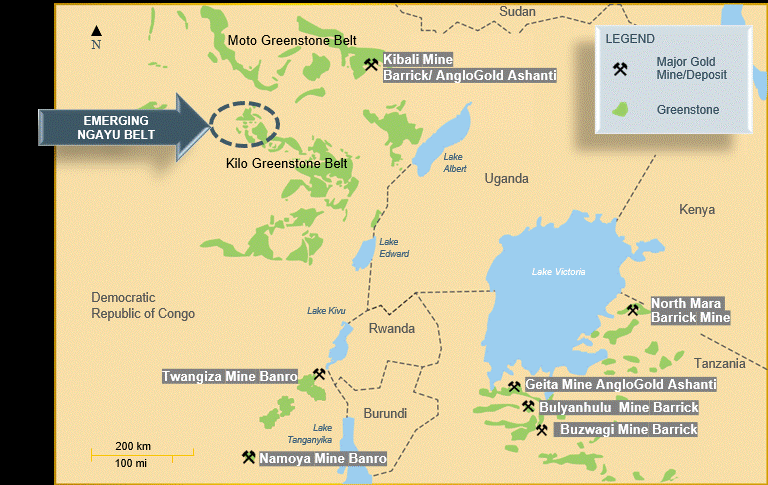
The area is 220 kilometres southwest of the Kibali gold mine, which is operated by Barrick Gold (Congo) SARL (“Barrick”). In 2020, Kibali once again achieved gold production at the top end of company guidelines with 808,134 ounces at “all-in sustaining costs” of US$778/oz (and total cash costs of US$608/oz), the lowest costs of any of Barrick’s six African mines.
Kibali proves what can be achieved in the area close to Ngayu and also acts as a very useful yardstick to Loncor's progress, allowing us to compare for example drill intercepts and resultant resource detail, both within the pit and underground.
Altitude within the Ngayu project area ranges from 550 metres above mean sea level to 950 metres above mean sea level. The topography is made up of gently rolling hills and slightly incised valleys. The vegetation is typical dense forest.
Figure 1: Ngayu is situated in the NE of the DRC - 220 kilometres from the world-class Barrick operated Kibali Mine
A copy of the Ngayu Technical Report can be obtained from SEDAR at www.sedar.com and EDGAR at www.sec.gov.
The early history of gold activity at Ngayu is not complete, however, gold was first prospected for in the Ngayu region by Belgian prospectors in 1909. The Ngayu project was owned by Société Minière de l’Aruwimi – Ituri and was exploited between 1929 and 1955. The database of the Central African Museum of Tervueren notes 13 occurrences of gold in the Ngayu greenstone belt, six of which are hosted within the Ngayu project area. The Tervuren database recorded historical gold production for some of the deposits occurring within the Ngayu greenstone belt. The largest hard rock gold mining operation in the Ngayu greenstone belt was at Adumbi. It is evident that mostly alluvial deposits were exploited, due to the ease of mining and extraction and due to the fact that it was mostly mined on a small scale.
The Ngayu Archean Greenstone Belt of northeastern DRC is geologically similar to the belts which host the world-class gold mines of AngloGold Ashanti/Barrick’s Kibali mine in the DRC (Moto greenstone belt) and AngloGold Ashanti’s Geita mine in Tanzania (Geita greenstone belt). Gold mineralization at Ngayu is spatially related to Banded Ironstone Formation (“BIF”), which is the case at both Kibali and Geita. The Ngayu belt is significantly larger in extent than the Geita belt.
Based on initial studies in 2017, it was found that a major structural, mineralized fracture zone separates an older volcano-sedimentary domain in the northern part of the Ngayu belt from a younger, predominantly sedimentary basin in the south. At Barrick’s Kibali mine, a similar geological setting has been determined with the gold deposits spatially related to a major structural break between an older volcano-sedimentary domain and a younger predominantly sedimentary basin.
At Ngayu, the major structural fracture trends east-northeast through the Imva area where a number of targets are located and then trends southeast through the Imbo mining licence where the Adumbi, Kitenge and Manzako deposits are located and then across the Imbo river to the Imbo East prospect. In total, this major structural break extends for 16 kilometres within the Imbo licence and will require further exploration to fully evaluate this prospective trend. Further detail on the developing Imbo East area can be found within the projects section of the website.
The Ngayu property is located in an Archean Greenstone Belt enclosing folded and fractured volcano-sedimentary series. In the project area, both the Upper and Lower Kibalian Groups are present. The Upper Kibalian represents the greenstone belt made up of metasediments and metavolcanics of greenschist facies including prominent banded ironstone units (BIF) which form prominent ridges throughout the Ngayu greenstone belt. Within the Ngayu Belt there is a strong association between gold mineralization and the presence of BIF, the BIF either constituting the host rock (e.g. Adumbi, Yindi, Makapela, Nagasa) or forming a significant part of the local stratigraphy (e.g. Mondarabe, Itali, Anguluku). BIF forms both physical and chemical traps for mineralizing hydrothermal fluids that follows. World-class examples of gold mines in similar geological settings to the Ngayu project include Kibali in the Moto greenstone belt and Geita in the Geita greenstone belt of northern Tanzania.
Figure 2: Ngayu Greenstone Belt Compared to KIbali and Geita Belts
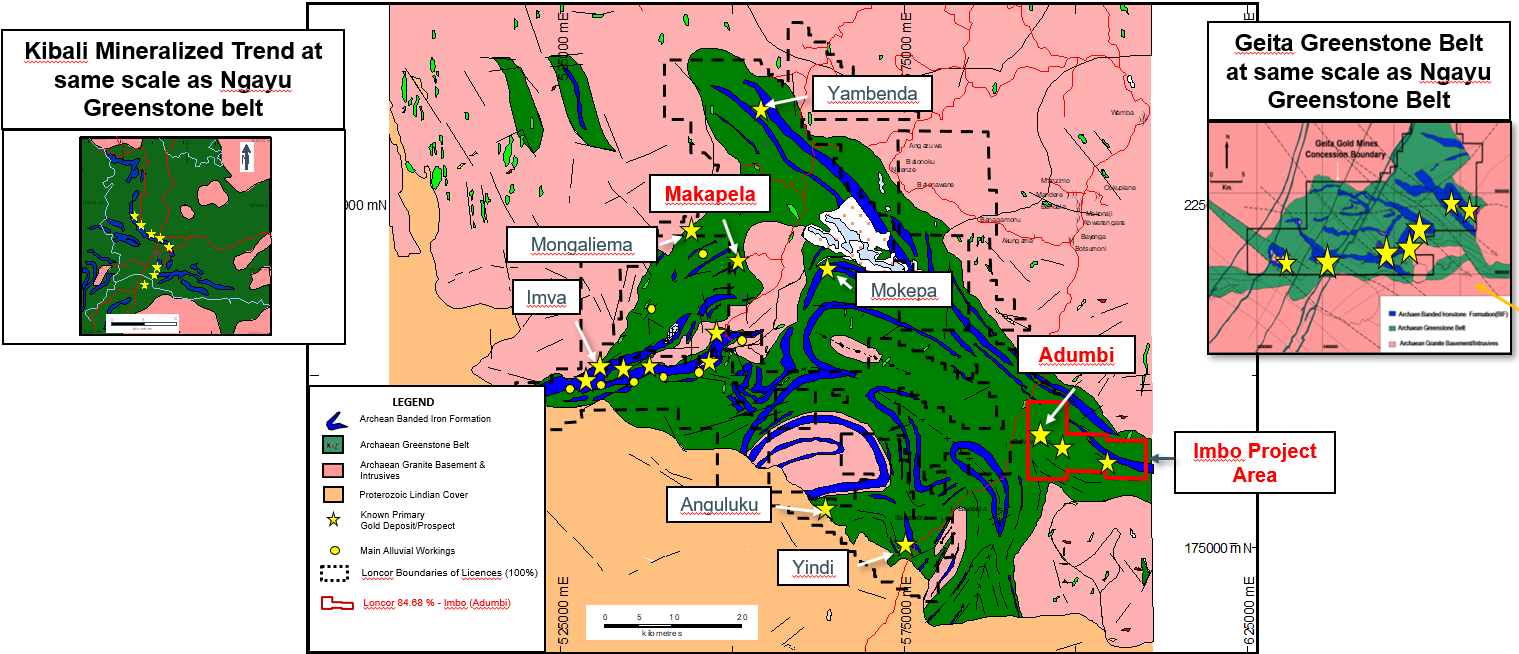
The majority of gold occurrences within the Ngayu properties are located close to the contact of BIF (Banded Ironstone Formation). Historically, only two deposits were exploited on a large-scale by previous owners, namely Yindi and Adumbi which Loncor now have 100% and 84.68% interests respectively. Remnant mining infrastructure from previous operations at Yindi includes the old laboratory, plant and camp, but are derelict. Makapela (100%) is a relatively new artisanal site which was developed by artisanal miners within the last 14 years and was one of the foci of the Company’s exploration activities previously.
A summary of the historical production for the Ngayu Belt is given in Table 1, although production records are incomplete, and the figures quoted represent only an approximation.
Table 1: Historical Gold Production for the Ngayu Belt (1925 – 1955)
| Deposit | Primary Au (oz) | Secondary Au (oz) | Total Au (oz) |
|---|---|---|---|
| Adumbi Area | 208,000 | 83,000 | 291,000 |
| Imva Fold Area | N/A | 200,700 | 200,700 |
| Yindi | 45,200 | 21,000 | 66,200 |
| Northern Ngayu Belt | N/A | 60,800 | 60,800 |
| Anguluku | 5,700 | N/A | 5,700 |
| Totals | 258,900 | 365,500 | 624,400 |
The most prolific area for alluvial mining was the Imva Fold area, where extensive artisanal mining continues today, and where several areas of primary gold mineralization (Matete, Nagasa, Anguluku and Itali) have been under investigation by Loncor.
Overview of Geology – Ngayu
Figure 3: Overview of the pit shell and geology of the central section of Adumbi Deposit
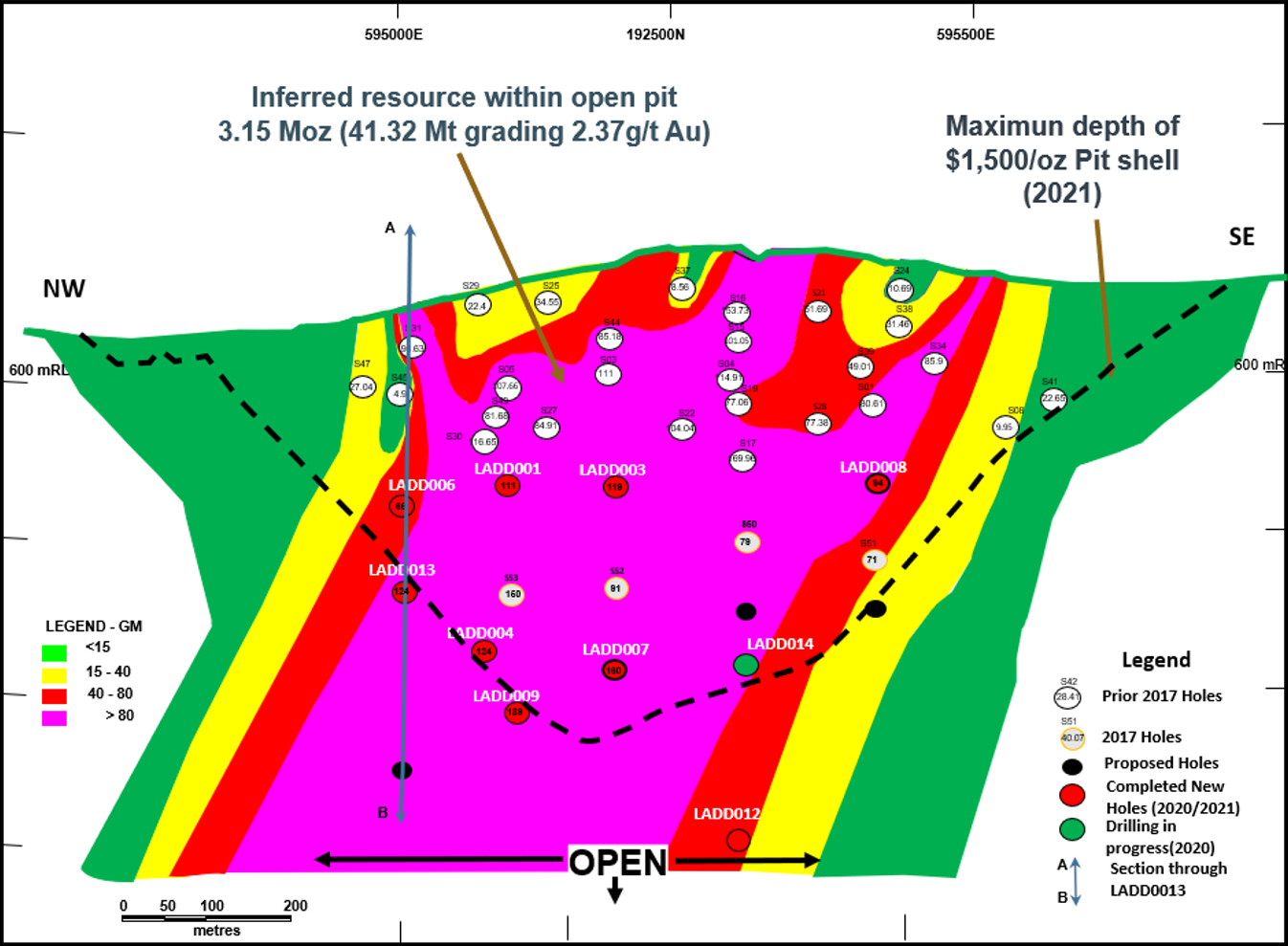
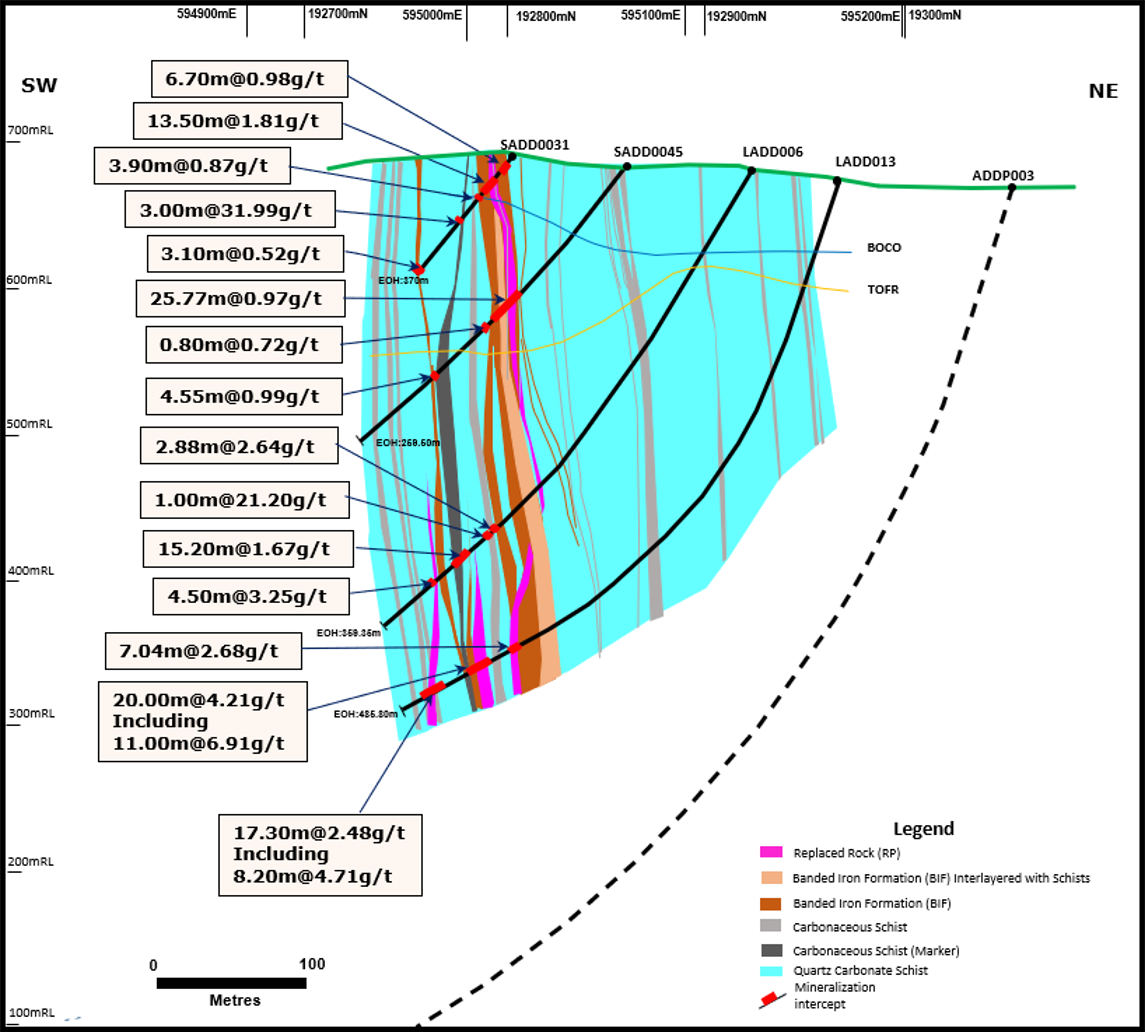
Figure 4: Cross-section across the central part of Adumbi Deposit
Loncor's Exploration History
Exploration by Loncor at Ngayu commenced in late 2009 and initially included desktop research, primarily utilising data from the Royal Museum for Central Africa in Terveuren, Belgium and preliminary interpretation of airborne geophysical data, acquired by Rio Tinto in 2009. A base camp was set up at Yindi in 2010.
At the beginning of Loncor’s Ngayu project, it was decided to divide the exploration into two concurrent programs:
- Assessment of areas of known gold mineralization (Yindi and Makapela) with the potential to rapidly reach the drilling stage and provide a mineral resource base for the Company. Soil sampling, augering, rock chip and channel sampling were carried out prior to diamond drilling.
- Regional programs aimed at assessing the remainder of the then 4,500 km2 land package as quickly and cost-effectively as possible, in order to identify and prioritise mineralized target areas for follow-up, and enable less-prospective ground to be relinquished with confidence. This program mainly entailed a regional BLEG (Bulk Leach Extractable Gold) survey and detailed interpretation of regional aeromagnetic data. Both these programs were carried out under a technology consultation services agreement between Loncor and Newmont who had taken a 20% equity stake in Loncor which was entered into in February 2011 (but is no longer in place).
The approach allowed for further delineation, drilling and resource announcements. For more detail, refer to the sections on the individual projects, plus the resources page.